
We read your photo as:
Explain the reasons for Black protest in the 1950s, the formation of women's organizations, and name some of these organizations.
ScanSolve AI Answer
Here are the answers to the requirements for your research assignment:
-
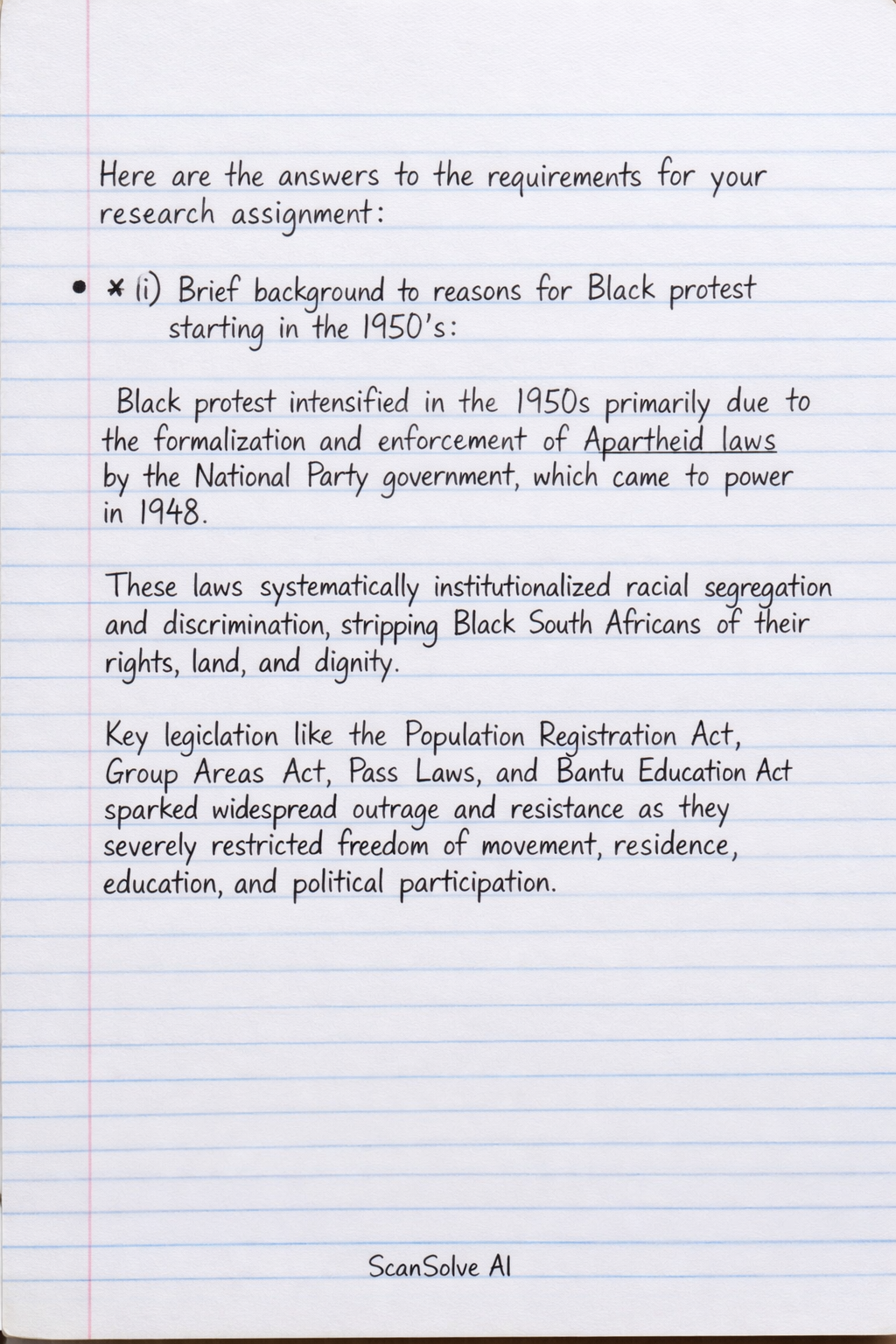
i) Brief background to reasons for Black protest starting in the 1950's: Black protest intensified in the 1950s primarily due to the formalization and enforcement of Apartheid laws by the National Party government, which came to power in 1948. These laws systematically institutionalized racial segregation and discrimination, stripping Black South Africans of their rights, land, and dignity. Key legislation like the Population Registration Act, Group Areas Act, Pass Laws, and Bantu Education Act sparked widespread outrage and resistance as they severely restricted freedom of movement, residence, education, and political participation.
-
ii) Formation of woman's organizations: Women's organizations formed in response to the escalating oppression under Apartheid, particularly the extension of pass laws to women in the mid-1950s. Women recognized the urgent need for organized resistance to protect their families and communities from the devastating impact of these laws and to fight for their own rights within the broader anti-apartheid struggle. They sought to mobilize women's collective power against the regime.
-
iii) Name some of these woman's organisations:
- Federation of South African Women (FEDSAW)
- Black Sash
- African National Congress (ANC) Women's League
- United Democratic Front (UDF) (women's groups were central to this broader coalition)
-
iv) Name/Identify key leaders of these organisations:
- Lilian Ngoyi (FEDSAW, ANC Women's League)
- Helen Joseph (FEDSAW, Black Sash)
- Rahima Moosa (FEDSAW)
- Sophia Williams-De Bruyn (FEDSAW)
- Albertina Sisulu (ANC Women's League, UDF)
- Frances Baard (FEDSAW, ANC Women's League)
-
v) Protest Actions organized by these organisations:
- The Women's March to the Union Buildings in Pretoria on August 9, 1956, organized by FEDSAW, where 20,000 women protested against pass laws.
- Anti-Pass Law Campaigns and defiance actions across the country.
- Black Sash silent vigils and public demonstrations against apartheid laws and human rights abuses.
- Establishment of advice offices by the Black Sash to provide legal aid and document abuses.
- Organization of consumer boycotts and stayaways by women's leagues and UDF affiliates.
- Grassroots community resistance against forced removals, inadequate housing, and Bantu Education.
-
vi) Reaction of the government/state: The government reacted with severe repression:
- Arrests, detentions without trial, and torture of leaders and participants.
- Banning orders placed on organizations and individuals, restricting their activities and movements.
- Use of police brutality and violence to suppress protests.
- Enactment of more repressive legislation like the Public Safety Act and Criminal Law Amendment Act to curb dissent.
- Charging many leaders, including Lilian Ngoyi and Helen Joseph, in the 1956 Treason Trial.
-
vii) Impact of their actions and activities:
- Raised national and international awareness about the brutality of Apartheid.
- Mobilized widespread community resistance, particularly among women, sustaining the anti-apartheid struggle.
- Contributed to growing international condemnation and sanctions against the apartheid regime.
- Empowered women to take on significant leadership roles and challenge both racial and gender oppression.
- Their efforts laid crucial groundwork for the eventual dismantling of Apartheid.
Still stuck on this one?
Ask a follow-up, and the answer starts from this question.
More History Questions
Handwritten Step-by-Step Solution
Get this as a handwritten image on WhatsApp — like a tutor wrote it for you.
Try on WhatsApp