
Summarize the colonial administration under the following topics Description of the colonial system of governments Hausa or Fulani pre colonial days Igbo or colonial days Yoruba pre colonial days Rules of the components of their respective structures Compare the difference precolonial administration
ScanSolve AI Answer
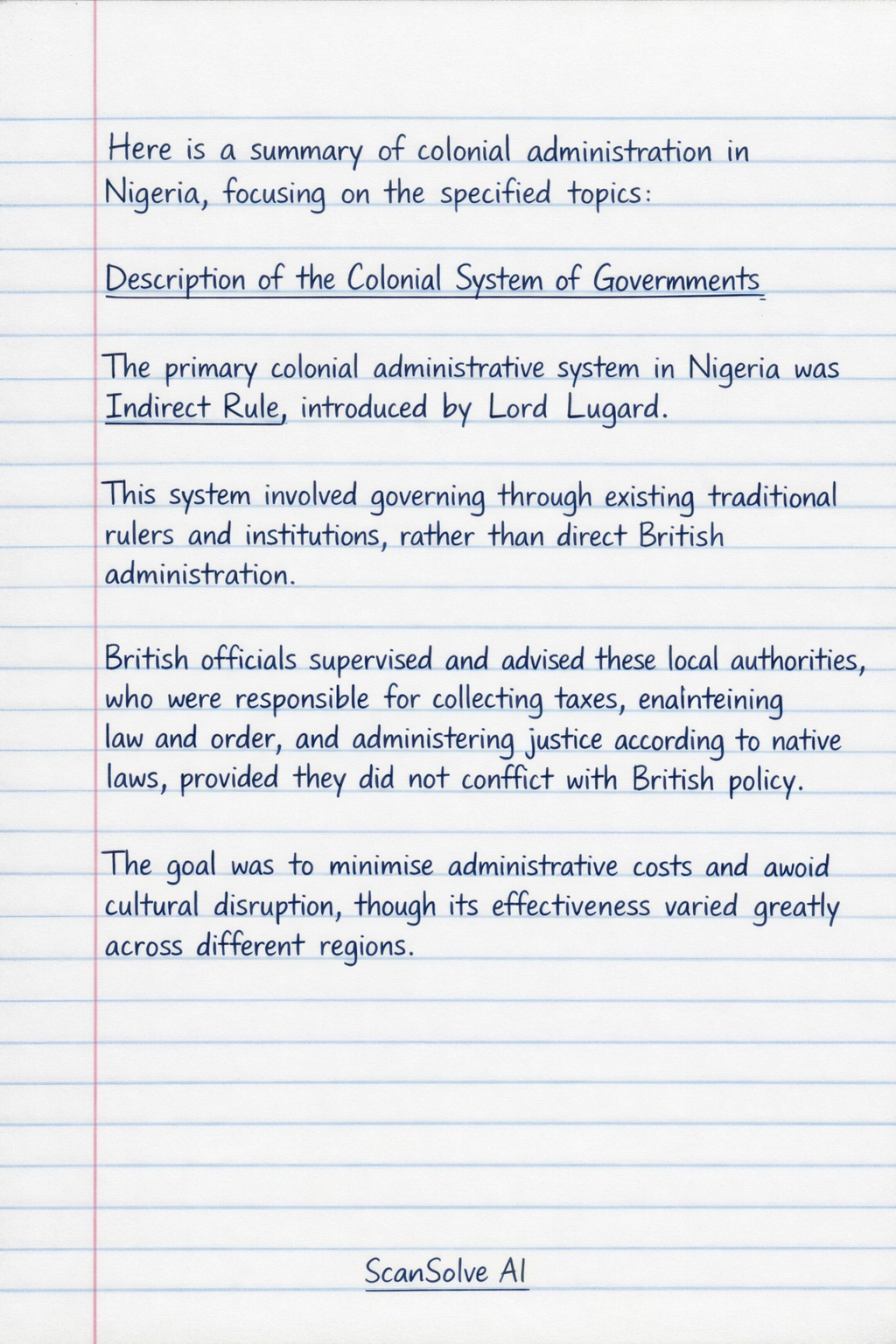
Here is a summary of colonial administration in Nigeria, focusing on the specified topics:
Description of the Colonial System of Governments
The primary colonial administrative system in Nigeria was Indirect Rule, introduced by Lord Lugard. This system involved governing through existing traditional rulers and institutions, rather than direct British administration. British officials supervised and advised these local authorities, who were responsible for collecting taxes, maintaining law and order, and administering justice according to native laws, provided they did not conflict with British policy. The goal was to minimize administrative costs and avoid cultural disruption, though its effectiveness varied greatly across different regions.
Hausa/Fulani Pre-Colonial and Colonial Days
- Pre-Colonial: The Hausa/Fulani states, particularly the Sokoto Caliphate, had a highly centralized and hierarchical system of government. Emirs, who were both political and religious leaders, ruled over large territories with a well-defined administrative structure including district heads, village heads, and a sophisticated judiciary based on Islamic law (Sharia). Power was largely hereditary within ruling families.
- Colonial: Indirect Rule was most successful here because the existing centralized emirate system closely mirrored the hierarchical structure the British sought to implement. The Emirs were retained as Native Authorities, their power largely preserved but now ultimately accountable to the British Resident. This system allowed for efficient tax collection and administration, though it sometimes solidified the power of the Emirs at the expense of their subjects.
Igbo Pre-Colonial and Colonial Days
- Pre-Colonial: The Igbo society was largely decentralized and republican, characterized by autonomous village groups and kinship-based governance. There were no kings or centralized political authorities. Decision-making involved councils of elders, age grades, title societies (e.g., Ozo), and women's associations. Authority was diffused, and consensus was key.
- Colonial: Indirect Rule faced significant challenges in Igboland due to the absence of centralized traditional rulers. The British attempted to create "chiefs" by appointing Warrant Chiefs, individuals who were given warrants of authority but often lacked traditional legitimacy. This imposition of an alien political structure led to widespread resentment, resistance, and protests, such as the Aba Women's Riot of 1929.
Yoruba Pre-Colonial and Colonial Days
- Pre-Colonial: The Yoruba had a system of centralized kingdoms with powerful Obas (kings) who were both spiritual and political heads. However, the Obas' power was often checked by various councils, such as the Oyo Mesi in the Oyo Empire, and secret societies like the Ogboni. This provided a system of checks and balances, preventing absolute monarchy.
- Colonial: Indirect Rule was adapted in Yorubaland. The British recognized the Obas as Native Authorities, similar to the Emirs. However, the British often undermined the traditional checks and balances on the Obas' power, leading to some Obas becoming more autocratic. This sometimes caused friction between the Obas and their people, as well as with the British who occasionally deposed Obas who were uncooperative.
Rules of the Components of their Respective Structures
- Hausa/Fulani: Emirs held executive, judicial, and religious authority, supported by district and village heads. Islamic law was the basis of justice.
- Igbo: Power was distributed among elders, age grades, and title holders. Decisions were made through consensus in village assemblies.
- Yoruba: Obas were symbolic and political heads, but their power was constrained by councils and societies. Chiefs and lineage heads managed local affairs.
Comparison of Pre-Colonial Administration
The primary difference in pre-colonial administration among these groups was the degree of centralization.
- The Hausa/Fulani had highly centralized, hierarchical emirates with clear lines of authority, a well-defined bureaucracy, and a unified legal system (Sharia).
- The Yoruba also had centralized kingdoms with powerful Obas, but their power was often balanced by councils and secret societies, creating a more complex system of checks and balances.
- The Igbo had a largely decentralized, republican system with no central authority, where governance was based on kinship, age, and achievement, with decisions made through communal participation.
Still stuck on this one?
Ask a follow-up, and the answer starts from this question.
More History Questions
Handwritten Step-by-Step Solution
Get this as a handwritten image on WhatsApp — like a tutor wrote it for you.
Try on WhatsApp