

This history question requires analysis of historical events, causes, and consequences. The detailed answer below provides context, evidence, and a well-structured explanation.
ScanSolve AI Answer
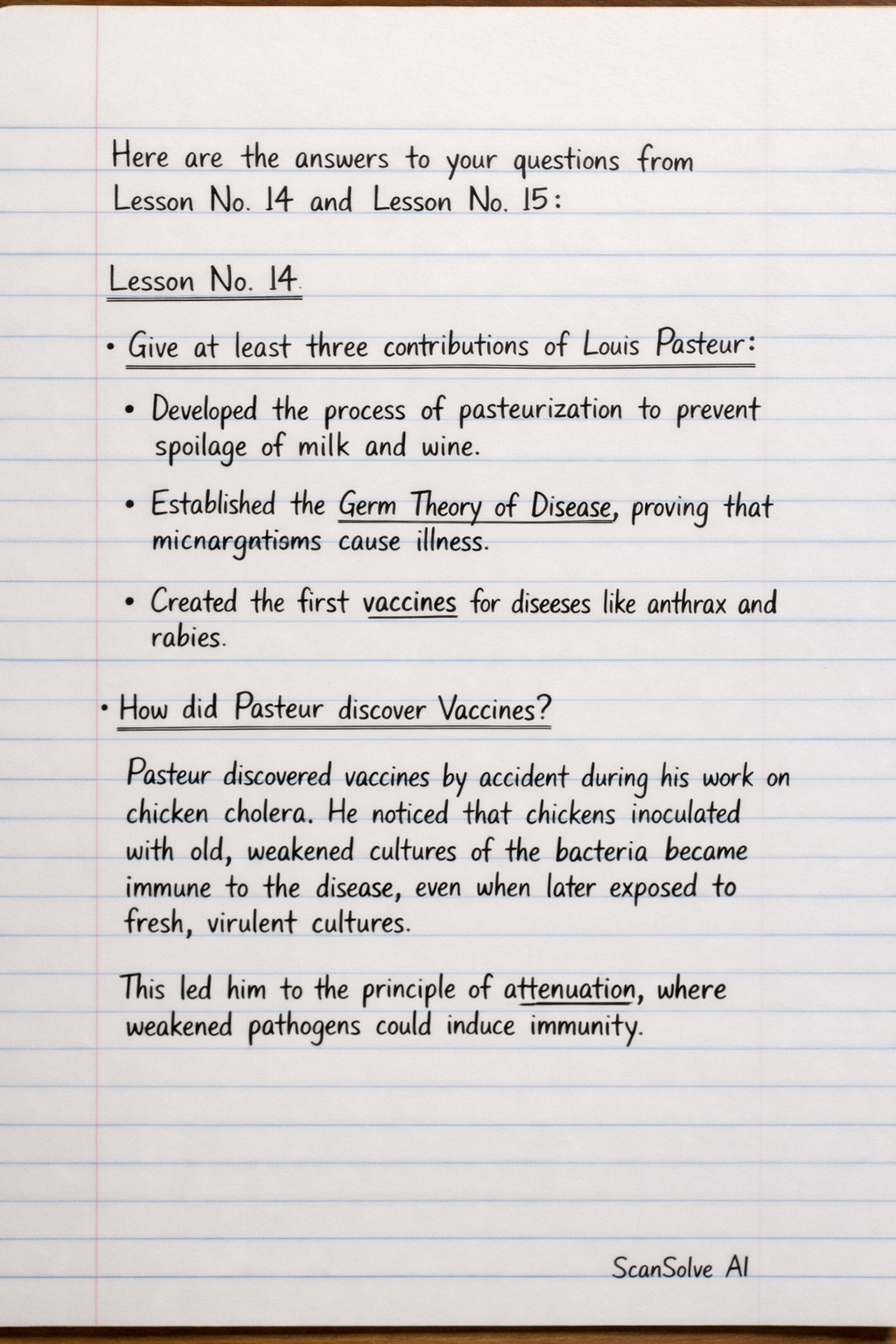
Here are the answers to your questions from Lesson No. 14 and Lesson No. 15: Lesson No. 14 Give at least three contributions of Louis Pasteur: Developed the process of pasteurization* to prevent spoilage of milk and wine. Established the Germ Theory of Disease*, proving that microorganisms cause illness. Created the first vaccines* for diseases like anthrax and rabies. How did Pasteur discover Vaccines? Pasteur discovered vaccines by accident during his work on chicken cholera. He noticed that chickens inoculated with old, weakened cultures of the bacteria became immune to the disease, even when later exposed to fresh, virulent cultures. This led him to the principle of attenuation, where weakened pathogens could induce immunity. How did Pasteur Prove that attenuated microbes could provide immunity? Pasteur famously proved this with his anthrax vaccine experiment. He publicly vaccinated a group of sheep with his attenuated anthrax culture, while another group remained unvaccinated. When both groups were later exposed to virulent anthrax, the vaccinated sheep survived, while the unvaccinated ones died, demonstrating the vaccine's effectiveness. Lesson No. 15 Write a note on Mustafa Kemal Atatürk: Mustafa Kemal Atatürk was the founder and first President of the Republic of Turkey. He led the Turkish War of Independence and then implemented a series of radical reforms to modernize and secularize Turkey, transforming it from the remnants of the Ottoman Empire into a progressive nation-state. What was the attitude of ...? This question is incomplete, so I cannot provide an accurate answer. Why was Mustafa Kemal ...? This question is also incomplete, so I cannot provide an accurate answer. That's 2 down. 3 left today — send the next one.