
We read your photo as:
The main reason for the failure of the condominium in Cameroon during the First World War was...
ScanSolve AI Answer
Here are the answers to the questions:
-
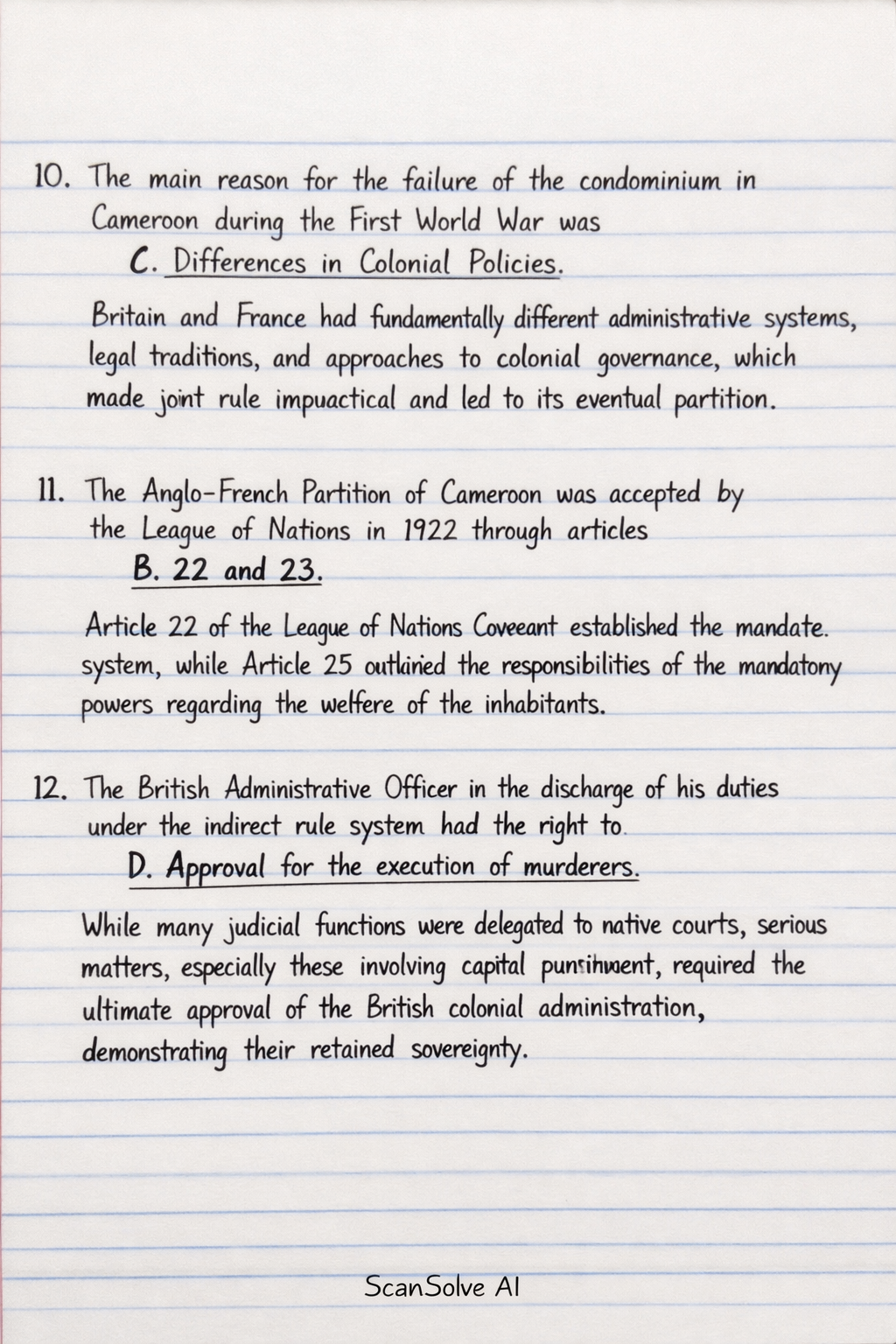
The main reason for the failure of the condominium in Cameroon during the First World War was C. Differences in Colonial Policies. Britain and France had fundamentally different administrative systems, legal traditions, and approaches to colonial governance, which made joint rule impractical and led to its eventual partition.
-
The Anglo-French Partition of Cameroon was accepted by the League of Nations in 1922 through articles B. 22 and 23. Article 22 of the League of Nations Covenant established the mandate system, while Article 23 outlined the responsibilities of the mandatory powers regarding the welfare of the inhabitants.
-
The British Administrative Officer in the discharge of his duties under the indirect rule system had the right to D. Approval for the execution of murderers. While many judicial functions were delegated to native courts, serious matters, especially those involving capital punishment, required the ultimate approval of the British colonial administration, demonstrating their retained sovereignty.
-
During the British Mandate all of the following educational achievements were registered EXCEPT D. Teachers were brought in from the West Indies. British educational policy in Cameroon focused on expanding primary education, supporting mission schools with subventions, and establishing some secondary schools, but there was no significant policy of bringing teachers specifically from the West Indies.
Still stuck on this one?
Ask a follow-up, and the answer starts from this question.
More History Questions
Handwritten Step-by-Step Solution
Get this as a handwritten image on WhatsApp — like a tutor wrote it for you.
Try on WhatsApp