
GCE HISTORY – CAMEROON & WWI QUESTIONS - Q1: What part was played in Cameroon during the First World War by Cameroonians? - Q2: Why were the Germans, despite their long resistance finally defeated in 1916? - Q3: What were the consequences of their defeat on Cameroon? - Focus: 3-part question covering Cameroonians’ role, German defeat 1916, and consequences ANSWERS IN POINT FORM PART 1: ROLE PLAYED BY CAMEROONIANS DURING WWI - Fought as soldiers in German Schutztruppe and later in British/French forces - Served as porters/carriers for ammunition, food and war equipment - Provided food, shelter and intelligence to both German and Allied forces - Some collaborated with Germans while others supported Allied forces - Suffered casualties, displacement and destruction of property PART 2: REASONS WHY GERMANS WERE DEFEATED IN 1916 DESPITE LONG RESISTANCE - Allied numerical superiority: British, French and Belgian forces outnumbered Germans - Three-pronged attack: Allies attacked from Nigeria, Chad and the sea simultaneously - Isolation: Cut off from Germany after British naval blockade, no reinforcements - Lack of resources: Shortage of ammunition, food and medical supplies - Guerrilla tactics failed: German hit-and-run tactics could not hold territory - Capture of key towns: Fall of Mora, Garoua and Yaounde weakened German control PART 3: CONSEQUENCES OF GERMAN DEFEAT ON CAMEROON - Partition of Cameroon: Divided into French Cameroon and British Cameroon under League of Nations Mandate 1919 - End of German rule: Germans lost colony and property was confiscated - Introduction of Mandate system: Cameroon placed under League of Nations supervision - Change in colonial policies: British used Indirect Rule, French used Assimilation - Economic changes: Plantations and infrastructure redirected to serve new colonial masters - Political awareness: WWI exposed Cameroonians to ideas of self-determination
ScanSolve AI Answer
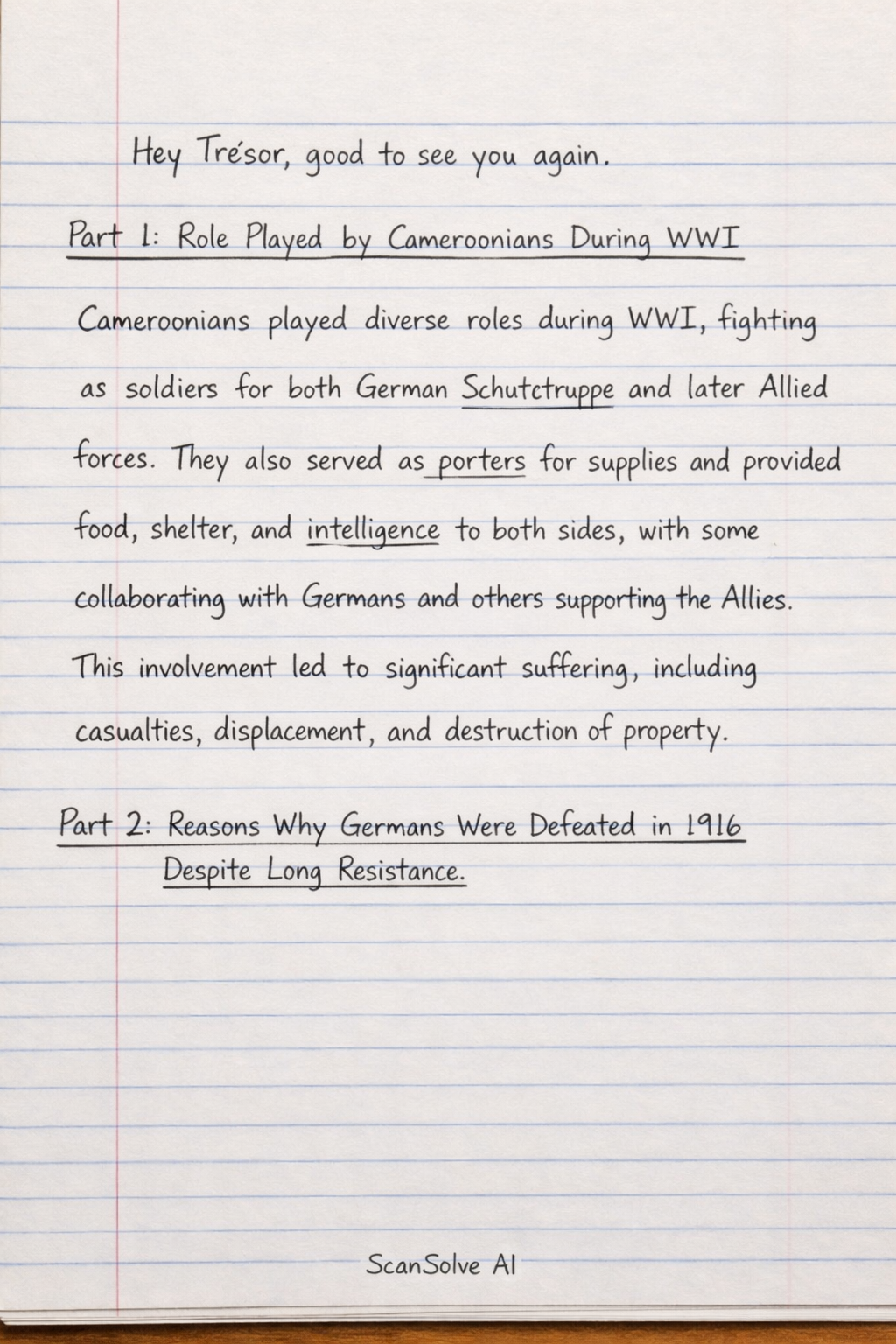
Part 1: Role Played by Cameroonians During WWI
Cameroonians played diverse roles during WWI, fighting as soldiers for both German Schutztruppe and later Allied forces. They also served as porters for supplies and provided food, shelter, and intelligence to both sides, with some collaborating with Germans and others supporting the Allies. This involvement led to significant suffering, including casualties, displacement, and destruction of property.
Part 2: Reasons Why Germans Were Defeated in 1916 Despite Long Resistance
The German forces in Cameroon were ultimately defeated in 1916 despite their initial resistance due to several factors. The Allies had numerical superiority and launched a three-pronged attack from Nigeria, Chad, and the sea. Germany's forces were isolated by a British naval blockade, preventing reinforcements and leading to a severe lack of resources like ammunition and food. Their guerrilla tactics proved insufficient to hold territory, especially after the capture of key towns such as Mora, Garoua, and Yaounde.
Part 3: Consequences of German Defeat on Cameroon
The defeat of the Germans had profound consequences for Cameroon, most notably its partition into French Cameroon and British Cameroon under a League of Nations Mandate in 1919. This marked the end of German rule, with their property confiscated and a new Mandate system introduced under international supervision. The new colonial masters implemented different policies, with the British using Indirect Rule and the French employing Assimilation. These changes also led to economic restructuring, redirecting plantations and infrastructure, and fostered a growing political awareness among Cameroonians regarding self-determination.
Still stuck on this one?
Ask a follow-up, and the answer starts from this question.
More History Questions
Handwritten Step-by-Step Solution
Get this as a handwritten image on WhatsApp — like a tutor wrote it for you.
Try on WhatsApp