
We read your photo as:
Trace the origin of Oyo empire. 2. Outline 5 social political Structure of Oyo empire. 3. Mention four factors that led to the fall of Oyo empire. 4. Outline four factors that led to the rise of Oyo empire. 5. Outline 5 economic activities of Oyo empire.
ScanSolve AI Answer
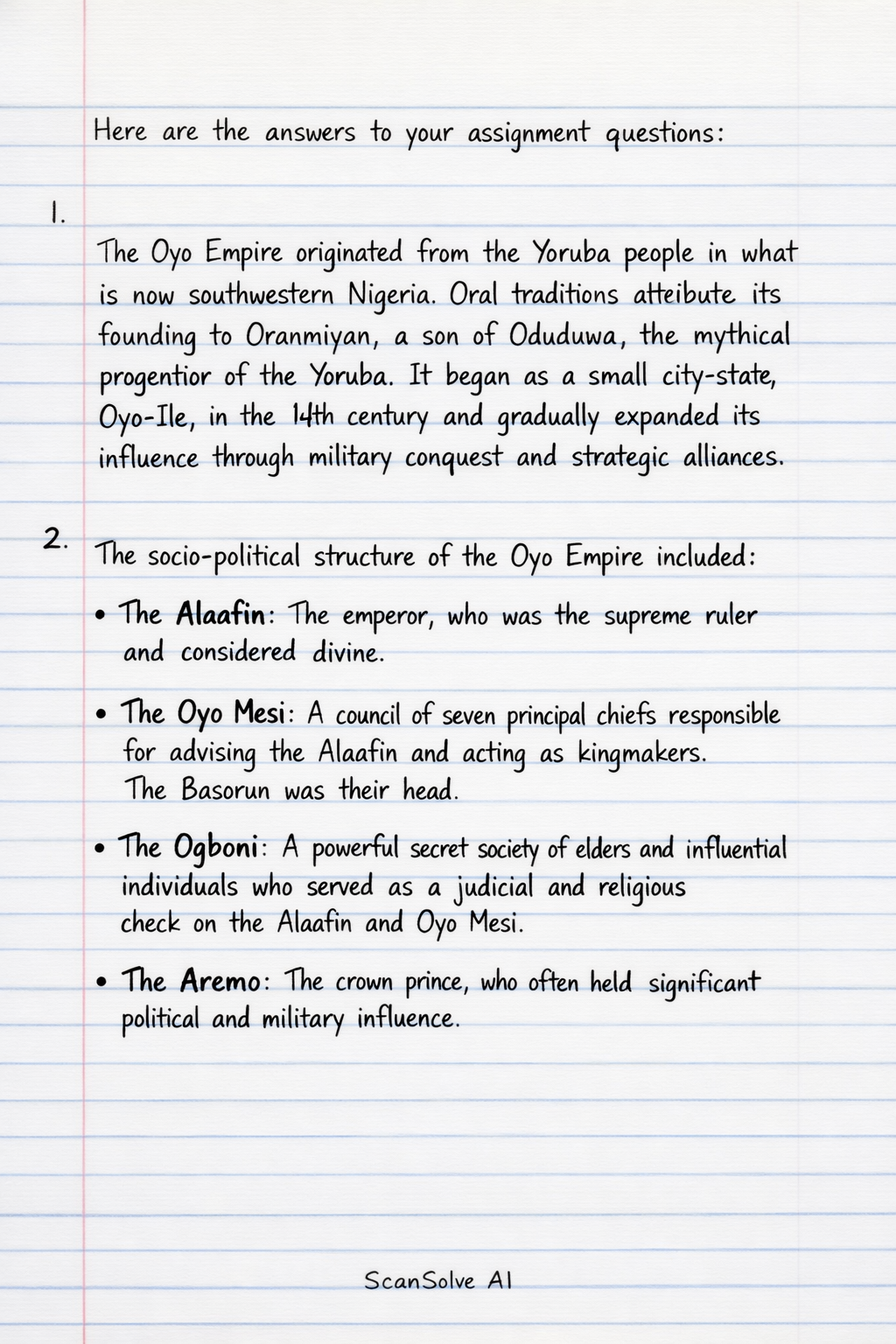
Here are the answers to your assignment questions:
-
The Oyo Empire originated from the Yoruba people in what is now southwestern Nigeria. Oral traditions attribute its founding to Oranmiyan, a son of Oduduwa, the mythical progenitor of the Yoruba. It began as a small city-state, Oyo-Ile, in the 14th century and gradually expanded its influence through military conquest and strategic alliances.
-
The socio-political structure of the Oyo Empire included:
- The Alaafin: The emperor, who was the supreme ruler and considered divine.
- The Oyo Mesi: A council of seven principal chiefs responsible for advising the Alaafin and acting as kingmakers. The Basorun was their head.
- The Ogboni: A powerful secret society of elders and influential individuals who served as a judicial and religious check on the Alaafin and Oyo Mesi.
- The Aremo: The crown prince, who often held significant political and military influence.
- Provincial Administration: Conquered territories were governed by appointed officials called Ajele, who collected tribute and maintained order.
-
Four factors that led to the fall of the Oyo Empire were:
- Internal conflicts and succession disputes: Weakened the central authority of the Alaafin and led to political instability.
- Rise of powerful provincial chiefs: Regional leaders and the Ajele gained too much autonomy, challenging the Alaafin's control and leading to secessionist movements.
- Jihad of Usman dan Fodio and Fulani invasion: The expansion of the Fulani Caliphate from the north exerted immense military pressure, leading to the loss of northern territories and a major defeat at the Battle of Ilorin.
- Economic disruption and the transatlantic slave trade: The increasing reliance on the slave trade led to internal instability, depopulation, and a shift in economic priorities that ultimately undermined the empire's stability.
-
Four factors that led to the rise of the Oyo Empire were:
- Strong military organization: The Oyo army, particularly its cavalry (horsemen), gave it a significant advantage over neighboring states in the savanna region, enabling rapid expansion.
- Strategic geographical location: Oyo's location allowed it to control vital trade routes between the forest and savanna regions, facilitating economic growth.
- Effective political system: The checks and balances between the Alaafin, Oyo Mesi, and Ogboni provided a stable governance structure for a long period.
- Economic prosperity: Based on a robust agricultural system, skilled craft production, and control over regional trade networks, including the lucrative transatlantic slave trade.
-
Five economic activities of the Oyo Empire were:
- Agriculture: The primary economic activity, involving the cultivation of crops such as yams, maize, millet, and kola nuts.
- Craft production: Skilled artisans produced various goods, including pottery, weaving, iron tools, leatherworks, and wood carvings.
- Trade: Oyo controlled major trade routes, facilitating the exchange of goods like salt, cloth, kola nuts, and agricultural products between different regions.
- Tribute collection: Conquered territories paid regular tributes in goods, services, or slaves, which significantly enriched the empire's treasury.
- Slavery: Both internal and external slave trade played a crucial role, providing labor for agriculture and crafts, and serving as a major commodity for exchange with European traders.
Still stuck on this one?
Ask a follow-up, and the answer starts from this question.
More History Questions
Handwritten Step-by-Step Solution
Get this as a handwritten image on WhatsApp — like a tutor wrote it for you.
Try on WhatsApp