
We read your photo as:
For the meaning of the underlined expression "Passer des nuits blanches". This French idiom means to spend sleepless nights.
ScanSolve AI Answer
Answer
Step-by-step solution
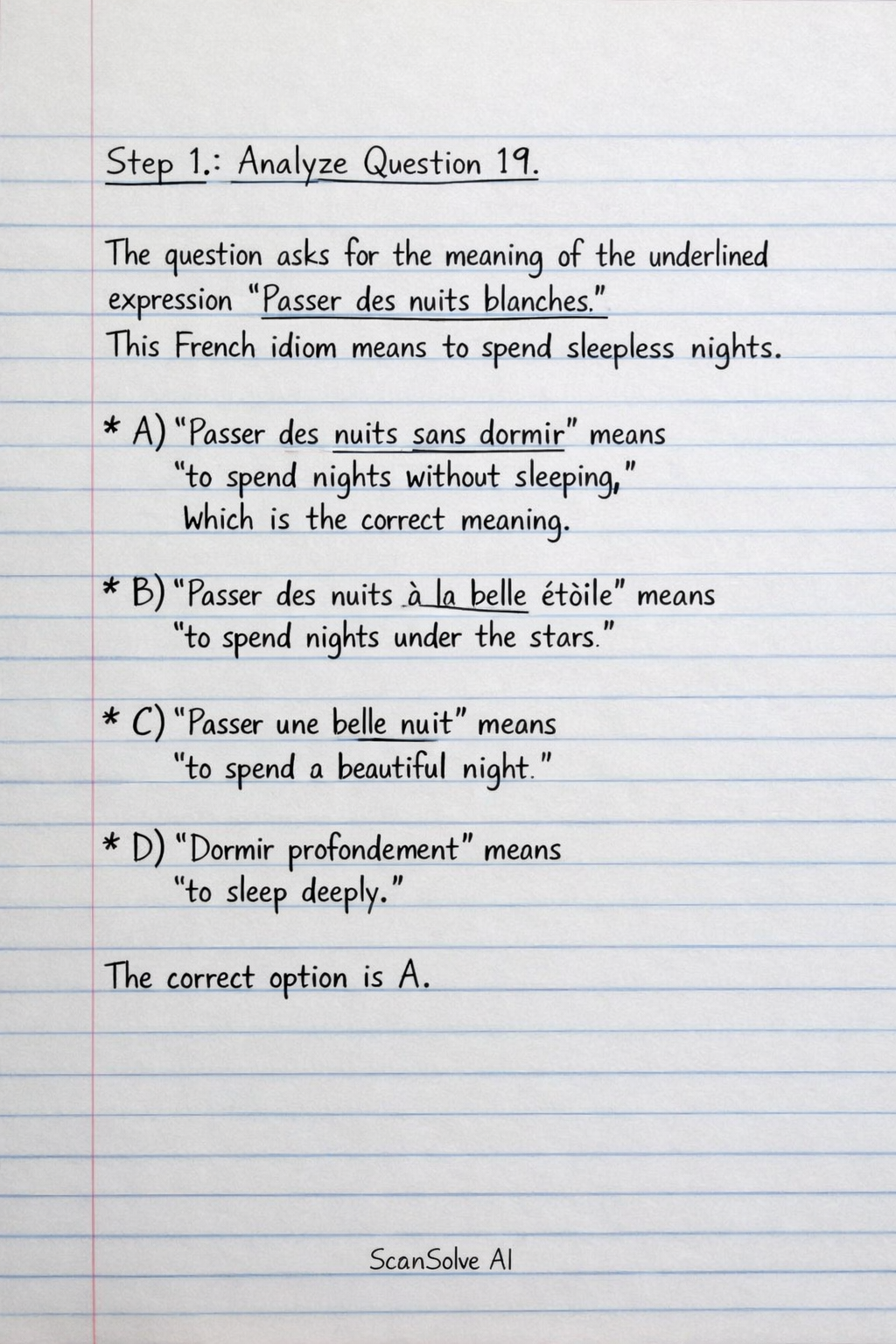
7 stepsAnalyze Question 19.
The question asks for the meaning of the underlined expression "Passer des nuits blanches". This French idiom means to spend sleepless nights.
- A) "Passer des nuits sans dormir" means "to spend nights without sleeping," which is the correct meaning.
- B) "Passer des nuits à la belle étoile" means "to spend nights under the stars."
- C) "Passer une belle nuit" means "to spend a beautiful night."
- D) "Dormir profondément" means "to sleep deeply." The correct option is A.
Analyze Question 20.
The sentence is "Les marchandises que j'ai ____ au port." (The goods that I ____ at the port.) This requires the past participle of "commander" (to order) to agree with the direct object "les marchandises" (the goods), which is feminine plural, because the direct object precedes the auxiliary verb "ai" (from "avoir").
- A) "commandées" is the feminine plural form, agreeing with "les marchandises".
- B) "Commandés" is masculine plural.
- C) "Commandé" is masculine singular.
- D) "Comntandée" is a misspelling and feminine singular. The correct option is A.
Analyze Question 21.
The sentence is "J'aimerais vivre jusqu'à ____ ans." (I would like to live until ____ years old.) This asks for the correct spelling of the number 80 in French.
- A) "quatre vingt" is incorrect; it should be hyphenated and have an 's' when referring to 80 exactly.
- B) "quatre-vingts" is the correct spelling for 80.
- C) "quatre-vingta" is incorrect.
- D) "quatre vins" is incorrect. The correct option is B.
Analyze Question 22.
The sentence is "Le réseau téléphonique est mauvais ____ les téléchargements sont lents." (The phone network is bad ____ downloads are slow.) This requires a conjunction to show the relationship between the two clauses. The second clause is a consequence of the first.
- A) "Or" means "now" or "but" (often used to introduce a new argument or a contrast).
- B) "Ni" means "neither/nor".
- C) "Mais" means "but" (introduces a contrast).
- D) "Donc" means "therefore" or "so" (introduces a consequence). The correct option is D.
Analyze Question 23.
The sentence is "Mon grand frère a ____ amis dans l'enseignement." (My older brother has ____ friends in education.) This requires a quantifier for "amis" (friends). "Amis" starts with a vowel.
- A) "beaucoup de" is used before a consonant.
- B) "beaucoup d'" is used before a vowel or silent 'h', which is correct for "amis".
- C) "beaucoup des" is incorrect in this context; "des" is a partitive article.
- D) "beaucoup" is incomplete; it needs "de" or "d'" before a noun. The correct option is B.
Analyze Question 24.
The question asks to transform the passive voice sentence "Le coup de fil a été reçu par Sam" (The phone call was received by Sam) into the active voice.
In the passive voice, "Le coup de fil" is the subject and "Sam" is the agent. In the active voice, the agent becomes the subject, and the original subject becomes the direct object. The tense (passé composé) must be maintained.- A) "Sam a reçu le coup de fil" (Sam received the phone call) is the correct active voice equivalent in the passé composé.
- B) "Sam reçoit le coup de fil" is in the present tense.
- C) "Sam recevra le coup de fil" is in the future tense.
- D) "Sam recevait le coup de fil" is in the imperfect tense. The correct option is A.
Analyze Question 25.
The sentence is "J'ai raté mon vol ____ embouteillages en ville." (I missed my flight ____ traffic jams in the city.) This requires a phrase to express the cause of missing the flight. Missing a flight is a negative event.
- A) "à force des" means "by dint of" or "through repeated effort," which doesn't fit this context.
- B) "à cause des" means "because of the," which is appropriate for expressing the cause of a negative event.
- C) "grâce aux" means "thanks to the," which is used for positive causes.
- D) "en raison de" means "due to" or "by reason of," which is also correct for cause but often more formal. "À cause des" is a more common and direct expression for this situation. The correct option is B.
The final answers are: 19. 20. 21. 22. 23. 24. 25.
Try one yourself
A new problem that tests the same skill.
Still stuck on this one?
Ask a follow-up, and the answer starts from this question.
More Languages Questions
Handwritten Step-by-Step Solution
Get this as a handwritten image on WhatsApp — like a tutor wrote it for you.
Try on WhatsApp