

This law problem is solved step by step below, with detailed explanations to help you understand the method and arrive at the correct answer.
ScanSolve AI Answer
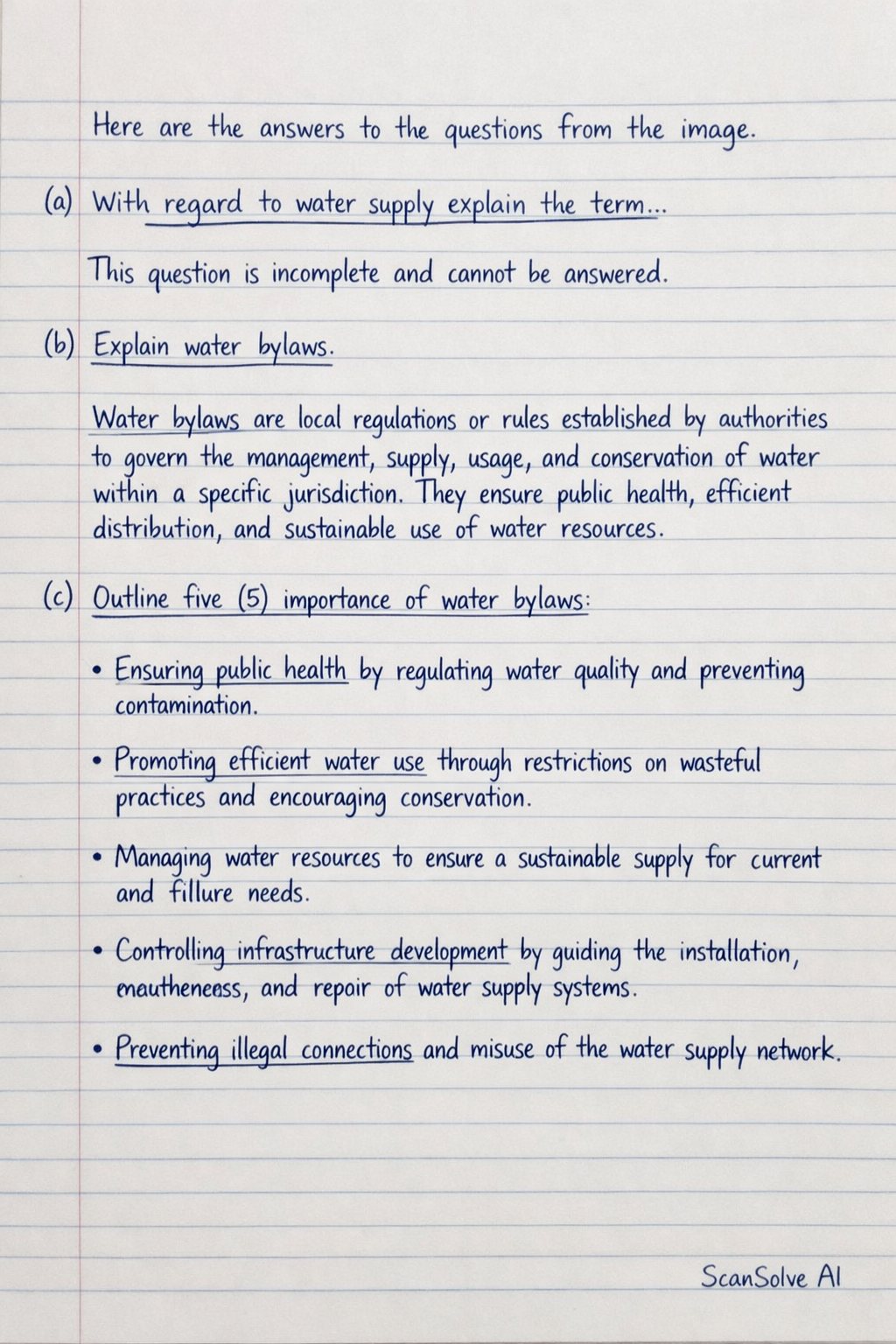
Here are the answers to the questions from the image. (a) With regard to water supply explain the term... This question is incomplete and cannot be answered. (b) Explain water bylaws. Water bylaws are local regulations or rules established by authorities to govern the management, supply, usage, and conservation of water within a specific jurisdiction. They ensure public health, efficient distribution, and sustainable use of water resources. (c) Outline five (5) importance of water bylaws. • Ensuring public health by regulating water quality and preventing contamination. • Promoting efficient water use through restrictions on wasteful practices and encouraging conservation. • Managing water resources to ensure a sustainable supply for current and future needs. • Controlling infrastructure development by guiding the installation, maintenance, and repair of water supply systems. • Preventing illegal connections and misuse of the water supply network. (d) State five regulators of water bylaws. • Local Government Authorities (e.g., Municipalities, City Councils) • Water Utility Companies (or Water Boards) • Environmental Protection Agencies • Public Health Departments • National Water Regulatory Bodies (e) (i) Explain the meaning of water main. A water main is a primary underground pipe in a water distribution system that transports large volumes of potable water from a treatment plant or reservoir to various service areas, from which smaller pipes branch off to supply individual properties. (ii) Outline the types of water main in use. Types of water mains can be classified by their function: • Trunk mains (or transmission mains): Large pipes that carry water over long distances from the source to major distribution points. • Distribution mains: Smaller pipes that branch off trunk mains to deliver water to local areas and individual service connections. (b) (i) List the water main fittings. • Elbows • Tees • Reducers • Couplings • Valves (e.g., gate valves, butterfly valves) (ii) Outline the type of water main distribution system. Types of water main distribution systems include: • Dead-end system (or Branching system): Water flows in one direction, with branches ending in dead ends. • Gridiron system (or Looped system): Mains are interconnected to form a grid, allowing water to flow from multiple directions, providing better pressure and reliability. • Ring system: A main pipe forms a loop around the area to be served, with branches extending inwards. (c) State types of tapping main. Types of tapping main refer to methods of connecting a service line to a main pipe: • Wet tapping (or live tapping): Connecting to a pressurized main without shutting down the water supply. • Dry tapping: Connecting to a main that is not under pressure or has been shut down. • Service saddle tapping: Using a saddle clamp to create a connection point on the main.