
We read your photo as:
Answer the following questions about citizenship: 5. Explain jus soli and jus sanguinis. 6. State a condition for naturalization. 7. What did Mr. Re-run Bwalya demonstrate by taking an oath of allegia
ScanSolve AI Answer
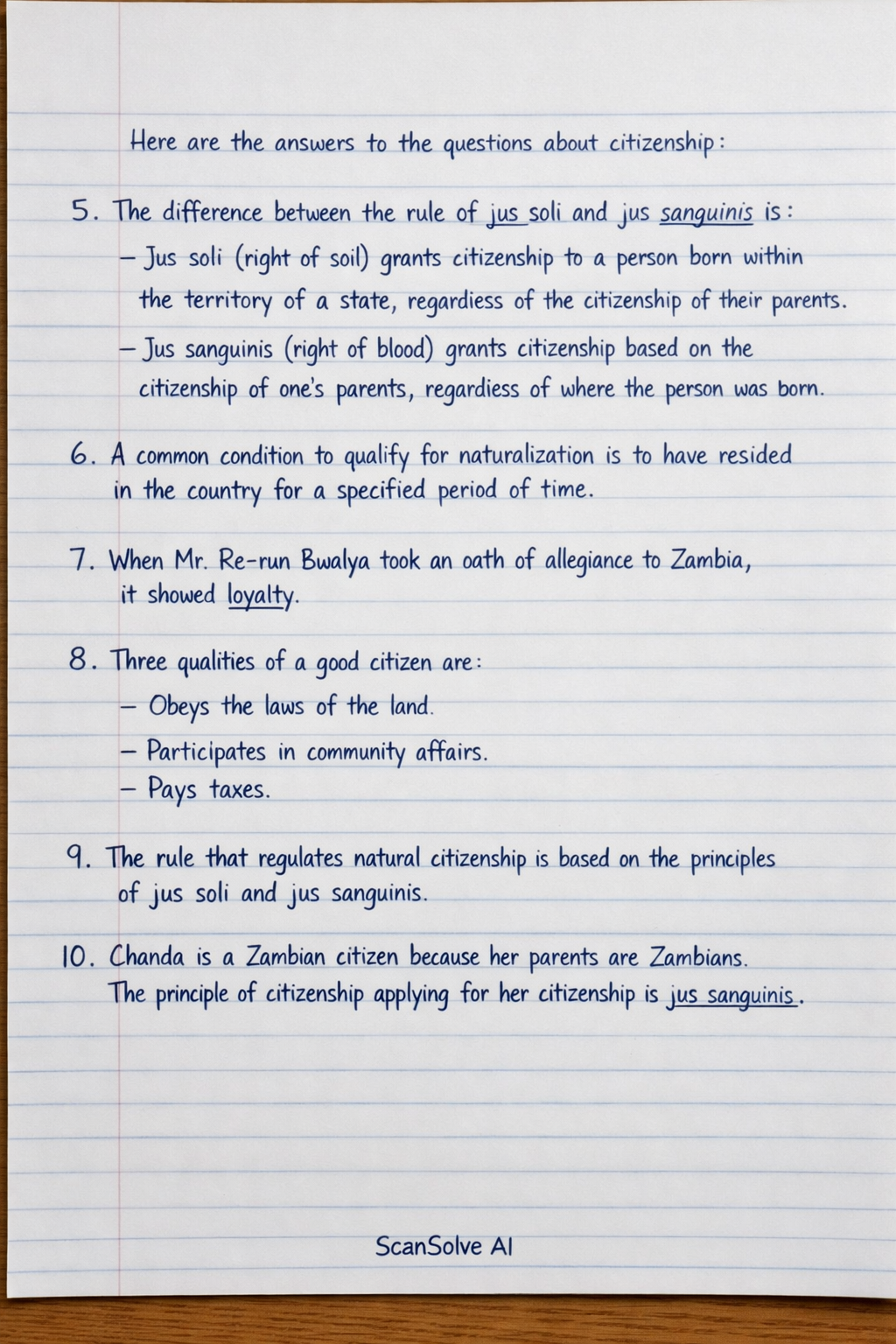
Here are the answers to the questions about citizenship:
5. The difference between the rule of jus soli and jus sanguinis is:
- Jus soli (right of soil) grants citizenship to a person born within the territory of a state, regardless of the citizenship of their parents.
- Jus sanguinis (right of blood) grants citizenship based on the citizenship of one's parents, regardless of where the person was born.
6. A common condition to qualify for naturalization (like Zambian citizenship) is to have resided in the country for a specified period of time.
7. When Mr. Re-run Bwalya took an oath of allegiance to Zambia, it showed loyalty.
8. Three qualities of a good citizen are:
- Obeys the laws of the land.
- Participates in community affairs.
- Pays taxes.
9. The rule that regulates natural citizenship is based on the principles of jus soli and jus sanguinis.
10. Chanda is a Zambian citizen because her parents are Zambians. The principle of citizenship applying for her citizenship is jus sanguinis.
11. The motive applying for her citizenship is based on descent from Zambian parents.
12. Civil rights is an aspect when a citizen is recognized and his and her rights are protected in the laws of the land.
13. In 2000 after renouncing her Zambian citizenship, she reverted to her former citizenship on her own. This type of repatriation is called reacquisition of citizenship or repatriation.
14. The giving up of citizenship and taking an Oath of allegiance to the country of which one wants to become a citizen is known as naturalization.
15. Poverty or economic hardship is an obstacle to good citizenship that prevents citizens from taking an active part in the affairs of the nation but rather pre-occupied with survival means.
16. According to the rule of jus soli, Hope is a citizen of Kenya.
17. Three conditions under which a naturalized citizen can lose Zambian citizenship are:
- Acquiring citizenship of another country voluntarily.
- Committing treason or sedition.
- Making false statements or committing fraud during the naturalization process.
18. Three personal responsibilities of a citizen are:
- Obeying laws.
- Paying taxes.
- Voting in elections.
32. Four civic responsibilities of a Zambian citizen are:
- Obeying the Constitution and laws.
- Paying taxes.
- Participating in community service.
- Protecting the environment.
33. The aspect of citizenship that requires a citizen to have a sense of responsibility to fulfill all his/her obligations to the various social groups that he or she belongs is civic duty or social responsibility.
Still stuck on this one?
Ask a follow-up, and the answer starts from this question.
More Law Questions
Handwritten Step-by-Step Solution
Get this as a handwritten image on WhatsApp — like a tutor wrote it for you.
Try on WhatsApp