
We read your photo as:
Based on the provided text, define armed conflict, identify two countries involved, list two social effects on civilians, define humanitarian crisis, and suggest two peaceful solutions to war.
ScanSolve AI Answer
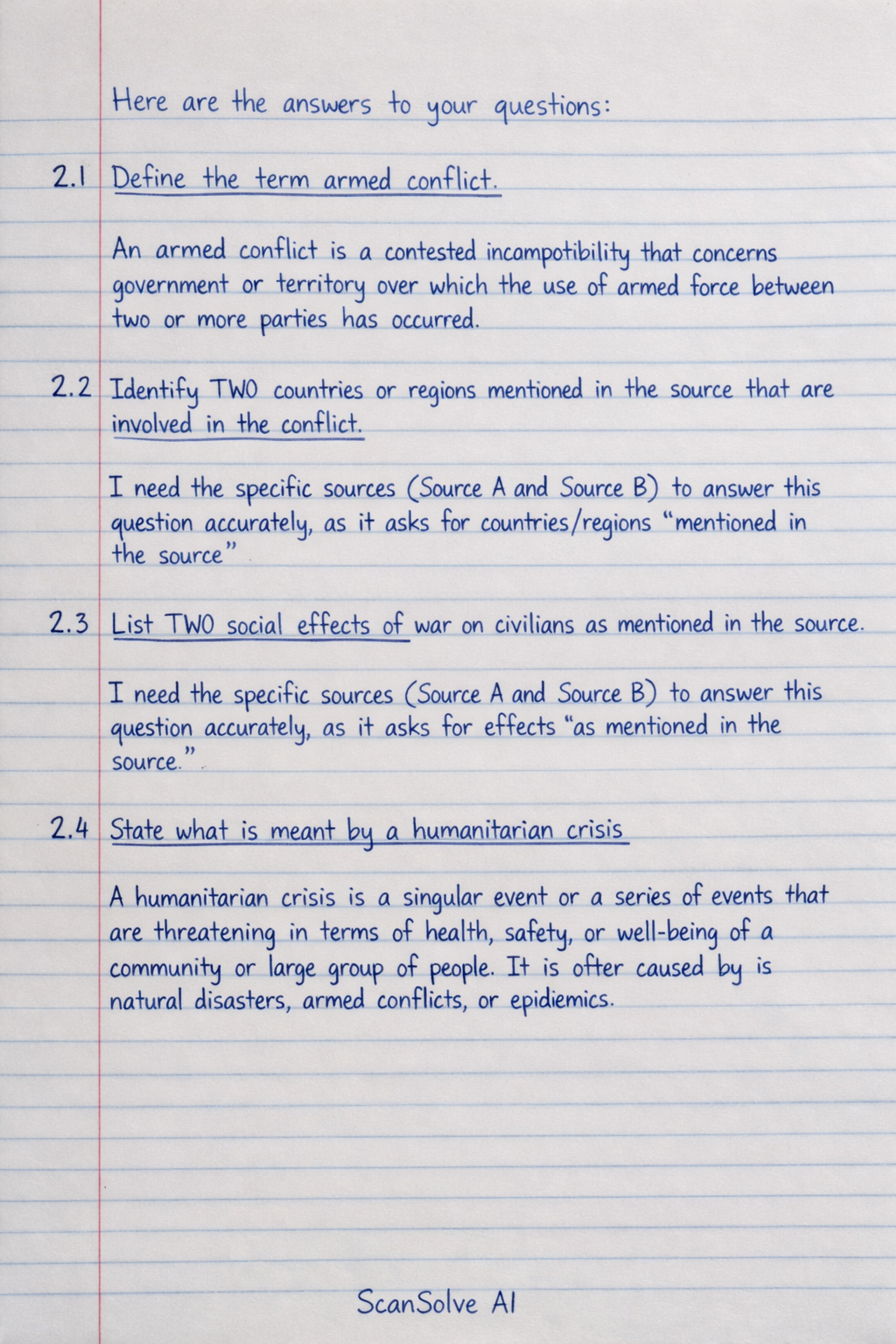
Here are the answers to your questions:
2.1 Define the term armed conflict.
An armed conflict is a contested incompatibility that concerns government or territory over which the use of armed force between two or more parties has occurred.
2.2 Identify TWO countries or regions mentioned in the source that are involved in the conflict.
I need the specific sources (Source A and Source B) to answer this question accurately, as it asks for countries/regions "mentioned in the source".
2.3 List TWO social effects of war on civilians as mentioned in the source.
I need the specific sources (Source A and Source B) to answer this question accurately, as it asks for effects "as mentioned in the source".
2.4 State what is meant by a humanitarian crisis.
A humanitarian crisis is a singular event or a series of events that are threatening in terms of health, safety, or well-being of a community or large group of people. It is often caused by natural disasters, armed conflicts, or epidemics.
2.5 Suggest TWO peaceful solutions that countries could use instead of war.
- Diplomacy and Negotiation: Countries can engage in direct talks, mediation, or arbitration to resolve disputes.
- Economic Sanctions: Imposing economic restrictions on a country can pressure it to change policies without resorting to military force.
2.6 Discuss TWO social consequences of war for communities living in conflict areas.
- Displacement and Refugee Crises: War often forces large populations to flee their homes, leading to internal displacement or refugee flows, disrupting social structures and creating humanitarian needs.
- Breakdown of Social Cohesion: Conflict can erode trust within communities, exacerbate ethnic or religious divisions, and lead to long-term social fragmentation, making post-conflict reconciliation challenging.
2.7 Analyse how the conflict between USA, Iran and Iraq can affect the global Economy.
A conflict involving the USA, Iran, and Iraq would significantly impact the global economy primarily through disruptions to oil supply and prices. The region is a major oil producer, and conflict could lead to reduced production, damage to infrastructure, and blockages of key shipping routes like the Strait of Hormuz. This would cause a sharp increase in global oil prices, leading to higher transportation costs, inflation, and potentially a global economic recession. Additionally, it could disrupt international trade routes and create uncertainty in financial markets, deterring investment.
2.8 Explain TWO environmental impacts of war on people living in war-torn countries.
- Contamination of Land and Water: The use of weapons, explosives, and chemical agents can contaminate soil and water sources with toxic substances, making land infertile and water unsafe for consumption, directly affecting public health and agriculture.
- Destruction of Infrastructure and Ecosystems: Bombing and military operations can destroy essential infrastructure like water treatment plants, leading to pollution. They also devastate natural habitats, forests, and agricultural land, leading to deforestation, soil erosion, and loss of biodiversity, which impacts local livelihoods and food security.
2.9 Evaluate the impact of rising fuel prices on individuals and households.
Rising fuel prices have several significant impacts on individuals and households:
- Increased Transportation Costs: Commuting to work, school, or running errands becomes more expensive, reducing disposable income. For households reliant on private vehicles, this can be a substantial financial burden.
- Higher Cost of Goods and Services: Fuel is a major component of transportation costs for goods. When fuel prices rise, businesses pass these costs onto consumers, leading to higher prices for food, clothing, and other essential goods, contributing to inflation and reducing purchasing power.
- Reduced Disposable Income and Savings: With more money spent on fuel and inflated goods, households have less money available for discretionary spending, savings, or investments, potentially impacting their quality of life and financial stability.
- Impact on Rural and Low-Income Households: These groups are often disproportionately affected. Rural households may travel longer distances, and low-income households spend a larger percentage of their income on necessities, making them more vulnerable to price increases.
2.10 Recommend ONE way in which governments can help protect the environment during or after war.
Governments can establish and enforce environmental protection policies and regulations even during or immediately after conflict. This includes identifying and securing hazardous waste sites, implementing rapid environmental impact assessments for reconstruction projects, and prioritizing the cleanup of contaminated areas to prevent further ecological damage and protect public health.
Still stuck on this one?
Ask a follow-up, and the answer starts from this question.
More Law Questions
Handwritten Step-by-Step Solution
Get this as a handwritten image on WhatsApp — like a tutor wrote it for you.
Try on WhatsApp