
We read your photo as:
Explain the concepts of Ijtihad, Hadith, Ijma, Qiyas, Mujtahid, and Madhab in Islamic jurisprudence.
ScanSolve AI Answer
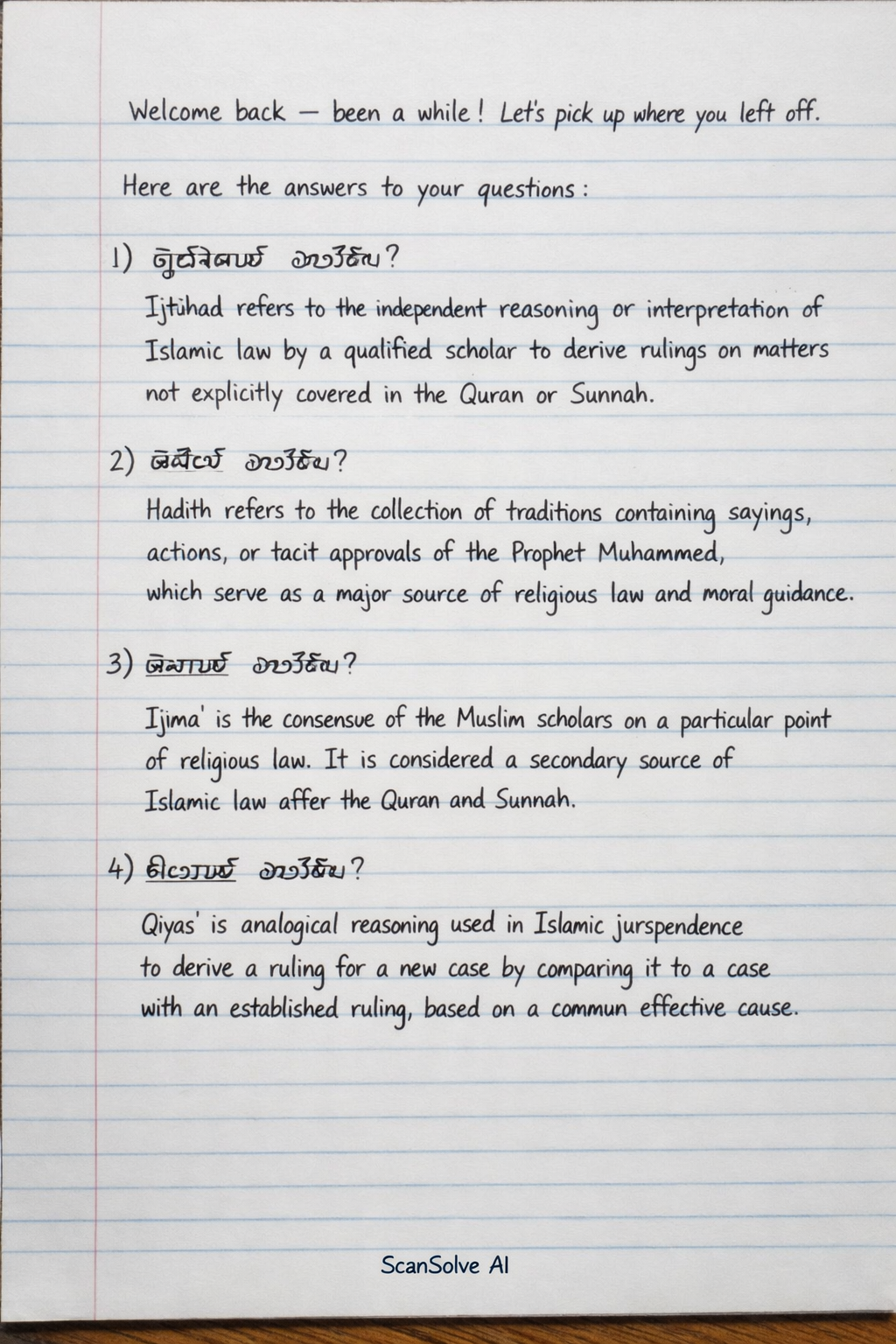
Here are the answers to your questions:
-
ಇಜ್ತಿಹಾಬ್ ಎಂದರೇನು? Ijtihad refers to the independent reasoning or interpretation of Islamic law by a qualified scholar to derive rulings on matters not explicitly covered in the Quran or Sunnah.
-
ಹದೀಸ್ ಎಂದರೇನು? Hadith refers to the collection of traditions containing sayings, actions, or tacit approvals of the Prophet Muhammad, which serve as a major source of religious law and moral guidance.
-
ಇಜ್ಮಾಅ್ ಎಂದರೇನು? Ijma' is the consensus of the Muslim scholars on a particular point of religious law. It is considered a secondary source of Islamic law after the Quran and Sunnah.
-
ಖಿಯಾಸ್ ಎಂದರೇನು? Qiyas is analogical reasoning used in Islamic jurisprudence to derive a ruling for a new case by comparing it to a case with an established ruling, based on a common effective cause.
-
ಮುಜ್ತಹಿದ್ ಅಂದರೆ ಯಾರು? A Mujtahid is a scholar who is qualified to perform Ijtihad, meaning they possess the necessary knowledge and understanding of Islamic texts and principles to derive independent legal rulings.
-
ಪ್ರಮುಖ ನಾಲ್ಕು ಮುಜ್ತಹಿದ್ಗಳ ಹೆಸರು ಬರೆ. The four prominent Mujtahids who founded the main Sunni schools of thought are:
- Imam Abu Hanifa
- Imam Malik ibn Anas
- Imam Muhammad ibn Idris al-Shafi'i
- Imam Ahmad ibn Hanbal
- ಮದ್ಹಬ್ ಎಂದರೇನು? A Madhab is a school of thought or legal school within Islamic jurisprudence. Each Madhab represents a distinct methodology for interpreting Islamic law, developed by a leading scholar and followed by their students.
Still stuck on this one?
Ask a follow-up, and the answer starts from this question.
More Law Questions
Handwritten Step-by-Step Solution
Get this as a handwritten image on WhatsApp — like a tutor wrote it for you.
Try on WhatsApp