

This law problem is solved step by step below, with detailed explanations to help you understand the method and arrive at the correct answer.
ScanSolve AI Answer
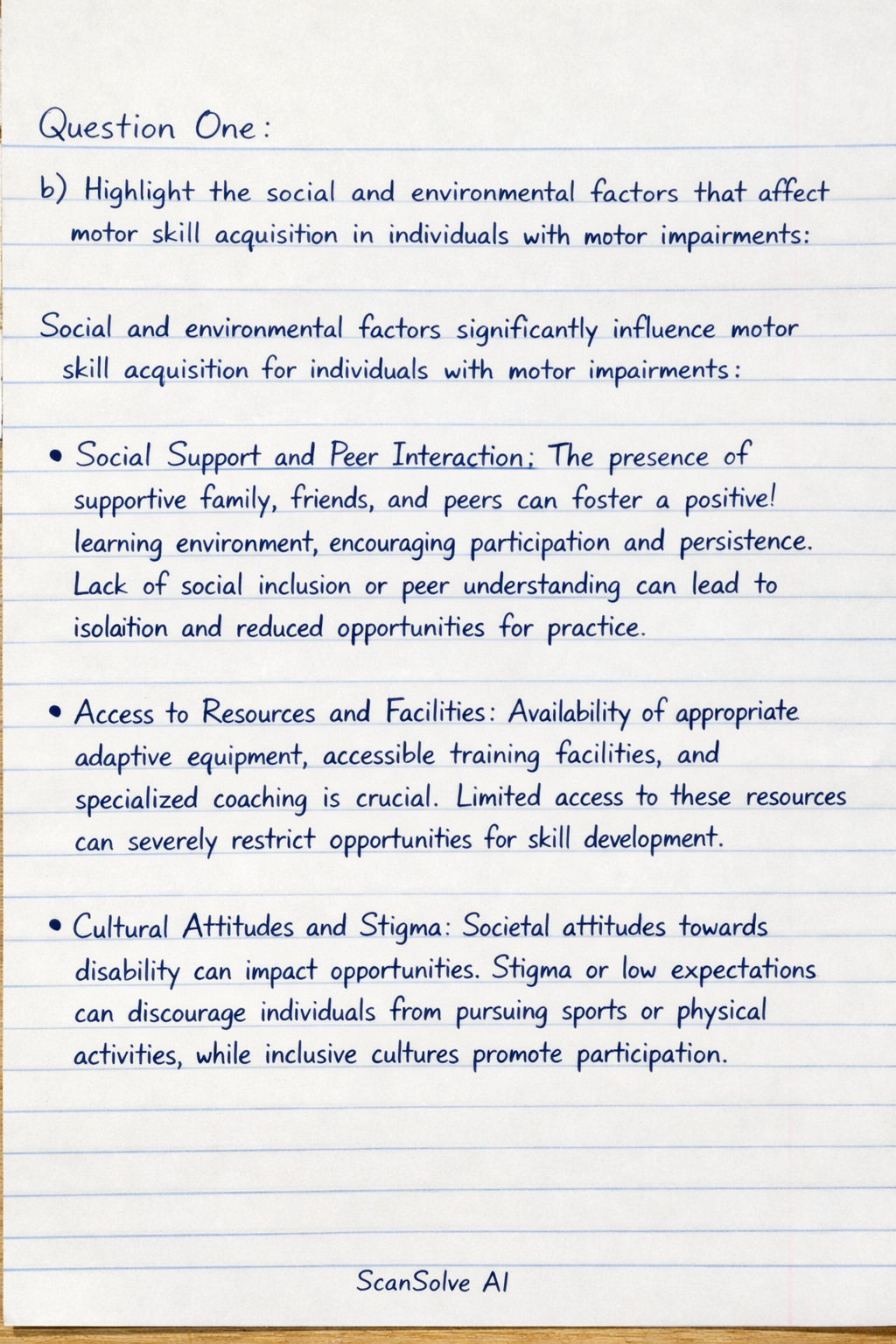
Question One: b) Highlight the social and environmental factors that affect motor skill acquisition in individuals with motor impairments. Social and environmental factors significantly influence motor skill acquisition for individuals with motor impairments: Social Support and Peer Interaction: The presence of supportive family, friends, and peers can foster a positive learning environment, encouraging participation and persistence. Lack of social inclusion or peer understanding can lead to isolation and reduced opportunities for practice. Access to Resources and Facilities: Availability of appropriate adaptive equipment, accessible training facilities, and specialized coaching is crucial. Limited access to these resources can severely restrict opportunities for skill development. Cultural Attitudes and Stigma: Societal attitudes towards disability can impact opportunities. Stigma or low expectations can discourage individuals from pursuing sports or physical activities, while inclusive cultures promote participation. Economic Status: Socioeconomic factors influence access to therapy, specialized equipment, and adapted sports programs. Financial constraints can limit opportunities for individuals to receive necessary support and training. Physical Environment: The design of public spaces, schools, and sports venues (e.g., ramps, accessible restrooms, smooth surfaces) directly affects an individual's ability to navigate and participate. Unsuitable environments create barriers to learning and practice. c) "Motor impairments are most commonly associated with delayed motor skill acquisition in learners." Discuss this statement. This statement is largely true. Motor impairments, by definition, involve difficulties with movement, coordination, or strength, which directly interfere with the typical developmental pathways for acquiring motor skills. Children with conditions like cerebral palsy, spina bifida, or developmental coordination disorder often exhibit milestones (e.g., sitting, walking, grasping) later than their typically developing peers. The neurological or physical challenges underlying the impairment make it harder to learn, refine, and automate movements, leading to a slower pace of skill acquisition. However, the degree of delay varies widely depending on the severity and type of impairment, and with appropriate interventions, many individuals can still achieve significant motor skill development, albeit at a different pace. d) Explain the influence of technological advancements in the developments and performance of adapted sports. Technological advancements have revolutionized adapted sports, significantly enhancing both development and performance: Specialized Equipment: Innovations in materials and design have led to highly specialized adaptive equipment, such as lightweight racing wheelchairs, prosthetic limbs optimized for specific sports (e.g., running blades), adaptive skis, and handcycles. This equipment allows athletes with diverse impairments to participate effectively and competitively. Training and Coaching Tools: Technology provides advanced tools for training, including motion capture systems, biomechanical analysis software, and virtual reality simulations. These tools help coaches analyze an athlete's technique, identify areas for improvement, and develop personalized training programs. Communication and Accessibility: Assistive communication devices and accessible interfaces improve interaction between athletes, coaches, and support staff. Technology also enhances accessibility to information and resources related to adapted sports. Performance Monitoring: Wearable technology and sensors allow for real-time monitoring of physiological data (heart rate, speed, power output) during training and competition. This data helps athletes and coaches optimize performance, prevent overtraining, and refine strategies. Classification Systems: Technology aids in developing more precise and objective classification systems for adapted sports, ensuring fair competition by grouping athletes with similar functional abilities. Question Two: a) Explain the role of coaches and trainers in the developments of athletes in adapted sports. Coaches and trainers play a multifaceted and crucial role in the development of athletes in adapted sports: Skill Development and Adaptation: They are responsible for teaching and refining sport-specific skills, often adapting techniques and strategies to suit the individual's impairment. This involves creative problem-solving and a deep understanding of biomechanics and adaptive equipment. Physical Conditioning and Injury Prevention: Coaches design tailored strength, endurance, and flexibility programs, considering the athlete's specific physical limitations and potential vulnerabilities. They also educate athletes on proper form and techniques to prevent injuries. Psychological Support and Motivation: They provide crucial emotional and psychological support, helping athletes build confidence, manage frustration, set realistic goals, and maintain motivation despite challenges. They foster a positive and inclusive environment. Equipment Selection and Modification: Coaches assist athletes in selecting, fitting, and optimizing adaptive equipment, ensuring it enhances performance and comfort while minimizing risk. They often work with specialists to customize equipment. Advocacy and Resource Navigation: They often act as advocates for their athletes, helping them navigate classification systems, access resources, and understand rules specific to adapted sports. They connect athletes with necessary support services. b) Analyze the impact of community based adapted sports Programs on local populations and social cohesion. Community-based adapted sports programs have a profound positive impact on local populations and social cohesion: Increased Participation and Health Outcomes: These programs provide accessible opportunities for individuals with disabilities to engage in physical activity, leading to improved physical health, mental well-being, and reduced sedentary lifestyles within the local population. Social Inclusion and Reduced Stigma: By integrating individuals with disabilities into mainstream community activities, these programs break down social barriers and reduce stigma. They foster understanding and acceptance, promoting a more inclusive community culture. Enhanced Social Cohesion: Adapted sports create shared experiences and common goals, bringing together individuals with and without disabilities, their families, volunteers, and local organizations. This interaction builds stronger community bonds and a sense of collective identity. Skill Development and Empowerment: Participants develop not only athletic skills but also life skills such as teamwork, discipline, and resilience. This empowerment can extend beyond the sports field, increasing confidence and participation in other community aspects. Economic Benefits: These programs can stimulate local economies through events, equipment purchases, and volunteer engagement. They also reduce healthcare costs associated with inactivity and improve the employability of individuals with disabilities. Question Three: a) Discuss the impact of doping scandals on the Integrity of athletes in Kenya. Doping scandals have severely damaged the integrity of athletes in Kenya, a nation renowned for its long-distance running prowess. Erosion of Trust and Reputation: Each scandal erodes public trust in Kenyan athletes and the authenticity of their achievements. It casts a shadow of doubt over clean athletes, forcing them to constantly prove their innocence. Damage to National Pride: Athletics is a significant source of national pride in Kenya. Doping incidents tarnish this image, leading to disappointment and embarrassment among citizens. Financial and Career Consequences: Athletes caught doping face bans, loss of prize money, sponsorship withdrawals, and irreparable damage to their careers. This also affects their ability to support their families and communities. Discouragement of Young Talent: Aspiring young athletes may become disillusioned, questioning the fairness of the sport and the value of hard work if they perceive that success can be achieved through illicit means. Increased Scrutiny and Sanctions: Repeated doping violations have led to increased scrutiny from international anti-doping agencies, potentially resulting in collective sanctions against Kenyan athletics, such as bans from major competitions or stricter testing protocols. b) Discuss how major athletic events such as, the Olympic or World Championship impact National Identity and global relations. Major athletic events like the Olympics or World Championships profoundly impact National Identity and global relations: Fostering National Identity: These events serve as powerful platforms for nations to showcase their talent, culture, and values. Victories by national athletes evoke immense pride and unity, strengthening a shared sense of national identity and belonging among citizens. The national anthem, flag, and team colors become symbols of collective achievement. Soft Power and Global Image: Success in major athletic events enhances a nation's soft power* and improves its global image. It can project an image of strength, discipline, and excellence, influencing international perceptions and potentially attracting tourism or investment. Diplomacy and Global Relations: Sports can act as a diplomatic tool, fostering goodwill and understanding between nations. Shared sporting experiences, even in competition, can create common ground and opportunities for dialogue, sometimes transcending political differences. Platform for Social and Political Statements: These events can also become stages for athletes or nations to make social or political statements, drawing global attention to issues like human rights, equality, or peace, thereby influencing international discourse. Economic and Cultural Exchange: Hosting major events brings significant economic benefits and cultural exchange, as visitors from around the world interact, sharing traditions and fostering mutual appreciation. Question Four: a) Discuss the physical attribute required for Success in a handball match. Success in a handball match requires a combination of several key physical attributes: Agility and Speed: Players need exceptional agility to change direction quickly, evade defenders, and create scoring opportunities. Speed* is crucial for fast breaks, quick transitions between offense and defense, and covering the court effectively. Power and Strength: Upper body strength is vital for powerful shots, effective passing, and defensive blocking. Lower body power* is needed for jumping, explosive movements, and maintaining stability during physical contact. Endurance (Cardiovascular Fitness): Handball is a high-intensity, continuous game requiring players to run, jump, and sprint repeatedly throughout the match. High cardiovascular endurance* ensures players can maintain performance levels without fatigue. Coordination and Dexterity: Excellent hand-eye coordination is essential for catching, passing, and shooting accurately. Dexterity* allows for quick ball handling and deceptive movements. Flexibility: Good flexibility* helps in executing a wide range of movements, such as reaching for the ball, throwing from various angles, and reducing the risk of muscle strains. b) Discuss the common injuries in handball, and how they can be prevented. Common injuries in handball often result from the sport's high intensity, rapid movements, and physical contact. Common Injuries: Upper Extremity Injuries: These include finger sprains (due to ball impact or catching), shoulder injuries (rotator cuff strains, dislocations from powerful throwing motions), and wrist sprains*. Lower Extremity Injuries: Ankle sprains are common due to quick changes in direction and landings. Knee injuries (ligament tears like ACL, meniscus tears) can occur from pivoting, jumping, and landing. Thigh muscle strains* (hamstring, quadriceps) are also frequent. Head and Face Injuries: Collisions can lead to concussions*, facial cuts, or nosebleeds. c) Explain how injuries in handball can be prevented. Injury prevention in handball focuses on a multi-faceted approach: Proper Warm-up and Cool-down: A thorough warm-up prepares muscles and joints for activity, increasing blood flow and flexibility. A cool-down* aids recovery and reduces muscle soreness. Strength and Conditioning: Implementing a balanced strength and conditioning program* that targets core stability, upper body strength, and lower body power helps muscles withstand the demands of the game and supports joints. Correct Technique: Emphasizing and coaching proper throwing, landing, and pivoting techniques* reduces undue stress on joints and muscles, particularly the shoulder, knee, and ankle. Appropriate Equipment: Wearing well-fitting athletic shoes with good ankle support and using finger taping* or protective gear for vulnerable areas can mitigate injury risk. Rule Adherence and Fair Play: Strict enforcement of rules and promoting fair play* reduces dangerous physical contact and aggressive behavior that can lead to injuries. Adequate Rest and Recovery: Ensuring players get sufficient rest* between training sessions and matches prevents overuse injuries and allows the body to repair and adapt. Question Five: a) Explain the following as used in the game of basketball: i. Three second rule: The three second rule prohibits an offensive player from remaining in the opponent's restricted area (the key or paint) for more than three consecutive seconds while their team is in control of the ball in the frontcourt. Violation results in a turnover. ii. Five second rule: The five second rule applies in several situations: An offensive player holding the ball cannot hold it for more than five seconds while being closely guarded by a defender. A player has five seconds to inbound the ball from out of bounds. A player has five seconds to attempt a free throw. Violation results in a turnover. iii. Ten second rule: The ten second rule requires a team to advance the ball from their backcourt (defensive half) into their frontcourt (offensive half) within ten seconds of gaining possession. Failure to do so results in a turnover. iv. Thirty second rule: The thirty second rule (often referred to as the shot clock) requires a team to attempt a shot at the basket within a specified time limit (which is 24 seconds in NBA/FIBA, but historically has been 30 seconds in some leagues or levels of play). The shot must hit the rim or enter the basket. Failure to do so results in a turnover. b) Explain why Basketball is not a common game in primary schools in Kenya. Basketball is not a common game in primary schools in Kenya for several reasons: Infrastructure and Equipment: Basketball requires specific infrastructure like a court with a hard surface, backboards, and hoops, which are often expensive and not readily available in many primary schools, especially in rural areas. The cost of basketballs themselves can also be a barrier. Cultural Preference and Resource Allocation: Traditional sports like football (soccer) and athletics have a stronger cultural presence and are often prioritized in terms of resource allocation, coaching, and school sports programs. Coaching and Training: There is a general scarcity of trained basketball coaches and physical education teachers with expertise in basketball at the primary school level. This limits the ability of schools to introduce and effectively teach the game. Perceived Complexity: Basketball can be perceived as a more complex game with numerous rules and