The United Nations Conference on Trade and Development UNCTAD has it's secretariat in

Economics
The United Nations Conference on Trade and Development UNCTAD has it's secretariat in

ScanSolve AI Answer

9 steps

Answer

C. To raise the standard of living of the people

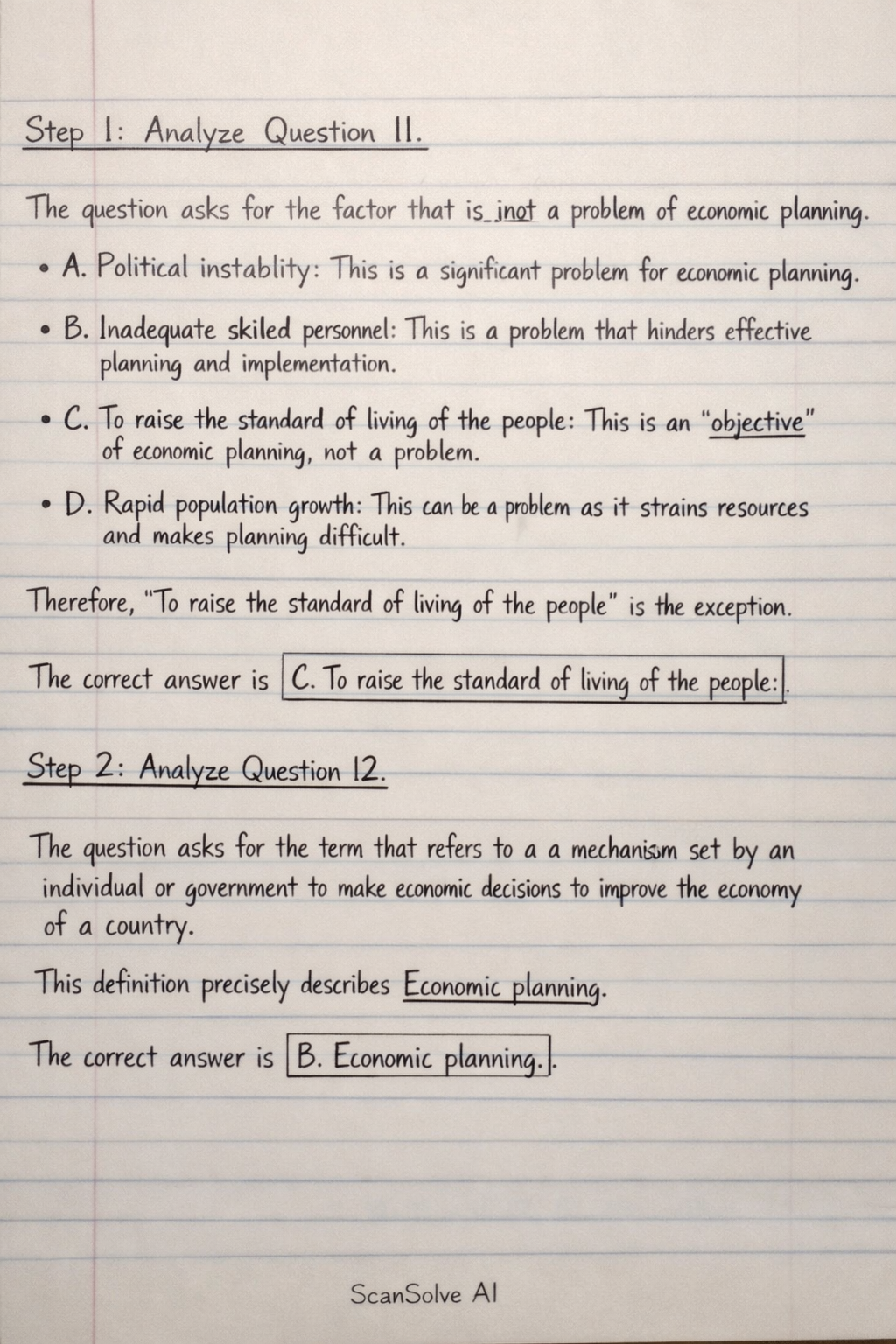
Step 1: Analyze Question 11. The question asks for the factor that is not a problem of economic planning. • A. Political instability: This is a significant problem for economic planning. • B. Inadequate skilled personnel: This is a problem that hinders effective planning and implementation. • C. To raise the standard of living of the people: This is an objective of economic planning, not a problem. • D. Rapid population growth: This can be a problem as it strains resources and makes planning difficult. Therefore, "To raise the standard of living of the people" is the exception.

The correct answer is C.Toraisethestandardoflivingofthepeople\boxed{C. To raise the standard of living of the people}.

Step 2: Analyze Question 12. The question asks for the term that refers to a mechanism set by an individual or government to make economic decisions to improve the economy of a country. This definition precisely describes Economic planning.

The correct answer is B.Economicplanning\boxed{B. Economic planning}.

Step 3: Analyze Question 13. The question asks for the location of the secretariat of the United Nations Conference on Trade and Development (UNCTAD). UNCTAD's headquarters is in Geneva, Switzerland.

The correct answer is D.Geneva\boxed{D. Geneva}.

Step 4: Analyze Question 14. The question asks for a reason for establishing UNCTAD. UNCTAD was established to assist developing countries in overcoming trade and development challenges, particularly in the context of globalization.

The correct answer is A.Toassistdevelopingcountriesinovercomingthedifficultiesasaresultofglobalization\boxed{A. To assist developing countries in overcoming the difficulties as a result of globalization}.

Step 5: Analyze Question 15. The question asks for an objective of the Sustainable Development Goals (SDGs). The SDGs are a set of 17 global goals, and a primary objective is to eradicate poverty in all its forms.

The correct answer is D.Povertyeradication\boxed{D. Poverty eradication}.

Step 6: Analyze Question 16. The question asks for the factor that is not a challenge of NEEDS (National Economic Empowerment and Development Strategy). NEEDS aimed to address challenges like corruption, poor infrastructure, and political instability. Employment generation was an objective of NEEDS, not a challenge it faced.

The correct answer is C.Employmentgeneration\boxed{C. Employment generation}.

Step 7: Analyze Question 17. The question asks for an achievement of the Asian Tiger Economies. The Asian Tigers (Hong Kong, Singapore, South Korea, Taiwan) are known for their rapid economic growth driven by industrialization and export-oriented policies.

The correct answer is A.Rapidindustrializationdrive\boxed{A. Rapid industrialization drive}.

Step 8: Analyze Question 18. The question asks for the establishment year of the African Development Bank (ADB). The ADB was established in 1964.

The correct answer is B.1964\boxed{B. 1964}.

Step 9: Analyze Question 19. The question asks for a major objective of Nigeria Vision 2020. Nigeria Vision 2020 aimed to transform Nigeria into one of the top 20 economies in the world, with a focus on equitable social development for all citizens.

The correct answer is D.Totranslatetheeconomicgrowthinequitablesocialdevelopmentforallcitizens\boxed{D. To translate the economic growth in equitable social development for all citizens}.

Step 10: Analyze Question 20. The question asks for the headquarters of the Economic Commission for Africa (ECA). The headquarters of the United Nations Economic Commission for Africa (UNECA) is in Addis Ababa, Ethiopia.

The correct answer is A.AddisAbaba,Ethiopia\boxed{A. Addis Ababa, Ethiopia}.


SECTION B: THEORY

Question 2c: c) Explain the concept of MDGs (5 marks) The Millennium Development Goals (MDGs) were eight international development goals for the year 2015 that were established following the Millennium Summit of the United Nations in 2000. These goals aimed to combat poverty, hunger, disease, illiteracy, environmental degradation, and discrimination against women, providing a framework for global efforts towards a common set of objectives.

Question 3a: a) Define the concept economic growth and development (5marks) Economic growth refers to an increase in the production of economic goods and services over time, typically measured by the percentage increase in real Gross Domestic Product (GDP). Economic development is a broader concept that encompasses economic growth but also includes improvements in the quality of life, such as better education, healthcare, infrastructure, and reduced poverty and inequality, signifying a sustained improvement in the well-being of a country's population.

Question 3b: b) Highlight five factors that influence economic growth (10marks)

  1. Natural Resources: Abundant and accessible natural resources (e.g., land, minerals, energy) provide raw materials for production.
  2. Human Capital: A skilled, educated, and healthy workforce enhances productivity and innovation.
  3. Physical Capital/Investment: Investment in infrastructure, machinery, and technology increases productive capacity.
  4. Technological Progress: Advances in technology lead to new products, more efficient production methods, and increased output.
  5. Institutional Framework: Stable political systems, rule of law, secure property rights, and effective governance create a conducive environment for economic activity.

Question 4a: a) Define economic planning (5marks) Economic planning is a deliberate governmental effort to influence, direct, and control economic activity to achieve specific economic and social objectives within a defined timeframe. It involves setting targets, allocating resources, and implementing policies to guide the economy towards desired outcomes.

Question 4b: b) Explain five problems associated with economic planning in West Africa (10marks)

  1. Political Instability and Corruption: Frequent changes in government and high levels of corruption often disrupt long-term plans and divert resources.
  2. Inadequate Data and Statistics: Lack of reliable and comprehensive data makes it difficult to formulate realistic plans and monitor progress effectively.
  3. Shortage of Skilled Personnel: A scarcity of trained economists, planners, and technical experts hinders the effective formulation and implementation of complex plans.
  4. External Dependence and Shocks: Reliance on primary commodity exports and foreign aid makes economies vulnerable to global price
Was this helpful?

Need help with your own homework?

Get instant step-by-step solutions to any question. Free to start.

Ask Your Question
Handwritten step-by-step solution preview

Handwritten Step-by-Step Solution

Get this as a handwritten image on WhatsApp — like a tutor wrote it for you.

Try on WhatsApp

Still have questions?

Quick Answer

Analyze Question 11. The question asks for the factor that is not a problem of economic planning.

The United Nations Conference on Trade and Development UNCTAD has it's secretariat in
Economics

This economics question tests your understanding of economic models and analysis. The step-by-step answer below applies the relevant framework and explains the reasoning.

ScanSolve AI Answer
Step 1: Analyze Question 11. The question asks for the factor that is not a problem of economic planning. • A. Political instability: This is a significant problem for economic planning. • B. Inadequate skilled personnel: This is a problem that hinders effective planning and implementation. • C. To raise the standard of living of the people: This is an objective of economic planning, not a problem. • D. Rapid population growth: This can be a problem as it strains resources and makes planning difficult. Therefore, "To raise the standard of living of the people" is the exception. The correct answer is C. To raise the standard of living of the people. Step 2: Analyze Question 12. The question asks for the term that refers to a mechanism set by an individual or government to make economic decisions to improve the economy of a country. This definition precisely describes Economic planning. The correct answer is B. Economic planning. Step 3: Analyze Question 13. The question asks for the location of the secretariat of the United Nations Conference on Trade and Development (UNCTAD). UNCTAD's headquarters is in Geneva, Switzerland. The correct answer is D. Geneva. Step 4: Analyze Question 14. The question asks for a reason for establishing UNCTAD. UNCTAD was established to assist developing countries in overcoming trade and development challenges, particularly in the context of globalization. The correct answer is A. To assist developing countries in overcoming the difficulties as a result of globalization. Step 5: Analyze Question 15. The question asks for an objective of the Sustainable Development Goals (SDGs). The SDGs are a set of 17 global goals, and a primary objective is to eradicate poverty in all its forms. The correct answer is D. Poverty eradication. Step 6: Analyze Question 16. The question asks for the factor that is not a challenge of NEEDS (National Economic Empowerment and Development Strategy). NEEDS aimed to address challenges like corruption, poor infrastructure, and political instability. Employment generation was an objective of NEEDS, not a challenge it faced. The correct answer is C. Employment generation. Step 7: Analyze Question 17. The question asks for an achievement of the Asian Tiger Economies. The Asian Tigers (Hong Kong, Singapore, South Korea, Taiwan) are known for their rapid economic growth driven by industrialization and export-oriented policies. The correct answer is A. Rapid industrialization drive. Step 8: Analyze Question 18. The question asks for the establishment year of the African Development Bank (ADB). The ADB was established in 1964. The correct answer is B. 1964. Step 9: Analyze Question 19. The question asks for a major objective of Nigeria Vision 2020. Nigeria Vision 2020 aimed to transform Nigeria into one of the top 20 economies in the world, with a focus on equitable social development for all citizens. The correct answer is D. To translate the economic growth in equitable social development for all citizens. Step 10: Analyze Question 20. The question asks for the headquarters of the Economic Commission for Africa (ECA). The headquarters of the United Nations Economic Commission for Africa (UNECA) is in Addis Ababa, Ethiopia. The correct answer is A. Addis Ababa, Ethiopia. --- SECTION B: THEORY Question 2c: c) Explain the concept of MDGs (5 marks) The Millennium Development Goals (MDGs) were eight international development goals for the year 2015 that were established following the Millennium Summit of the United Nations in 2000. These goals aimed to combat poverty, hunger, disease, illiteracy, environmental degradation, and discrimination against women, providing a framework for global efforts towards a common set of objectives. Question 3a: a) Define the concept economic growth and development (5marks) Economic growth refers to an increase in the production of economic goods and services over time, typically measured by the percentage increase in real Gross Domestic Product (GDP). Economic development is a broader concept that encompasses economic growth but also includes improvements in the quality of life, such as better education, healthcare, infrastructure, and reduced poverty and inequality, signifying a sustained improvement in the well-being of a country's population. Question 3b: b) Highlight five factors that influence economic growth (10marks) 1. Natural Resources: Abundant and accessible natural resources (e.g., land, minerals, energy) provide raw materials for production. 2. Human Capital: A skilled, educated, and healthy workforce enhances productivity and innovation. 3. Physical Capital/Investment: Investment in infrastructure, machinery, and technology increases productive capacity. 4. Technological Progress: Advances in technology lead to new products, more efficient production methods, and increased output. 5. Institutional Framework: Stable political systems, rule of law, secure property rights, and effective governance create a conducive environment for economic activity. Question 4a: a) Define economic planning (5marks) Economic planning is a deliberate governmental effort to influence, direct, and control economic activity to achieve specific economic and social objectives within a defined timeframe. It involves setting targets, allocating resources, and implementing policies to guide the economy towards desired outcomes. Question 4b: b) Explain five problems associated with economic planning in West Africa (10marks) 1. Political Instability and Corruption: Frequent changes in government and high levels of corruption often disrupt long-term plans and divert resources. 2. Inadequate Data and Statistics: Lack of reliable and comprehensive data makes it difficult to formulate realistic plans and monitor progress effectively. 3. Shortage of Skilled Personnel: A scarcity of trained economists, planners, and technical experts hinders the effective formulation and implementation of complex plans. 4. External Dependence and Shocks: Reliance on primary commodity exports and foreign aid makes economies vulnerable to global price