
We read your photo as:
Explain five functions of Economic and Financial Crimes Commission (EFCC).
ScanSolve AI Answer
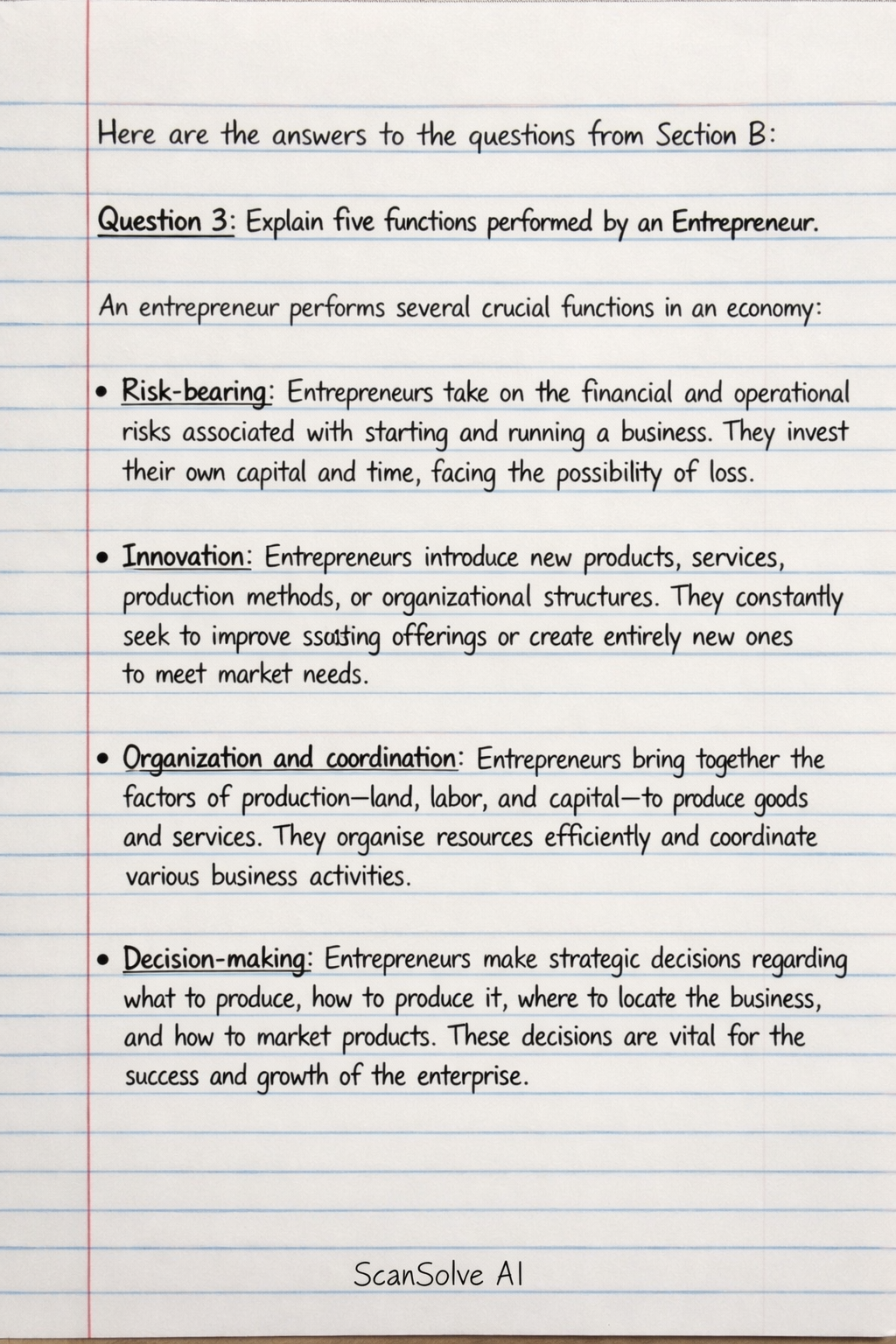
Here are the answers to the questions from Section B:
Question 3: Explain five functions performed by an Entrepreneur.
An entrepreneur performs several crucial functions in an economy:
- Risk-bearing: Entrepreneurs take on the financial and operational risks associated with starting and running a business. They invest their own capital and time, facing the possibility of loss.
- Innovation: Entrepreneurs introduce new products, services, production methods, or organizational structures. They constantly seek to improve existing offerings or create entirely new ones to meet market needs.
- Organization and coordination: Entrepreneurs bring together the factors of production—land, labor, and capital—to produce goods and services. They organize resources efficiently and coordinate various business activities.
- Decision-making: Entrepreneurs make strategic decisions regarding what to produce, how to produce it, where to locate the business, and how to market products. These decisions are vital for the success and growth of the enterprise.
- Management: Entrepreneurs oversee the day-to-day operations of the business, manage employees, and ensure that production and sales targets are met. They are responsible for the overall direction and performance of the firm.
Question 4:
a) What is Effective Demand?
Effective demand refers to the desire for a commodity backed by the ability and willingness to pay for it. It is the actual demand in the market, as opposed to mere desire or need without purchasing power.
b) Explain five factors that affect the demand for a commodity.
- Price of the commodity: Generally, as the price of a commodity increases, its quantity demanded decreases, and vice versa, assuming all other factors remain constant (Law of Demand).
- Income of the consumer: For normal goods, an increase in consumer income leads to an increase in demand. For inferior goods, an increase in income leads to a decrease in demand.
- Price of related goods:
- Substitutes: If the price of a substitute good increases, the demand for the original commodity will increase.
- Complements: If the price of a complementary good increases, the demand for the original commodity will decrease.
- Tastes and preferences: Changes in consumer tastes or preferences can significantly shift demand. If a product becomes more fashionable or desirable, its demand will increase.
- Expectations of future prices: If consumers expect the price of a commodity to rise in the future, they may increase their current demand to buy before the price increases. Conversely, expectations of a price fall may reduce current demand.
Question 5:
a) Define Price System.
A price system is an economic mechanism where the prices of goods and services are determined by the interaction of supply and demand in a market. Prices act as signals, guiding producers on what to produce and consumers on what to consume.
b) Explain four importance of Price System to an economy.
- Resource allocation: Prices guide resources to their most efficient uses. High prices signal producers to increase supply, attracting resources to those sectors, while low prices signal a need to reduce production.
- Rationing of goods: When goods are scarce, prices rise, effectively rationing the available supply to those who are most willing and able to pay, ensuring that limited resources are distributed.
- Information transmission: Prices convey information to both producers and consumers. Producers learn about consumer preferences and production costs, while consumers learn about the relative scarcity and value of goods.
- Incentives for efficiency: The price system encourages producers to operate efficiently to minimize costs and maximize profits, and it incentivizes consumers to seek the best value for their money.
c) Give two differences between capitalist and socialist price system.
- Ownership of resources: In a capitalist price system, most productive resources are privately owned, and prices are primarily determined by free market forces. In a socialist price system, productive resources are largely state-owned, and prices are often set or heavily influenced by central planning authorities.
- Role of profit: In a capitalist price system, profit motive is a primary driver for producers, and prices reflect this. In a socialist price system, the emphasis is on social welfare and equitable distribution, so prices may be set to achieve social goals rather than solely reflecting market forces or profit maximization.
Question 6:
a) Define Marketing Board.
A Marketing Board is a government-established organization that regulates the marketing of specific agricultural products, often with the aim of stabilizing prices, improving quality, and promoting exports for farmers.
b) Discuss three functions of Marketing Board.
- Price stabilization: Marketing boards often buy produce from farmers at guaranteed minimum prices, especially during periods of surplus, and sell it when prices are higher, thereby stabilizing farmer incomes and consumer prices.
- Quality control: They set and enforce quality standards for agricultural products, ensuring that only goods meeting certain specifications are marketed, which can enhance the reputation of the country's produce in international markets.
- Market access and promotion: Marketing boards help farmers access markets, both domestic and international, by providing infrastructure, logistics, and promotional activities. They can also negotiate better terms of trade for producers.
Question 7: Discuss five factors militating against rapid Industrialisation in Nigeria.
Rapid industrialization in Nigeria faces several challenges:
- Inadequate infrastructure: Poor and unreliable infrastructure, including erratic power supply, bad roads, and insufficient water supply, significantly increases production costs and hinders industrial growth.
- Lack of skilled labor: There is often a shortage of adequately trained and skilled technical personnel, engineers, and managers required to operate and maintain modern industrial facilities.
- Limited access to finance: Small and medium-sized enterprises (SMEs), which are crucial for industrialization, often struggle to access affordable credit and long-term financing from financial institutions.
- Political instability and corruption: Frequent changes in government policies, insecurity, and high levels of corruption create an unpredictable business environment, deterring both local and foreign investment in industries.
- Over-reliance on oil: Nigeria's economy is heavily dependent on crude oil exports, leading to neglect of other sectors, including manufacturing. This makes the economy vulnerable to oil price fluctuations and discourages diversification.
Question 8:
a) Explain the relationship between Savings and Investment.
Savings represent the portion of income not spent on current consumption, while investment refers to the expenditure on capital goods (like machinery, buildings) or financial assets that are expected to yield future income. In an economy, savings are a crucial source of funds for investment. When individuals and businesses save, these funds become available in the financial markets (e.g., banks, stock markets) to be borrowed by firms for investment purposes. Higher savings generally lead to more available funds for investment, which can drive economic growth and increased productive capacity.
b) Elaborate on three factors that affect Personal Consumption Expenditure.
- Disposable income: This is the most significant factor. As a person's disposable income (income after taxes) increases, their ability and tendency to spend on consumption goods and services also generally increase.
- Wealth: The total value of assets owned by an individual (e.g., property, stocks, savings) influences their consumption. A higher level of wealth can make individuals feel more secure and confident, leading to increased consumption even if current income remains constant.
- Consumer expectations: Expectations about future income, prices, and economic conditions affect current consumption. If consumers expect their income to rise or prices to increase in the future, they might increase their current spending. Conversely, expectations of job loss or economic downturns can lead to reduced consumption and increased saving.
Question 9: Write short notes on the following:
(i) Under Population
Under population occurs when a country's population is too small to fully utilize its available resources and technology, leading to a lower output per capita than could be achieved with a larger population. This can result in underutilization of land, capital, and other resources.
(ii) Over Population
Over population describes a situation where the existing population size is too large relative to the available resources and technology, leading to a decline in the standard of living, increased pressure on resources, and environmental degradation. The population exceeds the carrying capacity of the land.
(iii) Optimum Population
Optimum population is the ideal population size for a given area, where the available resources and technology allow for the highest possible standard of living or per capita income for its inhabitants. It represents the most efficient balance between population and resources.
(iv) Malthusian Population Theory
The Malthusian Population Theory, proposed by Thomas Malthus, states that human population tends to grow geometrically (exponentially), while food production grows arithmetically (linearly). This imbalance, Malthus argued, would inevitably lead to widespread poverty, famine, and disease, unless population growth is checked by "positive checks" (e.g., war, disease) or "preventive checks" (e.g., delayed marriage, moral restraint).
Question 10:
a) Define Supply of Labour.
The supply of labour refers to the total number of hours that workers are willing and able to offer for employment at various wage rates in a given period. It is influenced by factors such as population size, working age population, and labor force participation rates.
b) Expatiate on four factors that affect the supply of Labour.
- Wage rate: Generally, as the wage rate for a particular job increases, more people are willing to supply their labor, leading to an increase in the supply of labor. However, beyond a certain point, a higher wage might lead some to work fewer hours (income effect).
- Population size and structure: A larger total population, especially a larger working-age population, tends to increase the overall supply of labor. The age and gender distribution of the population also play a role.
- Education and training: The level of education and training available in an economy affects the supply of skilled labor. Investments in human capital can increase the supply of specialized workers.
- Non-monetary factors: Factors like working conditions, job security, prestige of the job, and opportunities for advancement can influence an individual's willingness to supply labor, even if the wage rate is not the highest.
Question 11:
a) What is Comparative Cost Advantage?
Comparative cost advantage is an economic principle that states that a country or individual should specialize in producing goods or services for which they have a lower opportunity cost compared to another country or individual. Even if one country has an absolute advantage in producing all goods, both countries can benefit from trade by specializing in what they produce relatively more efficiently.
b) Elaborate on five assumptions of Comparative Cost Advantage.
- Two countries, two goods: The theory typically simplifies the world to two countries and two goods to illustrate the core concept.
- Free trade: It assumes there are no barriers to trade, such as tariffs, quotas, or other restrictions, allowing goods to move freely between countries.
- Perfect mobility of factors of production within countries: Labor and capital can move freely between industries within a country, but are immobile between countries.
- Constant costs of production: The theory assumes that the cost of producing each unit of a good remains constant regardless of the quantity produced (i.e., no economies or diseconomies of scale).
- No transportation costs: It assumes that there are no costs associated with transporting goods between countries, which simplifies the calculation of trade benefits.
Question 12: Explain five functions of Economic and Financial Crimes Commission (EFCC).
The Economic and Financial Crimes Commission (EFCC) in Nigeria performs several key functions:
- Investigation of financial crimes: The EFCC is responsible for investigating all financial crimes, including advance fee fraud (419), money laundering, counterfeiting, illegal oil bunkering, and other forms of economic sabotage.
- Enforcement of financial laws: It enforces various financial and economic laws, such as the Money Laundering Act, the Advance Fee Fraud and Other Fraud Related Offences Act, and the Failed Banks (Recovery of Debts) and Financial Malpractices in Banks Act.
- Prosecution of offenders: The commission has the power to prosecute individuals and organizations found to be involved in economic and financial crimes in Nigerian courts.
- Coordination with other agencies: The EFCC coordinates with other domestic and international law enforcement agencies to combat economic and financial crimes, sharing intelligence and collaborating on investigations.
- Prevention and public enlightenment: It undertakes measures to prevent economic and financial crimes, including public awareness campaigns and educational programs to sensitize the public about the dangers and consequences of such crimes.
Still stuck on this one?
Ask a follow-up, and the answer starts from this question.
More Economics Questions
Handwritten Step-by-Step Solution
Get this as a handwritten image on WhatsApp — like a tutor wrote it for you.
Try on WhatsApp