

This law problem is solved step by step below, with detailed explanations to help you understand the method and arrive at the correct answer.
ScanSolve AI Answer
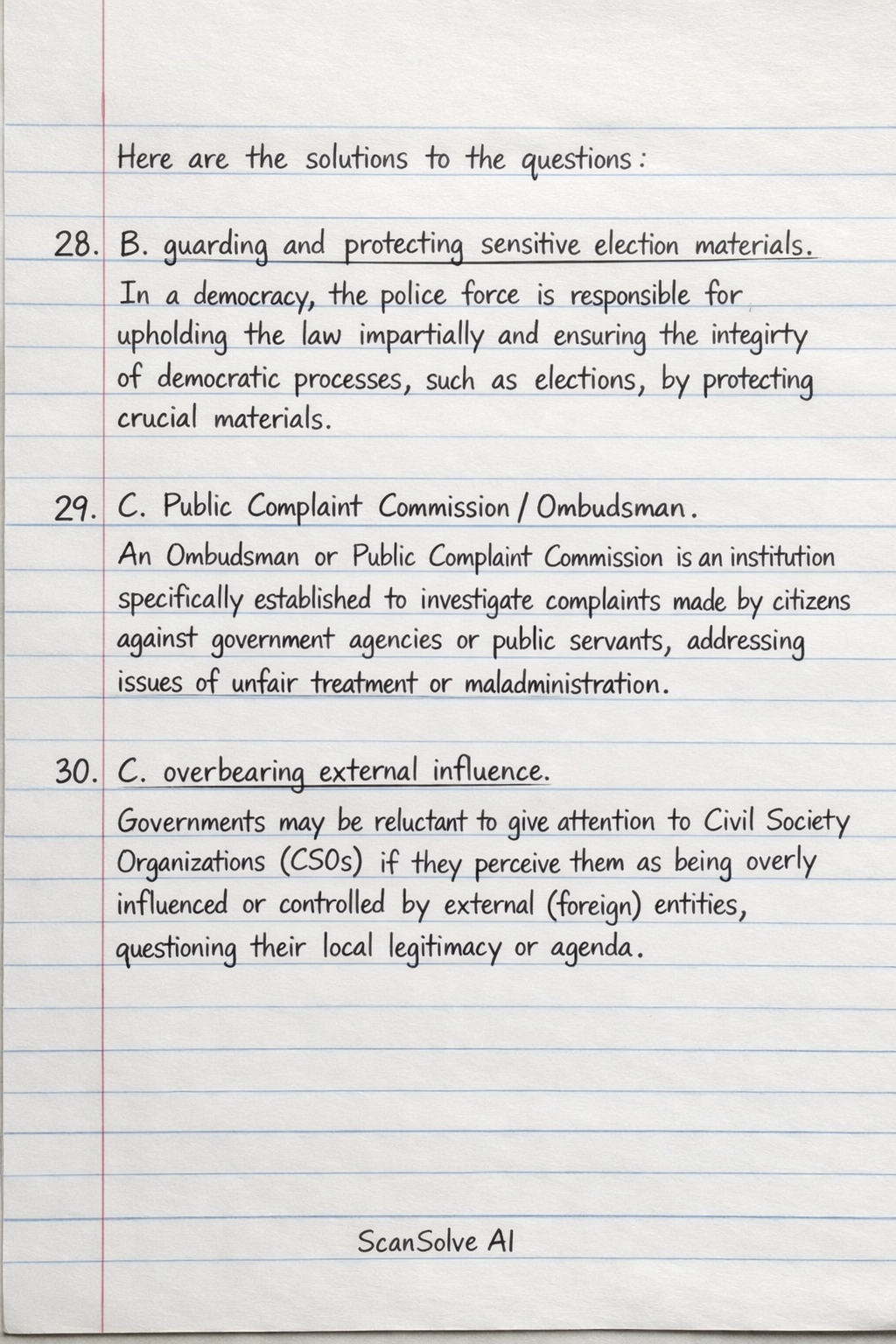
Here are the solutions to the questions: 28. B. guarding and protecting sensitive election materials. In a democracy, the police force is responsible for upholding the law impartially and ensuring the integrity of democratic processes, such as elections, by protecting crucial materials. 29. C. Public Complaint Commission/Ombudsman. An Ombudsman or Public Complaint Commission is an institution specifically established to investigate complaints made by citizens against government agencies or public servants, addressing issues of unfair treatment or maladministration. 30. C. overbearing external influence. Governments may be reluctant to give attention to Civil Society Organizations (CSOs) if they perceive them as being overly influenced or controlled by external (foreign) entities, questioning their local legitimacy or agenda. 31. A. they concern individuals directly and influence their peaceful existence as human beings. The core freedoms of the Universal Declaration of Human Rights are fundamental because they directly relate to the dignity, well-being, and peaceful existence of every individual, forming the basis for a just society. 32. C. tolerance of other people's views, opinions, beliefs etc. The Universal Declaration of Human Rights emphasizes the responsibility of individuals to respect and tolerate the rights and freedoms of others, which includes their views, opinions, and beliefs, as a cornerstone of human rights. 33. C. red-tapism. In public service, "bureaucracy" often refers to red-tapism, which is characterized by excessive adherence to rules, procedures, and formalities, leading to inefficiency, delays, and a lack of responsiveness. 34. B. abandonment of many projects. Constant changes in public service, such as frequent policy shifts or changes in leadership, often lead to a lack of continuity, resulting in the abandonment of ongoing projects and a waste of resources. 35. A. government should be subject to the law. The rule of law is a fundamental principle stating that all individuals and institutions, including the government itself, are accountable to publicly promulgated laws that are equally enforced and independently adjudicated. 36. B. be self sufficient. Youth empowerment programs aim to equip young people with the skills, knowledge, and opportunities necessary to become independent and capable of supporting themselves, thereby achieving self-sufficiency. Last free one today — make it count tomorrow, or type /upgrade for unlimited.