
Question 1 is compulsory. Answer three other questions. Credit will be given for clear diagrams and well-labeled sketches where necessary. Time: 2 hours 30 minutes SECTION A (Compulsory) Question 1 Study the table below showing average monthly rainfall and temperature for a tropical station. Month J F M A M J J A S O N D Rainfall (mm) 18 42 85 140 220 310 420 390 320 210 95 30 Temperature (°C) 28 29 29 28 27 26 25 25 26 27 28 28 Questions a) Calculate: i. The annual rainfall total. (2 marks) ii. The annual temperature range. (2 marks) b) Draw a simple climatic graph using the data above. (8 marks) c) Describe the rainfall pattern shown in the table. (4 marks) d) Explain two factors responsible for the rainfall pattern. (4 marks) e) Identify the climatic region represented by the data. Give one reason. (2 marks) [Total: 22 marks] SECTION B Question 2 — Rocks and Weathering a) Distinguish between: i. Igneous rocks and sedimentary rocks. (4 marks) ii. Physical weathering and chemical weathering. (4 marks) b) Explain how exfoliation takes place in tropical desert regions. (6 marks) c) Describe three effects of weathering on human activities. (6 marks) Question 3 — Vulcanicity and Earth Movements a) What is vulcanicity? (2 marks) b) With the aid of a clearly labeled diagram, describe the formation of a volcanic cone. (8 marks) c) Explain three positive effects of volcanic activity on man. (6 marks) d) State four negative effects of earthquakes. (4 marks) Question 4 — Rivers a) Define: i. Watershed (2 marks) ii. River capture (2 marks) b) Describe the main characteristics of the upper course of a river. (6 marks) c) Explain the formation of: i. Waterfalls (4 marks) ii. Oxbow lakes (6 marks) Question 5 — Coastlines a) Differentiate between: i. Erosion and deposition along the coast. (4 marks) ii. Concordant and discordant coastlines. (4 marks) b) Explain how waves erode the coastline. (6 marks) c) Describe the formation of spits and lagoons. (6 marks) Question 6 — Climate and Vegetation a) State four characteristics of the equatorial climate. (4 marks) b) Explain how relief influences climate. (6 marks) c) Describe the characteristics of tropical rainforest vegetation. (6 marks) d) Explain two ways in which man destroys natural vegetation. (4 marks) Question 7 — Soils a) What is soil? (2 marks) b) Name and describe the three main soil horizons. (6 marks) c) Explain four factors influencing soil formation. (8 marks) d) State four methods of soil conservation. (4 marks) Question 8 — Oceans and Relief a) Distinguish between continental shelf and continental slope. (4 marks) b) Explain the formation of fold mountains. (6 marks) c) Describe the importance of oceans to man. (6 marks) d) Name four major ocean currents of the world. (4 marks)
Law
ScanSolve AI Answer
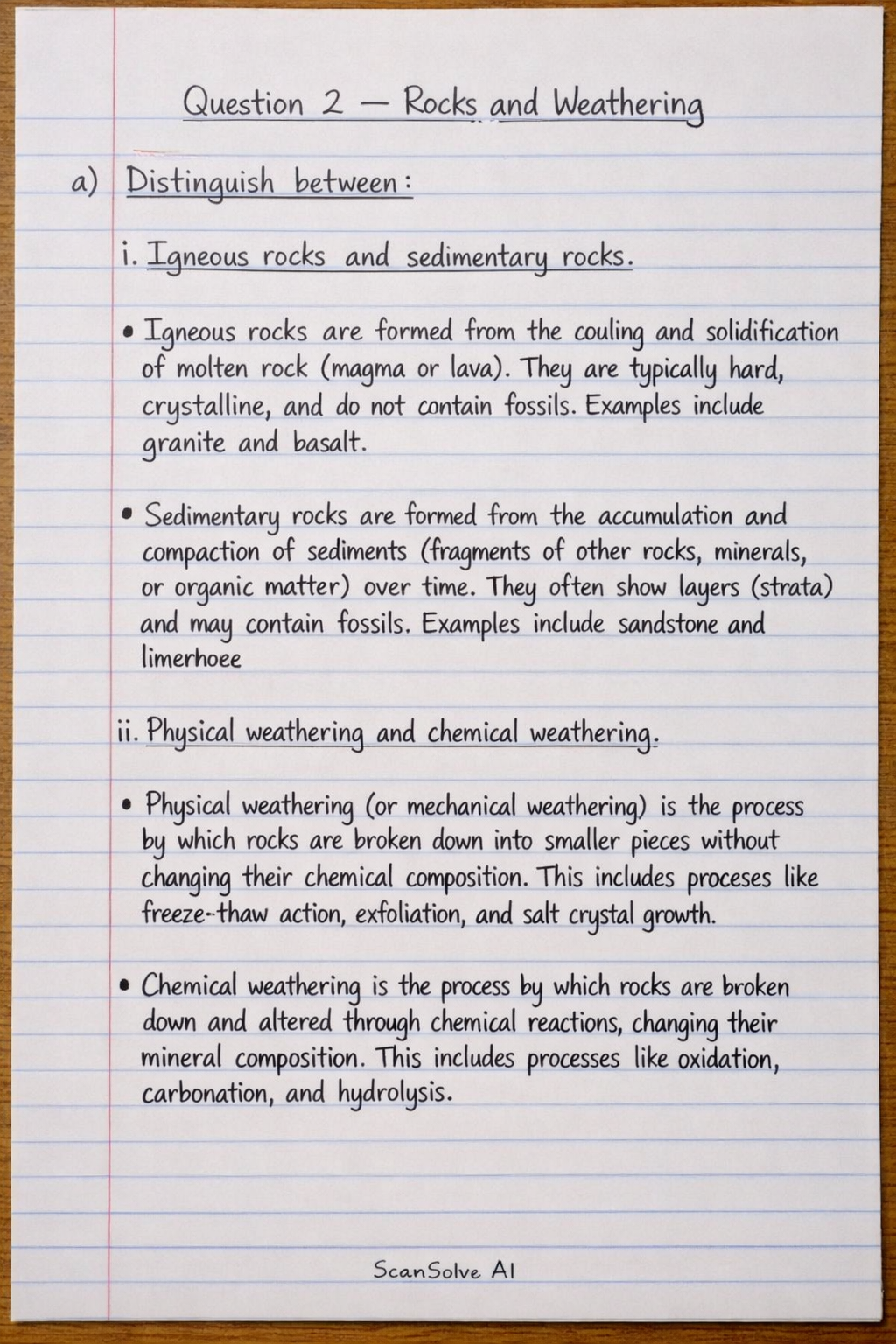
Question 2 — Rocks and Weathering
a) Distinguish between:
i. Igneous rocks and sedimentary rocks.
- Igneous rocks are formed from the cooling and solidification of molten rock (magma or lava). They are typically hard, crystalline, and do not contain fossils. Examples include granite and basalt.
- Sedimentary rocks are formed from the accumulation and compaction of sediments (fragments of other rocks, minerals, or organic matter) over time. They often show layers (strata) and may contain fossils. Examples include sandstone and limestone.
ii. Physical weathering and chemical weathering.
- Physical weathering (or mechanical weathering) is the process by which rocks are broken down into smaller pieces without changing their chemical composition. This includes processes like freeze-thaw action, exfoliation, and salt crystal growth.
- Chemical weathering is the process by which rocks are broken down and altered through chemical reactions, changing their mineral composition. This includes processes like oxidation, carbonation, and hydrolysis.
b) Explain how exfoliation takes place in tropical desert regions.
Exfoliation, also known as onion-peeling or thermal fracturing, occurs in tropical desert regions due to extreme diurnal temperature changes.
- During the day, intense solar radiation heats the outer layers of large, bare rock surfaces more rapidly and to a greater extent than the inner layers.
- The heated outer layers expand, while the cooler inner layers remain relatively stable.
- At night, temperatures drop sharply, causing the outer layers to cool and contract rapidly.
- This repeated expansion and contraction creates stress within the rock. Over time, these stresses cause the outer layers of the rock to peel off in concentric sheets, similar to an onion, exposing fresh rock surfaces.
c) Describe three effects of weathering on human activities.
- Soil Formation and Agriculture: Weathering breaks down parent rock into smaller particles, contributing to the formation of soil. This process is crucial for agriculture, as fertile soils support crop growth, providing food and livelihoods.
- Construction and Infrastructure: Weathering can weaken building materials like stone and concrete over time, leading to the deterioration of structures, roads, and monuments. This necessitates maintenance, repairs, and can increase construction costs.
- Mineral Extraction and Mining: Weathering processes can concentrate valuable minerals near the Earth's surface, making them more accessible for mining. For example, bauxite (an aluminum ore) often forms through intense chemical weathering in tropical regions.
Was this helpful?
Still stuck on this one?
Ask a follow-up, and the answer starts from this question.
Got a different question?Ask your own question
More Law Questions
QPAPER 1: OBJECTIVE Answer all questions. Each question is followed by four options lettered A–D…QHAPPY SUNDAY. SECTION A: PHYSICAL GEOGRAPHY a) Distinguish between: The processes of convection and…Q2026 WASSCE – GEOGRAPHY PAPER 2 – ESSAY (THEORY) Answer FIVE questions only. Question 1 is…QCONFIRMED CTVET INTEGRATED SCIENCE PAPER 2 - ESSAY Time Allowed: 2 Hour 30 Minutes Answer four…QBECE 2026 Integrated Science Section B Practice (For Candidates) INSTRUCTION Answer any THREE…
Handwritten Step-by-Step Solution
Get this as a handwritten image on WhatsApp — like a tutor wrote it for you.
Try on WhatsApp