
We read your photo as:
Outline five features of the traditional political system in the pre-colonial era.
ScanSolve AI Answer
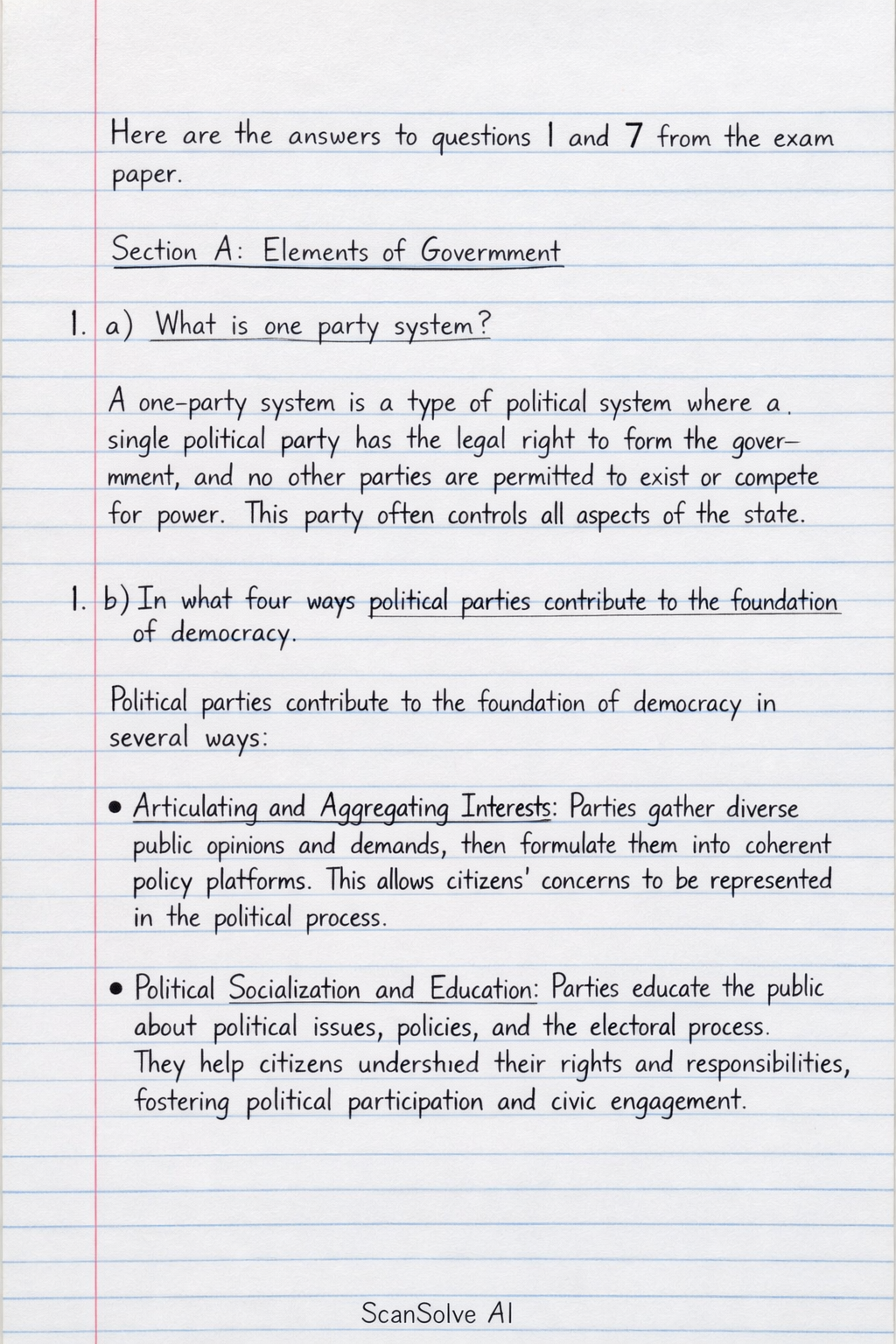
Here are the answers to questions 1 and 7 from the exam paper.
Section A: Elements of Government
1. a) What is one party system?
A one-party system is a type of political system where a single political party has the legal right to form the government, and no other parties are permitted to exist or compete for power. This party often controls all aspects of the state and society.
1. b) In what four ways political parties contribute to the foundation of democracy.
Political parties contribute to the foundation of democracy in several ways:
- Articulating and Aggregating Interests: Parties gather diverse public opinions and demands, then formulate them into coherent policy platforms. This allows citizens' concerns to be represented in the political process.
- Political Socialization and Education: Parties educate the public about political issues, policies, and the electoral process. They help citizens understand their rights and responsibilities, fostering political participation and civic engagement.
- Recruiting and Training Leaders: Parties identify, recruit, and train individuals to run for public office. They provide a structured path for aspiring leaders to gain experience and develop the skills necessary for governance.
- Providing a Mechanism for Accountability: In a multi-party system, opposition parties scrutinize the actions of the ruling party, holding them accountable to the electorate. This oversight helps prevent abuse of power and ensures transparency in government.
Section B: Political and Constitutional Development in West Africa and International Relations
7. a) Explain the term colonial rule or colonialism.
Colonial rule, or colonialism, is a system where one country (the colonial power) establishes and maintains political, economic, and cultural control over another territory and its people. This often involves exploiting the colonized land's resources and labor for the benefit of the colonizing power, imposing its own laws and institutions, and suppressing indigenous cultures.
7. b) Examine four functions of the resident governor under the crown colony system.
Under the crown colony system, the resident governor served as the chief administrative and executive authority, performing several key functions:
- Chief Executive and Administrator: The governor was the supreme executive head, responsible for the day-to-day administration of the colony. This included overseeing government departments, implementing policies, and maintaining law and order.
- Legislative Authority: While often assisted by a legislative council, the governor typically held significant legislative powers, including the ability to assent to or veto laws passed by the council, and sometimes to legislate by decree, especially in the early stages of colonial rule.
- Commander-in-Chief: The governor was the commander of all military and police forces within the colony, responsible for its defense and internal security. This power was crucial for maintaining colonial authority and suppressing any resistance.
- Judicial Oversight: Although a separate judiciary existed, the governor often had powers related to the judicial system, such as appointing judges, granting pardons, or commuting sentences. This ensured that the judicial system aligned with colonial interests.
Still stuck on this one?
Ask a follow-up, and the answer starts from this question.
More History Questions
Handwritten Step-by-Step Solution
Get this as a handwritten image on WhatsApp — like a tutor wrote it for you.
Try on WhatsApp