
Side panel LCP4801-26-S1 Welcome Message Assessment 1 QUIZ Assessment 1 Question 1 Not yet answered Marked out of 5.00 Flag question Question text Jus Cogens is a peremptory norm of international law, under which no derogation is permitted Select one: True False Question 2 Not yet answered Marked out of 5.00 Flag question Question text The pacta sunt servanda rule places a good faith obligation on parties to comply with the treaty's terms and conditions once the treaty has entered into force between them. Select one: True False Question 3 Not yet answered Marked out of 5.00 Flag question Question text Countermeasures are a form of unilateral action where injured states are entitled to take forcible measures against a state responsible for the breach of an international obligation. Select one: True False Question 4 Not yet answered Marked out of 5.00 Flag question Question text Monism means that international law must be translated into national law before it can be enforceable in a domestic court. Select one: True False Question 5 Not yet answered Marked out of 5.00 Flag question Question text A reservation to a treaty may be withdrawn at any time, and the consent of a State which has accepted the reservation is required for its withdrawal. Select one: True False Question 6 Not yet answered Marked out of 5.00 Flag question Question text The term ‘sanctions’ in its narrow sense denotes the collective action by a state against the violator state. Select one: True False Question 7 Not yet answered Marked out of 5.00 Flag question Question text In S v Banda 1989 4 SA 519 (Bop), the Court held that the constitutive theory is preferrable as it is more objective Select one: True False Question 8 Not yet answered Marked out of 5.00 Flag question Question text Ratification is the way in which a state that was not a party to the original treaty may become a party to a treaty. Select one: True False Question 9 Not yet answered Marked out of 5.00 Flag question Question text An international organisation can be defined as a collectivity of States established by treaty, with a constitution and common organs, having a personality distinct from that of its member-States, and being a subject of international law with treaty-making capacity. Select one: True False Question 10 Not yet answered Marked out of 5.00 Flag question Question text State jurisdiction is divided into four distinct powers or competences which are exercised by states Select one: True False Question 11 Not yet answered Marked out of 5.00 Flag question Question text In conciliation, a commission set up for that purpose (either permanently or on an ad hoc basis), and it assists the parties to the dispute. Select one: True False Question 12 Not yet answered Marked out of 5.00 Flag question Question text The Vienna Convention on the Law of Treaties (VCLT) provides that any person who can produce appropriate full powers can conclude treaties on behalf of the state. Select one: True False Question 13 Not yet answered Marked out of 5.00 Flag question Question text The Vienna Convention on the Law of Treaties (VCLT) allows states to make reservations after signing or ratifying a treaty. Select one: True False Question 14 Not yet answered Marked out of 5.00 Flag question Question text The proliferation of international organisations in modern society is part of the development and transformation of international law. Select one: True False Question 15 Not yet answered Marked out of 5.00 Flag question Question text The 1933 Montevideo Convention on the Rights and Duties of States identified four criteria for statehood, namely, a) a permanent population, b) a defined territory, c) government, and d) Recognition by other states. Select one: True False Question 16 Not yet answered Marked out of 5.00 Flag question Question text TWAIL is a response to decolonization and the end of direct European colonial rule over non-Europeans. Select one: True False Question 17 Not yet answered Marked out of 5.00 Flag question Question text An international organisation is not a subject of international law. Select one: True False Question 18 Not yet answered Marked out of 5.00 Flag question Question text Pacta sunt servanda is one of the most time-honoured principles of international law, which enjoins States to implement their international obligations in good faith Select one: True False Question 19 Not yet answered Marked out of 5.00 Flag question Question text In the ICJ, nine judges constitute a quorum, and all decisions are by majority vote of the judges present. Select one: True False Question 20 Not yet answered Marked out of 5.00 Flag question Question text According to the Montevideo Convention, there are no criteria relating to the size of the population required for statehood. Select one: True False
ScanSolve AI Answer
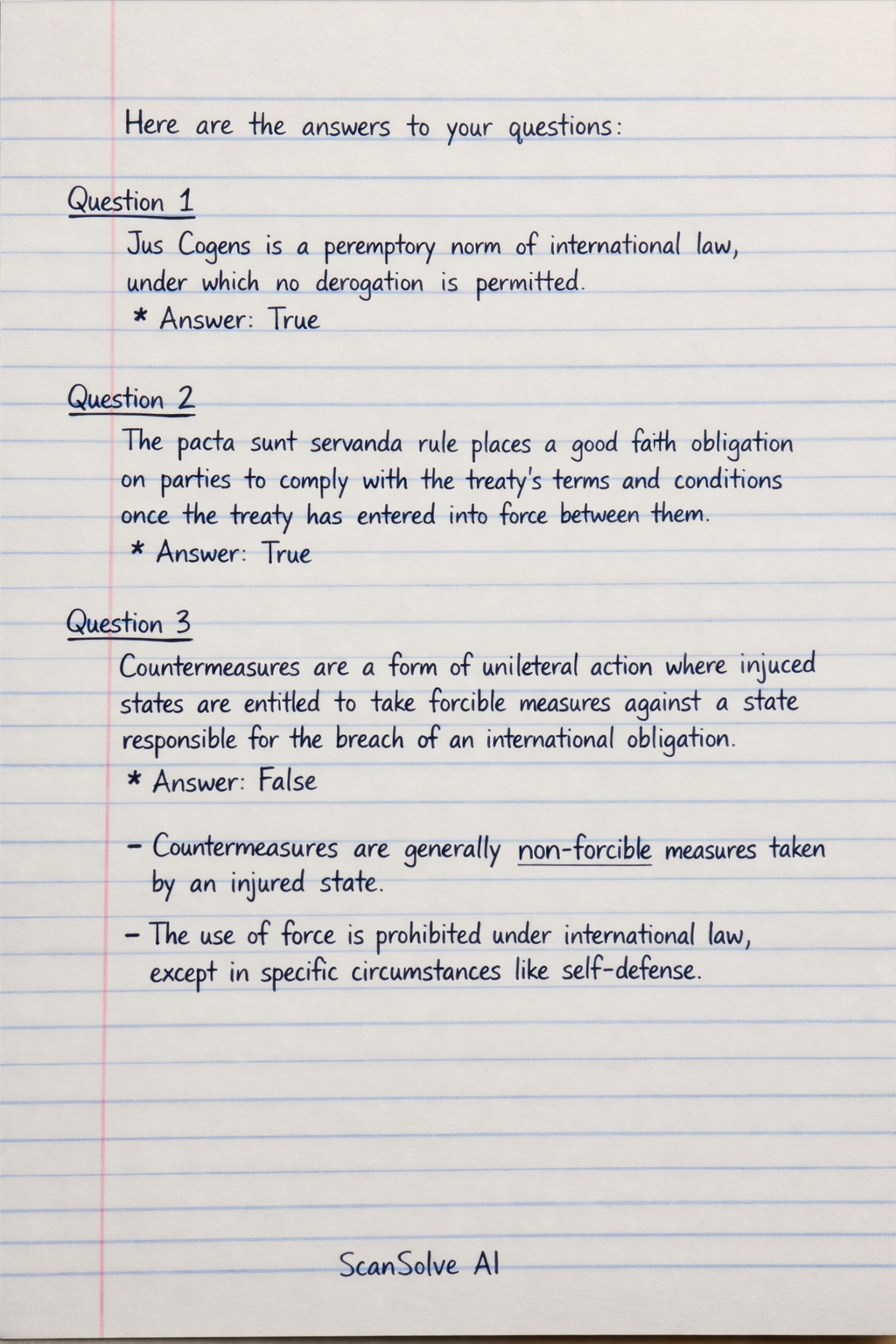
Here are the answers to your questions:
Question 1
Jus Cogens is a peremptory norm of international law, under which no derogation is permitted
- Answer: True
Question 2
The pacta sunt servanda rule places a good faith obligation on parties to comply with the treaty's terms and conditions once the treaty has entered into force between them.
- Answer: True
Question 3
Countermeasures are a form of unilateral action where injured states are entitled to take forcible measures against a state responsible for the breach of an international obligation.
- Answer: False
- Countermeasures are generally non-forcible measures taken by an injured state. The use of force is prohibited under international law, except in specific circumstances like self-defense.
Question 4
Monism means that international law must be translated into national law before it can be enforceable in a domestic court.
- Answer: False
- This statement describes dualism. Monism holds that international and national law form a single legal system, and international law is directly applicable in domestic courts.
Question 5
A reservation to a treaty may be withdrawn at any time, and the consent of a State which has accepted the reservation is required for its withdrawal.
- Answer: False
- According to Article 22 of the Vienna Convention on the Law of Treaties (VCLT), a reservation may be withdrawn at any time, and the consent of a State which has accepted the reservation is not required for its withdrawal.
Question 6
The term ‘sanctions’ in its narrow sense denotes the collective action by a state against the violator state.
- Answer: False
- "Collective action" implies action by multiple states or an international organization, not "by a state" (singular). Sanctions can be unilateral or collective, but the phrasing here is contradictory.
Question 7
In S v Banda 1989 4 SA 519 (Bop), the Court held that the constitutive theory is preferrable as it is more objective.
- Answer: False
- In S v Banda, the court preferred the declaratory theory of state recognition, finding it more objective than the constitutive theory.
Question 8
Ratification is the way in which a state that was not a party to the original treaty may become a party to a treaty.
- Answer: False
- This describes accession. Ratification is the formal act by which a state expresses its consent to be bound by a treaty it has already signed.
Question 9
An international organisation can be defined as a collectivity of States established by treaty, with a constitution and common organs, having a personality distinct from that of its member-States, and being a subject of international law with treaty-making capacity.
- Answer: True
Question 10
State jurisdiction is divided into four distinct powers or competences which are exercised by states
- Answer: False
- State jurisdiction is typically categorized into three main types: prescriptive (to prescribe laws), enforcement (to enforce laws), and adjudicative (to adjudicate disputes).
Question 11
In conciliation, a commission set up for that purpose (either permanently or on an ad hoc basis), and it assists the parties to the dispute.
- Answer: True
Question 12
The Vienna Convention on the Law of Treaties (VCLT) provides that any person who can produce appropriate full powers can conclude treaties on behalf of the state.
- Answer: True
Question 13
The Vienna Convention on the Law of Treaties (VCLT) allows states to make reservations after signing or ratifying a treaty.
- Answer: False
- Reservations are typically made at the time of signing, ratifying, accepting, approving, or acceding to a treaty, not after these acts have been completed.
Question 14
The proliferation of international organisations in modern society is part of the development and transformation of international law.
- Answer: *True
Still stuck on this one?
Ask a follow-up, and the answer starts from this question.
More Law Questions
Handwritten Step-by-Step Solution
Get this as a handwritten image on WhatsApp — like a tutor wrote it for you.
Try on WhatsApp