
We read your photo as:
The Education Act of 1961 was a landmark legislation in Ghana, enacted shortly after independence. It aimed to transform the educational system to align with the nation's post-colonial aspirations.
ScanSolve AI Answer
The Education Act of 1961 was a landmark legislation in Ghana, enacted shortly after independence. It aimed to transform the educational system to align with the nation's post-colonial aspirations.
-
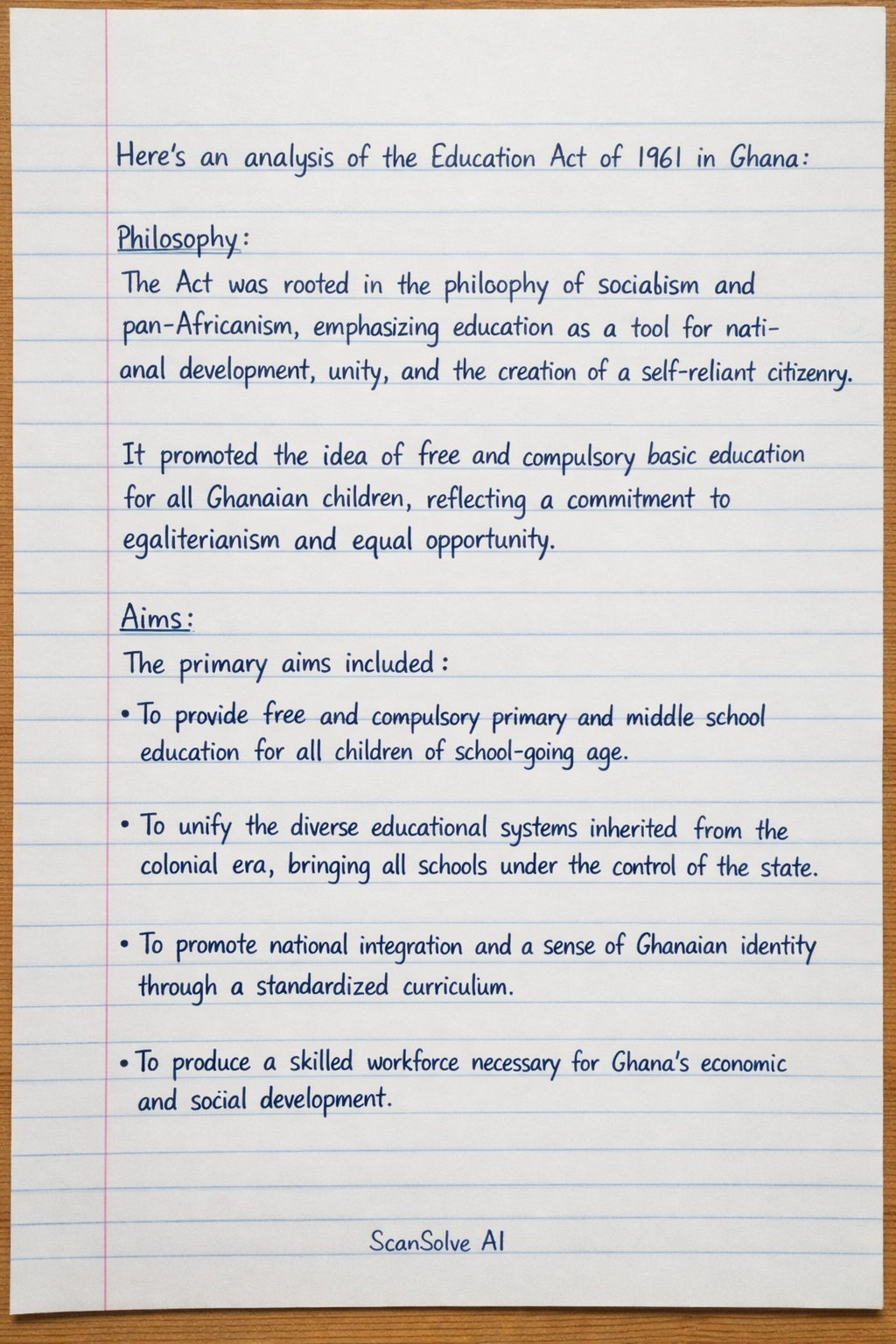
Philosophy: The Act was rooted in the philosophy of socialism and pan-Africanism, emphasizing education as a tool for national development, unity, and the creation of a self-reliant citizenry. It promoted the idea of free and compulsory basic education for all Ghanaian children, reflecting a commitment to egalitarianism and equal opportunity.
-
Aims: The primary aims included:
- To provide free and compulsory primary and middle school education for all children of school-going age.
- To unify the diverse educational systems inherited from the colonial era, bringing all schools under the control of the state.
- To promote national integration and a sense of Ghanaian identity through a standardized curriculum.
- To produce a skilled workforce necessary for Ghana's economic and social development.
-
Rationale: The Act was deemed necessary to address the inequalities and fragmentation of the colonial education system, which largely favored urban areas and mission schools. It sought to correct the imbalance in access to education, reduce illiteracy, and ensure that education served the needs of an independent Ghana rather than colonial interests. It was also a key component of President Nkrumah's broader socialist agenda.
-
Achievements:
- Significant increase in school enrollment at the primary and middle school levels, leading to a substantial rise in literacy rates.
- The establishment of a unified national education system, reducing disparities between different types of schools.
- Greater government control over education, allowing for more coordinated planning and resource allocation.
- Promotion of a national curriculum that emphasized Ghanaian history, culture, and values.
-
Challenges:
- Rapid expansion led to a strain on resources, resulting in overcrowded classrooms, inadequate facilities, and a shortage of qualified teachers.
- Maintaining quality of education became difficult amidst the rapid increase in student numbers.
- The financial burden of providing free education proved substantial for the nascent nation.
- Resistance from some religious bodies who previously managed schools, as the Act curtailed their autonomy.
- The politicization of education under the one-party state led to concerns about academic freedom and ideological indoctrination.
Still stuck on this one?
Ask a follow-up, and the answer starts from this question.
More Law Questions
Handwritten Step-by-Step Solution
Get this as a handwritten image on WhatsApp — like a tutor wrote it for you.
Try on WhatsApp