A company used rented premises during December but has not yet paid the rent at the reporting date; why does this create a liability?

Economics
A company used rented premises during December but has not yet paid the rent at the reporting date; why does this create a liability?

ScanSolve AI Answer

Answer

b. There is a present obligation resulting from past events

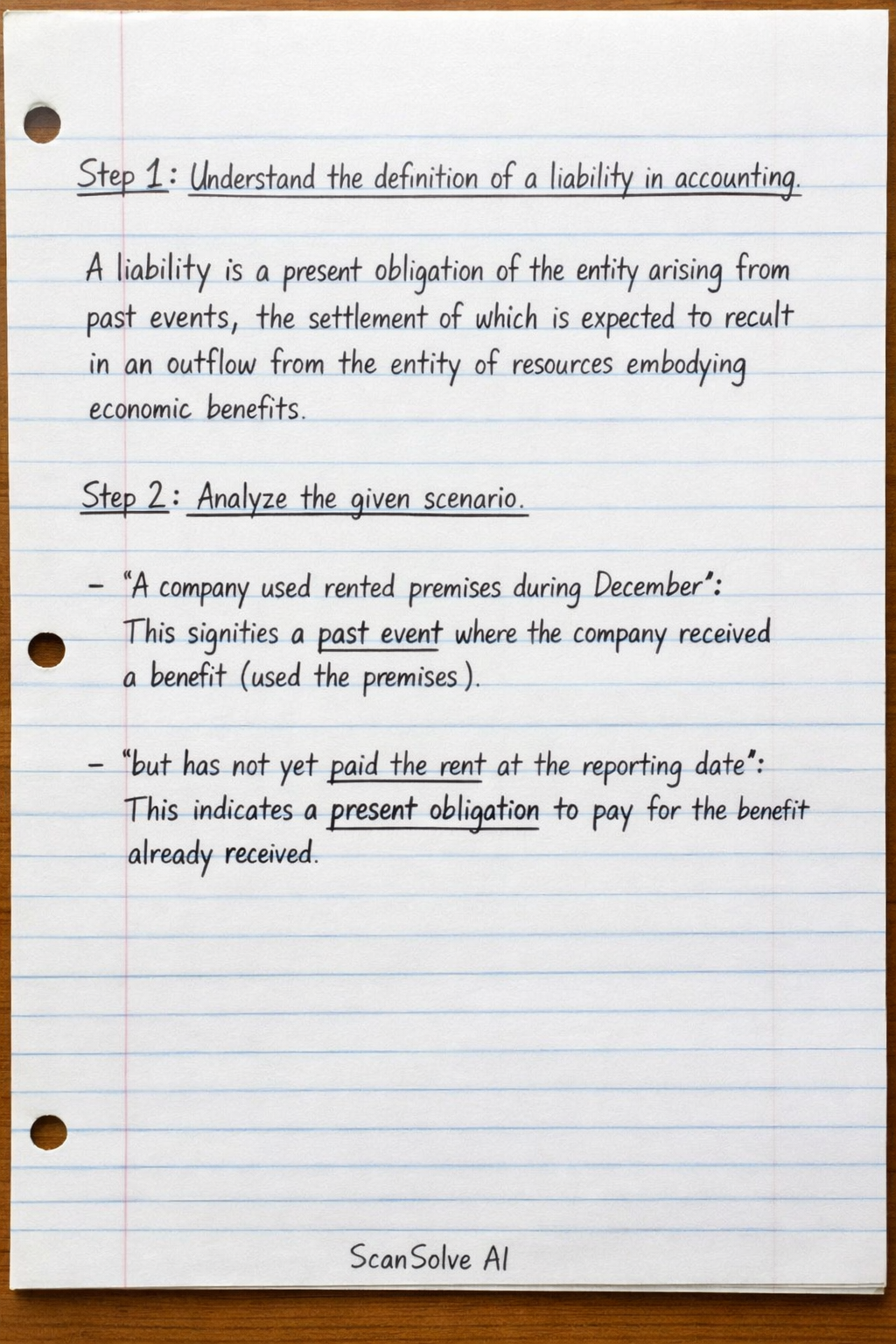
Step 1: Understand the definition of a liability in accounting.
A liability is a present obligation of the entity arising from past events, the settlement of which is expected to result in an outflow from the entity of resources embodying economic benefits.

Step 2: Analyze the given scenario.

  • "A company used rented premises during December": This signifies a past event where the company received a benefit (used the premises).
  • "but has not yet paid the rent at the reporting date": This indicates a present obligation to pay for the benefit already received.

Step 3: Evaluate the options based on the definition.

  • a. The company owns the property: Incorrect. The premises are "rented," meaning the company does not own them.
  • b. There is a present obligation resulting from past events: Correct. The past event is using the premises, and the present obligation is to pay the rent for that usage. This directly matches the definition of a liability.
  • c. None of the above: Incorrect, as option b is correct.
  • d. The payment will occur in the next financial year: This describes the timing of the payment, not the fundamental reason why the obligation exists. A liability exists as soon as the obligation arises from a past event, regardless of when it's due.
  • e. The amount is estimated: While some liabilities are estimated, rent is typically a known, fixed amount. Even if it were estimated, the estimation itself is not the reason it's a liability; the underlying obligation is.

Step 4: Conclude the correct option.
The core reason this creates a liability is the existence of a present obligation due to a past event.

\text{b. There is a present obligation resulting from past events}

Was this helpful?

Need help with your own homework?

Get instant step-by-step solutions to any question. Free to start.

Ask Your Question
Handwritten step-by-step solution preview

Handwritten Step-by-Step Solution

Get this as a handwritten image on WhatsApp — like a tutor wrote it for you.

Try on WhatsApp

Still have questions?

Quick Answer

Understand the definition of a liability in accounting. A liability is a present obligation of the entity arising from past events, the settlement of which is expected to result in an outflow from the entity of resources embodying economic benefits.

A company used rented premises during December but has not yet paid the rent at the reporting date; why does this create a liability?
Economics

This economics question tests your understanding of economic models and analysis. The step-by-step answer below applies the relevant framework and explains the reasoning.

ScanSolve AI Answer
Step 1: Understand the definition of a liability in accounting. A liability is a present obligation of the entity arising from past events, the settlement of which is expected to result in an outflow from the entity of resources embodying economic benefits. Step 2: Analyze the given scenario. "A company used rented premises during December": This signifies a past event where the company received a benefit (used the premises). "but has not yet paid the rent at the reporting date": This indicates a present obligation to pay for the benefit already received. Step 3: Evaluate the options based on the definition. a. The company owns the property: Incorrect. The premises are "rented," meaning the company does not own them. b. There is a present obligation resulting from past events: Correct. The past event is using the premises, and the present obligation is to pay the rent for that usage. This directly matches the definition of a liability. c. None of the above: Incorrect, as option b is correct. d. The payment will occur in the next financial year: This describes the timing of the payment, not the fundamental reason why the obligation exists. A liability exists as soon as the obligation arises from a past event, regardless of when it's due. e. The amount is estimated: While some liabilities are estimated, rent is typically a known, fixed amount. Even if it were estimated, the estimation itself is not the reason it's a liability; the underlying obligation is. Step 4: Conclude the correct option. The core reason this creates a liability is the existence of a present obligation due to a past event. b. There is a present obligation resulting from past events