
![1. Calculate the length of OP. 1.1.2. Determine the value of cosec2 0 + 1. 1.2. Without the use calculator, determine the value of sin 60°. tan 30° / sec 45°. 1.3. Solve for x, correct to one decimal place xe [0°; 90°] tan 2x = 1.19](/_next/image?url=https%3A%2F%2Fohijasnjvprzodcmxltt.supabase.co%2Fstorage%2Fv1%2Fobject%2Fpublic%2Fwhatsapp-images%2F1781844607694-fd3cb0ace892dcc7.png&w=3840&q=75)
This mathematics problem involves applying core mathematical principles and formulas. Below you will find a complete step-by-step solution with detailed explanations for each step, helping you understand not just the answer but the method behind it.
ScanSolve AI Answer
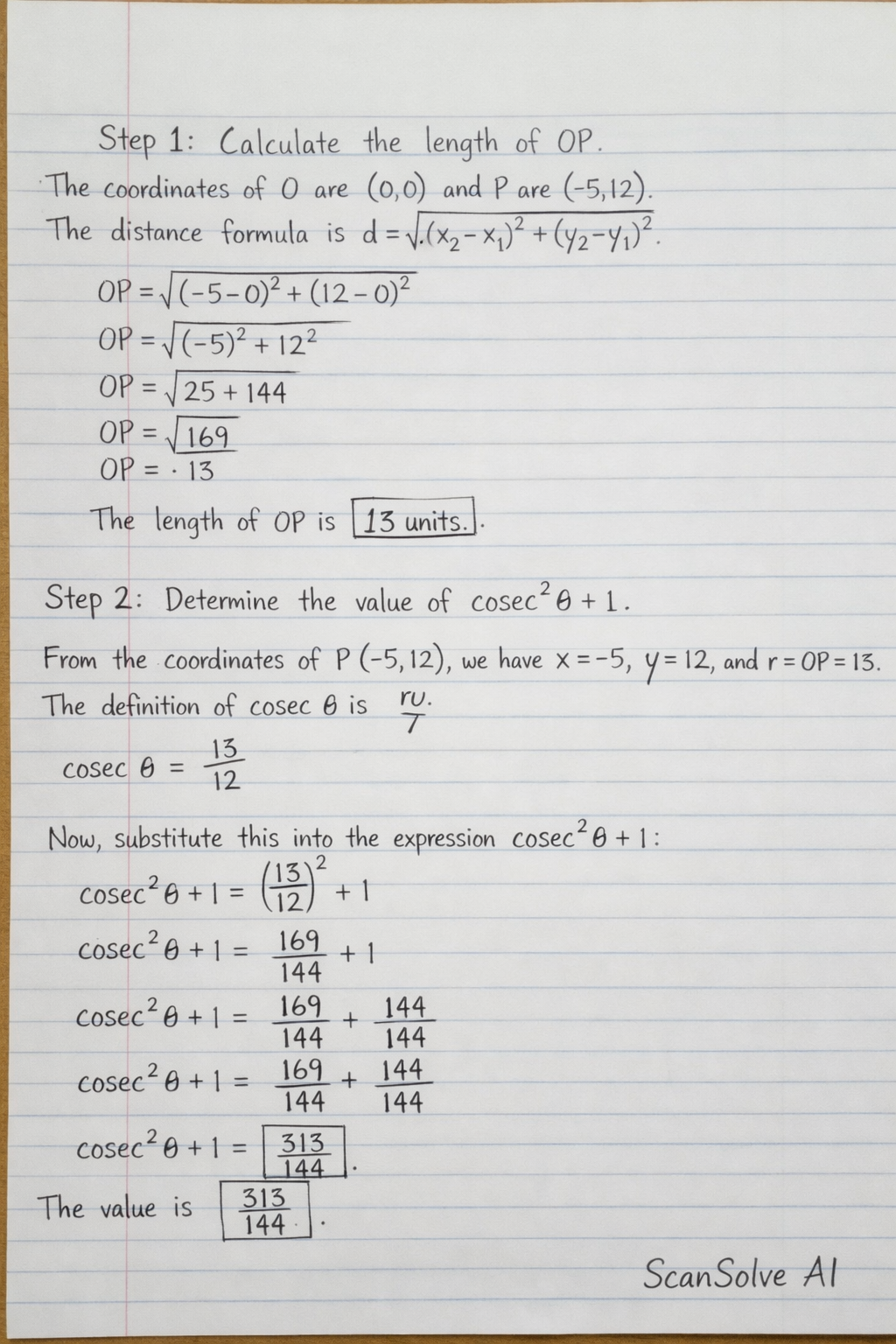
Step 1: Calculate the length of OP. The coordinates of O are (0,0) and P are (-5,12). The distance formula is d = sqrt((x_2-x_1)^2 + (y_2-y_1)^2). OP = sqrt((-5-0)^2 + (12-0)^2) OP = sqrt((-5)^2 + (12)^2) OP = sqrt(25 + 144) OP = sqrt(169) OP = 13 The length of OP is 13 units. Step 2: Determine the value of cosec^2 + 1. From the coordinates of P (-5,12), we have x = -5, y = 12, and r = OP = 13. The definition of cosec is (r)/(y). cosec = (13)/(12) Now, substitute this into the expression cosec^2 + 1: cosec^2 + 1 = ((13)/(12))^2 + 1 cosec^2 + 1 = (169)/(144) + 1 cosec^2 + 1 = (169)/(144) + (144)/(144) cosec^2 + 1 = (169 + 144)/(144) cosec^2 + 1 = (313)/(144) The value is (313)/(144). Step 3: Determine the value of ( 60^ · 30^)/( 45^) without a calculator. Recall the exact trigonometric values: 60^ = sqrt(3)2 30^ = (1)/(sqrt(3)) 45^ = (1)/( 45^) = (1)/(1/sqrt(2)) = sqrt(2) Substitute these values into the expression: ( 60^ · 30^)/( 45^) = (sqrt(3)2) · ((1)/(sqrt(3)))sqrt(2) Simplify the numerator: = sqrt(3)2sqrt(3)sqrt(2) = (1)/(2)sqrt(2) = (1)/(2sqrt(2)) To rationalize the denominator, multiply the numerator and denominator by sqrt(2): = (1)/(2sqrt(2)) · sqrt(2)sqrt(2) = sqrt(2)2 · 2 = sqrt(2)4 The value is sqrt(2)4. Step 4: Solve for x, correct to one decimal place, for 2x = 1.19 where x [0^; 90^]. Given the equation: 2x = 1.19 To find 2x, take the inverse tangent of both sides: 2x = (1.19) Using a calculator for (1.19): 2x ≈ 49.96^ Now, solve for x: x = (49.96^)/(2) x ≈ 24.98^ Rounding to one decimal place: x ≈ 25.0^ This value is within the given range x [0^; 90^]. The value of x is 25.0^.