
We read your photo as:
1 Between which two integers does sqrt(11) lie? Classify the following numbers: -1.5252... and sqrt(-25) and write 0.7 as a common fraction.
ScanSolve AI Answer
Step-by-step solution
25 stepsHere are the solutions to your questions:
QUESTION 1
1.1 To find between which two integers lies, we find the perfect squares closest to 11.
Identify perfect squares around 11.
Place between the square roots of these perfect squares.
Thus, lies between the integers 3 and 4.
1.2 We classify the numbers using the given symbols: N (Natural numbers), Q (Rational numbers), Q' (Irrational numbers), Z (Integers), R (Real numbers). We will assume R' refers to non-real numbers in this context.
1.2.1
This is a repeating decimal, which can be expressed as a fraction.
Therefore, it is a Rational number (Q) and also a Real number (R).1.2.2
The square root of a negative number is an imaginary number. Imaginary numbers are not real numbers.
Therefore, is a non-real number (R').1.3 To write 0,7 as a common fraction, we assume 0,7 means (0.7 repeating).
Let be the repeating decimal.
Multiply by 10 to shift the decimal.
Subtract the first equation from the second.
Solve for .
QUESTION 2
2.1 Simplify the following:
2.1.1
Distribute each term from the first parenthesis to the second.
Multiply the terms.
Combine like terms.
2.1.2
Factor out the lowest power of 3 from the numerator and denominator.
Numerator:
Denominator:Simplify the terms in the parentheses.
Numerator:
Denominator:Rewrite the fraction and simplify using exponent rules ().
Evaluate .
2.2 Factorize the following expressions fully:
2.2.1
Find two numbers that multiply to and add to .
These numbers are and 3.
Rewrite the middle term using these numbers.
Factor by grouping.
Factor out the common binomial factor .
2.2.2
Recognize the first three terms as a perfect square trinomial.
Recognize the expression as a difference of squares, , where and .
Apply the difference of squares formula.
2.3 Solve the following equations simultaneously for and :
Equation 1:
Equation 2:From Equation 1, express in terms of .
Substitute Equation 3 into Equation 2.
Distribute and solve for .
Substitute the value of back into Equation 3 to find .
State the solution.
Still stuck on this one?
Ask a follow-up, and the answer starts from this question.
More Mathematics Questions
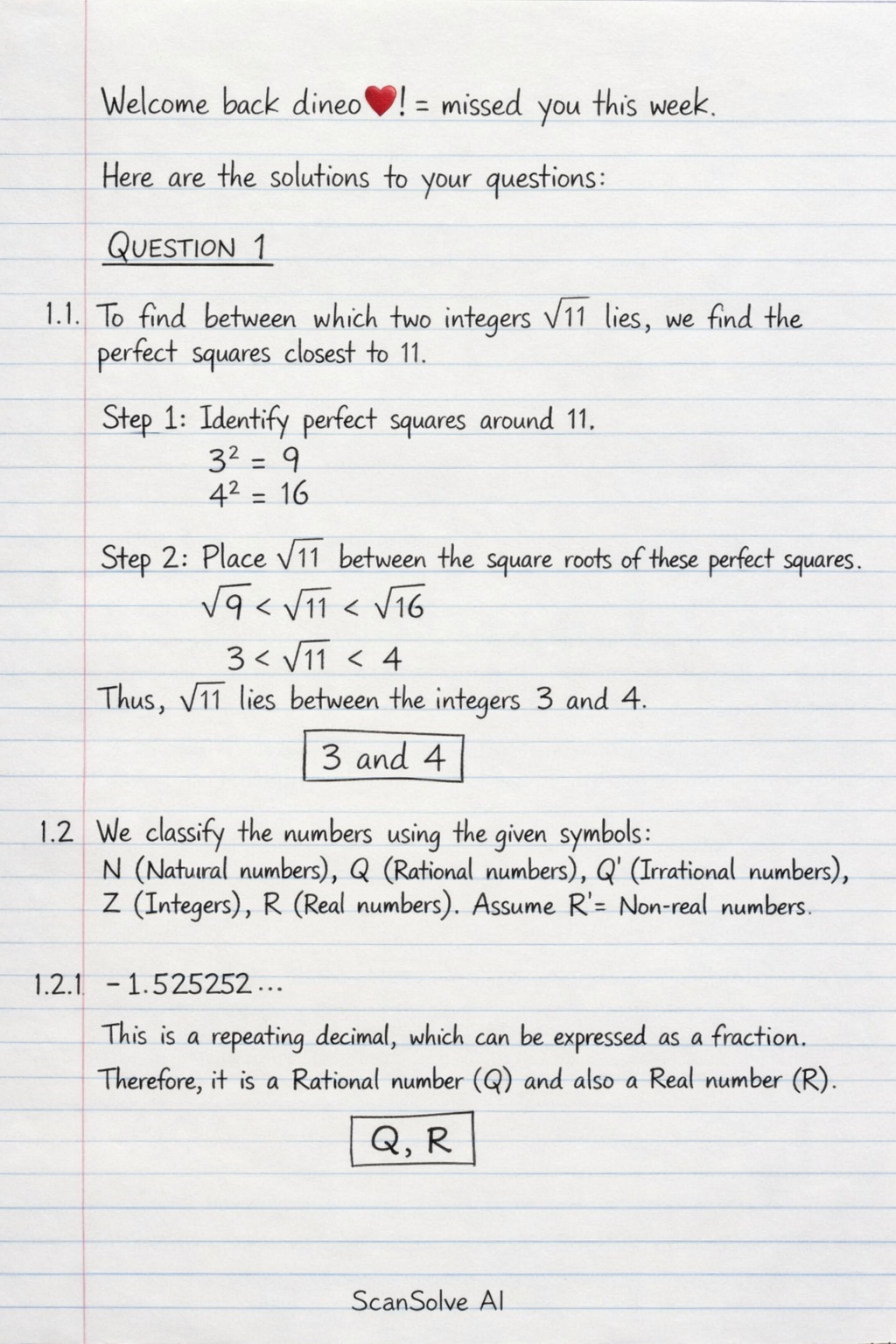
Handwritten Step-by-Step Solution
Get this as a handwritten image on WhatsApp — like a tutor wrote it for you.
Try on WhatsApp