
We read your photo as:
1 Determine the co-ordinate of M the midpoint of line RT. 3.2 Calculate the gradient of the line WT. 3.3 Prove that RW is perpendicular to WT.
ScanSolve AI Answer
Answers
3 partsStep-by-step solution
9 stepsHere are the solutions to Question 3:
Part 3.1· 2 steps
Determine the co-ordinate of M the midpoint of line RT.
To find the midpoint M of a line segment with endpoints and , we use the formula:
Given R() and T().
Substitute the coordinates of R and T into the midpoint formula.
Calculate the coordinates of M.
The coordinates of M are .
Part 3.2
Calculate the gradient of the line WT.
To calculate the gradient of a line passing through two points and , we use the formula:
Given W() and T().
Substitute the coordinates of W and T into the gradient formula.
Simplify the expression to find the gradient.
The gradient of line WT is .
Part 3.3· 2 steps
Prove that RW is perpendicular to WT.
For two lines to be perpendicular, the product of their gradients must be . We already have . Now we need to calculate the gradient of RW.
Given R() and W().
Calculate the gradient of RW.
Multiply the gradients of RW and WT.
Since the product of their gradients is , RW is indeed perpendicular to WT.
Part 3.4
If RWTK is a parallelogram, determine the values of a and b.
In a parallelogram, the diagonals bisect each other, meaning they share a common midpoint. The diagonals of RWTK are RT and WK. We already found the midpoint of RT in 3.1 as .
Now we find the midpoint of WK using W() and K().
Set up the midpoint formula for WK.
Equate the x-coordinates of and .
Equate the y-coordinates of and .
The values are and .
Try one yourself
A new problem that tests the same skill.
Still stuck on this one?
Ask a follow-up, and the answer starts from this question.
More Mathematics Questions
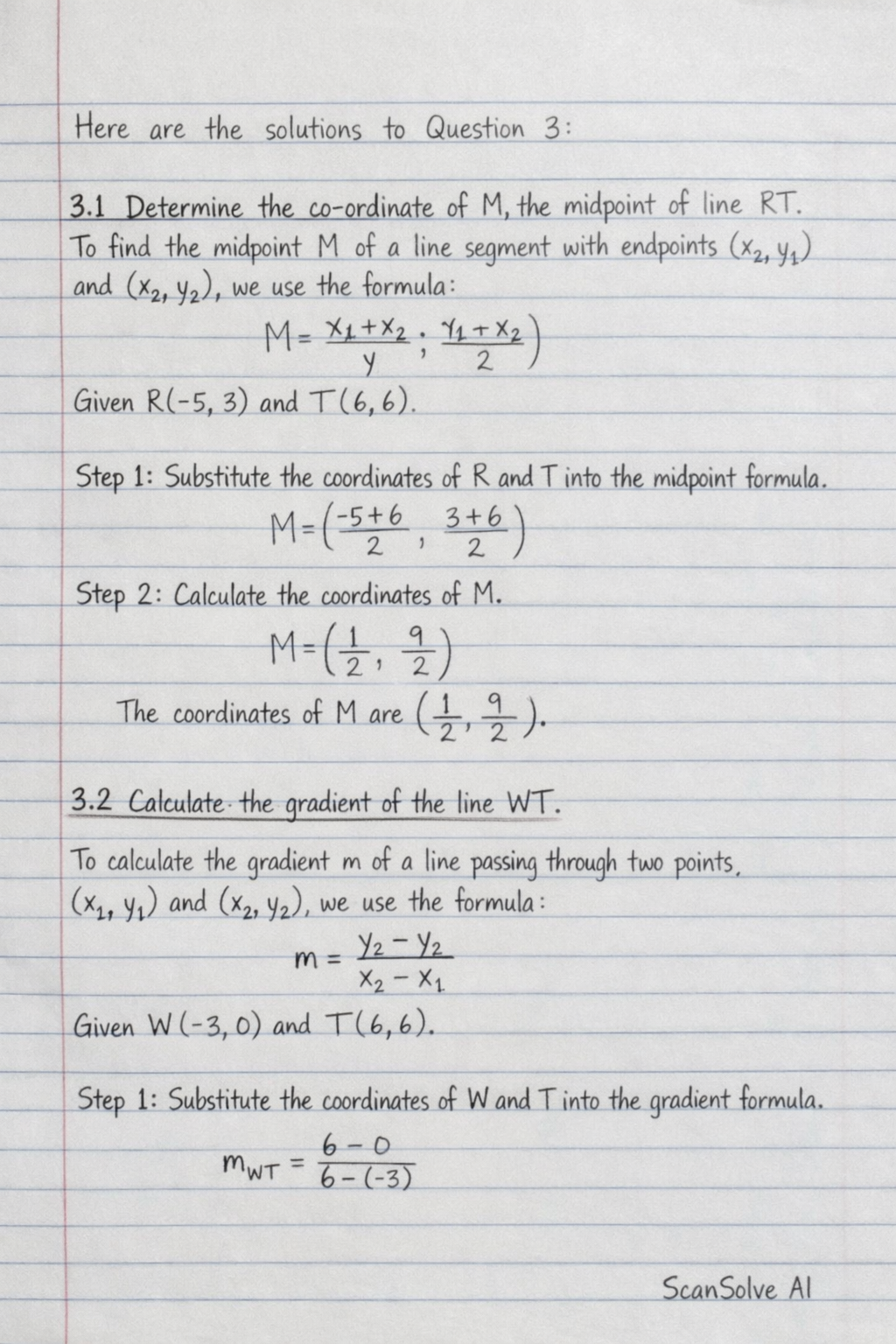
Handwritten Step-by-Step Solution
Get this as a handwritten image on WhatsApp — like a tutor wrote it for you.
Try on WhatsApp