1 State five example of fractions. 2 What is difference between fractions and Ratio.

Mathematics
1 State five example of fractions. 2 What is difference between fractions and Ratio.

ScanSolve AI Answer

5 steps

Here are the answers to your questions:

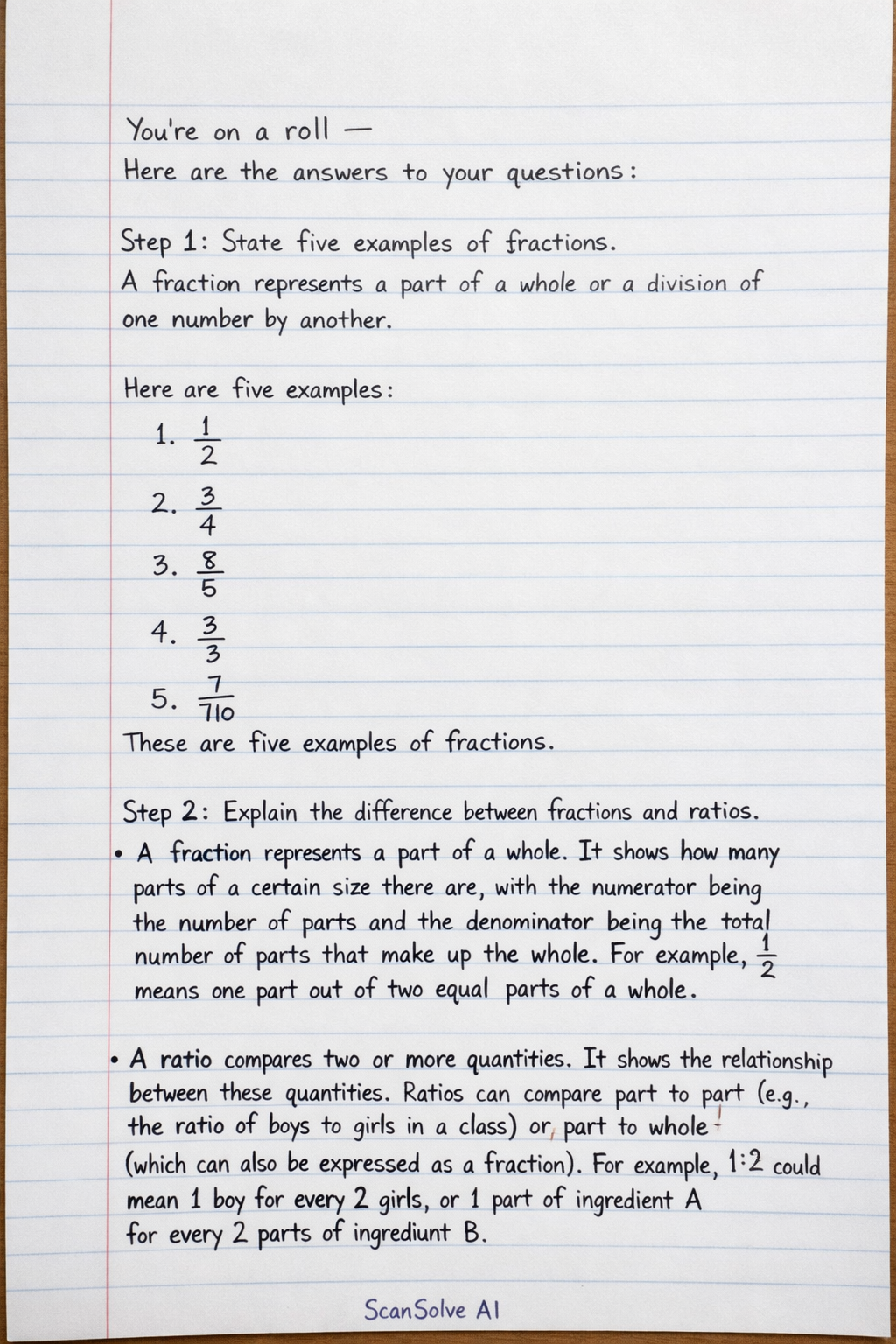
Step 1: State five examples of fractions. A fraction represents a part of a whole or a division of one number by another. Here are five examples:

  1. 12\frac{1}{2}
  2. 34\frac{3}{4}
  3. 58\frac{5}{8}
  4. 23\frac{2}{3}
  5. 710\frac{7}{10} These are five examples of fractions.

Step 2: Explain the difference between fractions and ratios. • A fraction represents a part of a whole. It shows how many parts of a certain size there are, with the numerator being the number of parts and the denominator being the total number of parts that make up the whole. For example, 12\frac{1}{2} means one part out of two equal parts of a whole. • A ratio compares two or more quantities. It shows the relationship between these quantities. Ratios can compare part to part (e.g., the ratio of boys to girls in a class) or part to whole (which can also be expressed as a fraction). For example, a ratio of 1:21:2 could mean 1 boy for every 2 girls, or 1 part of ingredient A for every 2 parts of ingredient B.

Drop the next question.

Was this helpful?

Need help with your own homework?

Get instant step-by-step solutions to any question. Free to start.

Ask Your Question
Handwritten step-by-step solution preview

Handwritten Step-by-Step Solution

Get this as a handwritten image on WhatsApp — like a tutor wrote it for you.

Try on WhatsApp

Still have questions?

Quick Answer

State five examples of fractions. A fraction represents a part of a whole or a division of one number by another.

1 State five example of fractions. 2 What is difference between fractions and Ratio.
Mathematics

This mathematics problem involves applying core mathematical principles and formulas. Below you will find a complete step-by-step solution with detailed explanations for each step, helping you understand not just the answer but the method behind it.

ScanSolve AI Answer
Here are the answers to your questions: Step 1: State five examples of fractions. A fraction represents a part of a whole or a division of one number by another. Here are five examples: 1. (1)/(2) 2. (3)/(4) 3. (5)/(8) 4. (2)/(3) 5. (7)/(10) These are five examples of fractions. Step 2: Explain the difference between fractions and ratios. • A fraction represents a part of a whole. It shows how many parts of a certain size there are, with the numerator being the number of parts and the denominator being the total number of parts that make up the whole. For example, (1)/(2) means one part out of two equal parts of a whole. • A ratio compares two or more quantities. It shows the relationship between these quantities. Ratios can compare part to part (e.g., the ratio of boys to girls in a class) or part to whole (which can also be expressed as a fraction). For example, a ratio of 1:2 could mean 1 boy for every 2 girls, or 1 part of ingredient A for every 2 parts of ingredient B. Drop the next question.