

This mathematics problem involves applying core mathematical principles and formulas. Below you will find a complete step-by-step solution with detailed explanations for each step, helping you understand not just the answer but the method behind it.
ScanSolve AI Answer
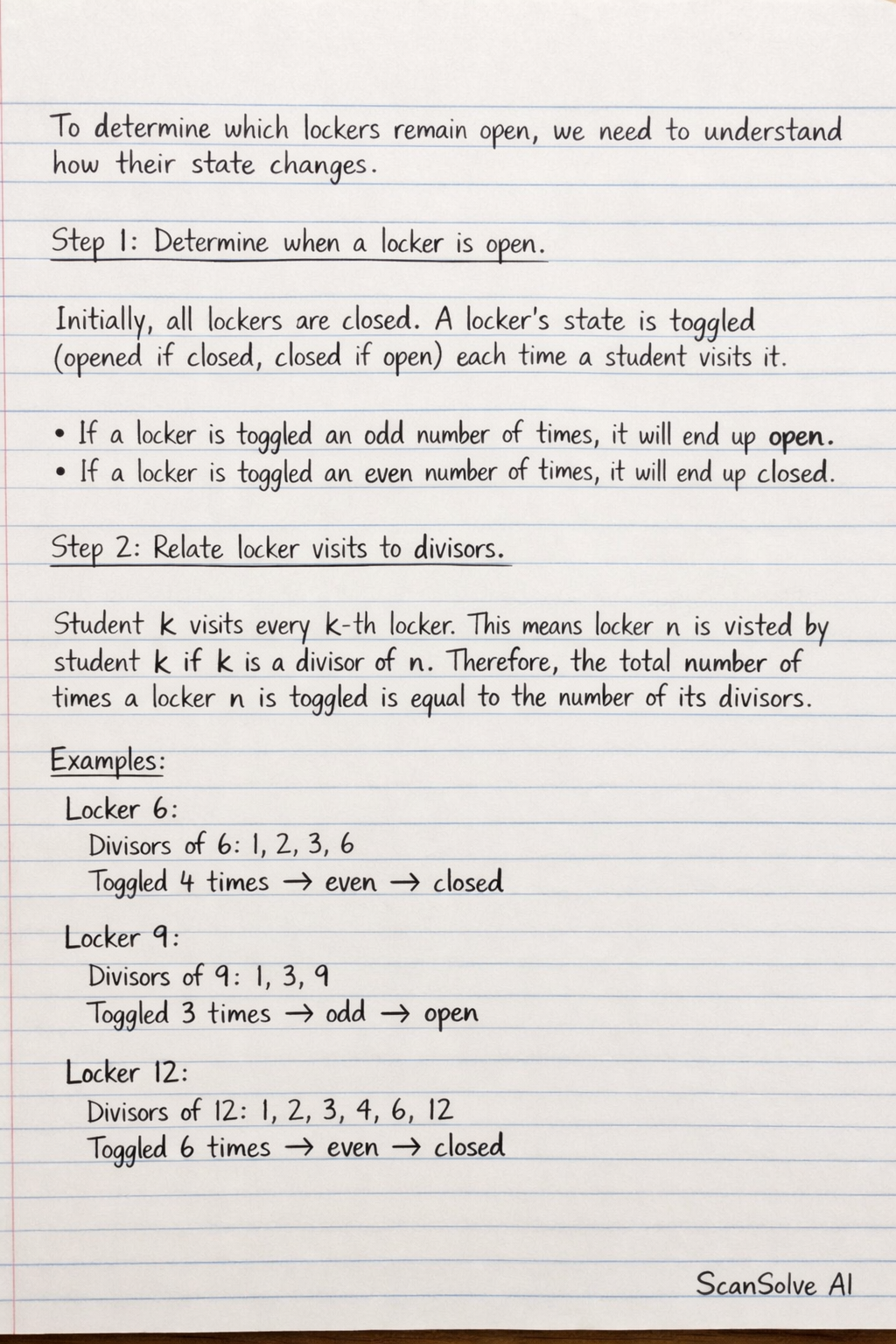
To determine which lockers remain open, we need to understand how their state changes. Step 1: Determine when a locker is open. Initially, all lockers are closed. A locker's state is toggled (opened if closed, closed if open) each time a student visits it. • If a locker is toggled an odd number of times, it will end up open. • If a locker is toggled an even number of times, it will end up closed. Step 2: Relate locker visits to divisors. Student k visits every k-th locker. This means locker n is visited by student k if k is a divisor of n. Therefore, the total number of times a locker n is toggled is equal to the number of its divisors. Step 3: Identify numbers with an odd number of divisors. A number has an odd number of divisors if and only if it is a perfect square. This is because divisors usually come in pairs (d, n/d). If n is not a perfect square, all its divisors can be paired up, resulting in an even number of divisors. If n is a perfect square, say n = m^2, then m is a divisor that is paired with itself, making the total count of divisors odd. Step 4: List the perfect squares between 1 and 100. The lockers that will remain open are those whose numbers are perfect squares between 1 and 100. • 1^2 = 1 • 2^2 = 4 • 3^2 = 9 • 4^2 = 16 • 5^2 = 25 • 6^2 = 36 • 7^2 = 49 • 8^2 = 64 • 9^2 = 81 • 10^2 = 100 The lockers that will be open at the end are: 1, 4, 9, 16, 25, 36, 49, 64, 81, 100 Send me the next one 📸