

This mathematics problem involves applying core mathematical principles and formulas. Below you will find a complete step-by-step solution with detailed explanations for each step, helping you understand not just the answer but the method behind it.
ScanSolve AI Answer
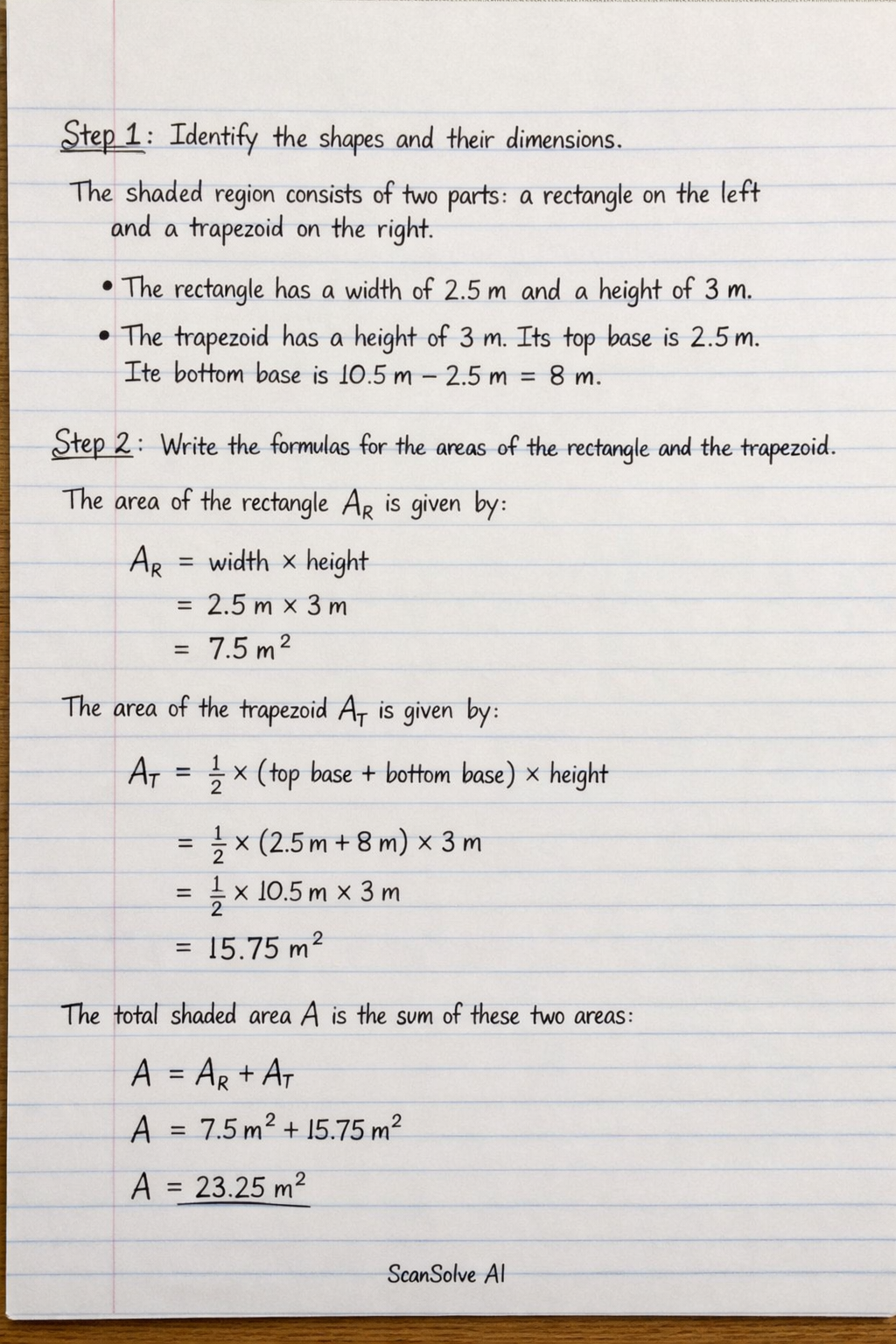
Step 1: Identify the shapes and their dimensions. The shaded region consists of two parts: a rectangle on the left and a trapezoid on the right. • The rectangle has a width of 2.5 m and a height of 3 m. • The trapezoid has a height of 3 m. Its top base is 2.5 m. Its bottom base is the total bottom length minus the rectangle's width: 10.5 m - 2.5 m = 8 m. Step 2: Write the formulas for the areas of the rectangle and the trapezoid. The area of the rectangle A_R is given by: A_R = width × height The area of the trapezoid A_T is given by: A_T = (1)/(2) × (top base + bottom base) × height The total shaded area A is the sum of these two areas: A = A_R + A_T Step 3: Substitute the dimensions and apply the distributive property. Substitute the dimensions into the area formulas: A = (2.5 m × 3 m) + ((1)/(2) × (2.5 m + 8 m) × 3 m) Notice that the height, 3 m, is a common factor in both terms. We can factor it out using the distributive property: A = 3 m × (2.5 m + (1)/(2) × (2.5 m + 8 m)) A = 3 m × (2.5 m + (1)/(2) × (10.5 m)) A = 3 m × (2.5 m + 5.25 m) A = 3 m × (7.75 m) Step 4: Calculate the final area. A = 23.25 m^2 The area of the shaded portion is 23.25 m^2. Send me the next one 📸