
We read your photo as:
2.1 Calculate the total expenses for printing 100 and 200 brochures. 1.2.2 Derive the formula for total expenses. 1.2.3 Calculate total income for 100 and 200 brochures. 1.2.4 Plot income and expenses
ScanSolve AI Answer
Step-by-step solution
6 stepsAnswer question 1.2.1.
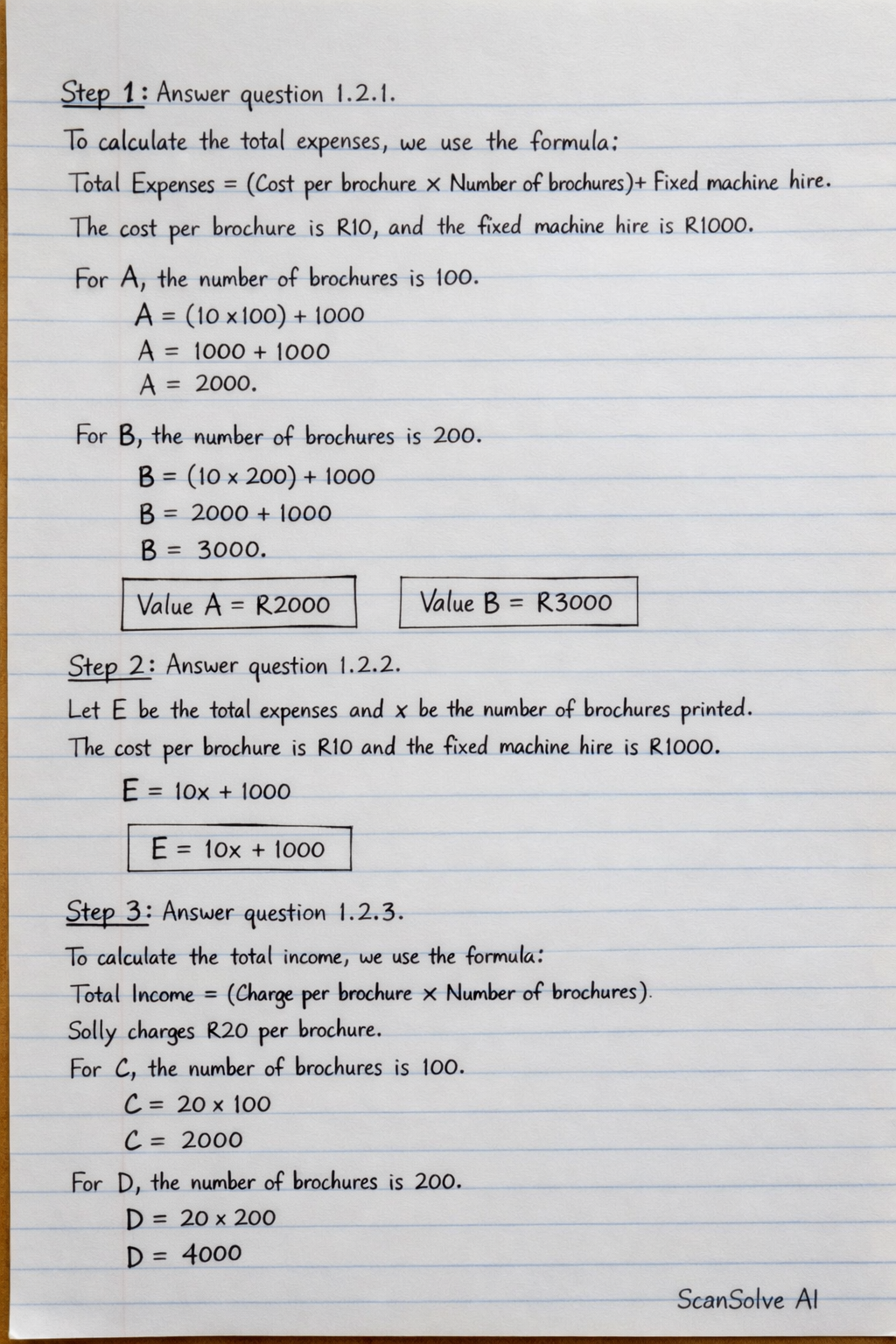
To calculate the total expenses, we use the formula: Total Expenses = (Cost per brochure Number of brochures) + Fixed machine hire.
The cost per brochure is R10, and the fixed machine hire is R1000.For A, the number of brochures is 100.
For B, the number of brochures is 200.
Answer question 1.2.2.
Let be the total expenses and be the number of brochures printed.
The cost per brochure is R10 and the fixed machine hire is R1000.Answer question 1.2.3.
To calculate the total income, we use the formula: Total Income = (Charge per brochure Number of brochures).
Solly charges R20 per brochure.For C, the number of brochures is 100.
For D, the number of brochures is 200.
Answer question 1.2.4.
This question requires drawing a graph. I will provide the points for the income graph.
The points for Solly's income are:- (0 brochures, R0 income)
- (100 brochures, R2000 income)
- (200 brochures, R4000 income) Plot these points and draw a line through them on the same axes as the expenses graph.
Answer question 1.2.5.
Solly's monthly expenses are equal to his monthly income when:
Using the formulas from Step 2 and Step 3 (where income is ):
Subtract from both sides:
Divide by 10:
Solly's monthly expenses are equal to his monthly income when 100 brochures are printed.
Answer question 1.2.6.
Calculate the profit for 160 brochures using the formula: Profit = Income - Expenses.
First, calculate the Income for 160 brochures:
Next, calculate the Expenses for 160 brochures:
Finally, calculate the Profit:
Still stuck on this one?
Ask a follow-up, and the answer starts from this question.
More Mathematics Questions
Handwritten Step-by-Step Solution
Get this as a handwritten image on WhatsApp — like a tutor wrote it for you.
Try on WhatsApp