

This mathematics problem involves applying core mathematical principles and formulas. Below you will find a complete step-by-step solution with detailed explanations for each step, helping you understand not just the answer but the method behind it.
ScanSolve AI Answer
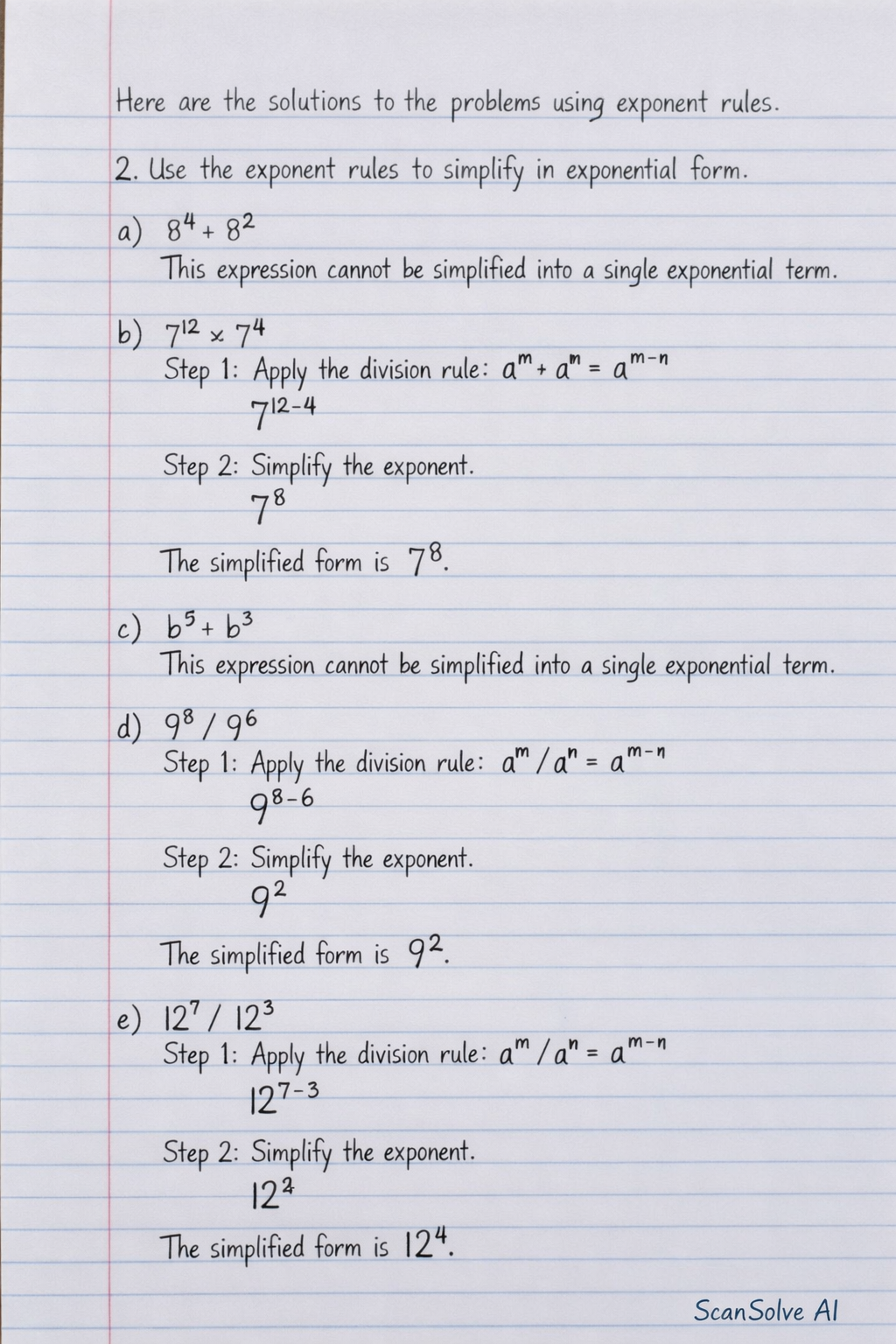
Here are the solutions to the problems using exponent rules. 2. Use the exponent rules to simplify in exponential form. a)* 8^4 + 8^2 This expression cannot be simplified into a single exponential term using exponent rules because it is an addition of terms with different exponents. b)* 7^12 ÷ 7^4 Step 1: Apply the division rule for exponents, a^m ÷ a^n = a^m-n. 7^12-4 Step 2: Simplify the exponent. 7^8 The simplified form is 7^8. c)* b^5 + b^3 This expression cannot be simplified into a single exponential term using exponent rules because it is an addition of terms with different exponents. d)* 9^8 / 9^6 Step 1: Apply the division rule for exponents, a^m / a^n = a^m-n. 9^8-6 Step 2: Simplify the exponent. 9^2 The simplified form is 9^2. e)* 12^7 / 12^3 Step 1: Apply the division rule for exponents, a^m / a^n = a^m-n. 12^7-3 Step 2: Simplify the exponent. 12^4 The simplified form is 12^4. f)* y^8 / y^4 Step 1: Apply the division rule for exponents, a^m / a^n = a^m-n. y^8-4 Step 2: Simplify the exponent. y^4 The simplified form is y^4. 3. Use the exponent rules to simplify these, and leave your answer in exponential form. a)* (8^6)^2 Step 1: Apply the power of a power rule, (a^m)^n = a^m × n. 8^6 × 2 Step 2: Simplify the exponent. 8^12 The simplified form is 8^12. b)* (9^12)^4 Step 1: Apply the power of a power rule, (a^m)^n = a^m × n. 9^12 × 4 Step 2: Simplify the exponent. 9^48 The simplified form is 9^48. c)* (a^5)^3 Step 1: Apply the power of a power rule, (a^m)^n = a^m × n. a^5 × 3 Step 2: Simplify the exponent. a^15 The simplified form is a^15. d)* (p^2)^2 Step 1: Apply the power of a power rule, (a^m)^n = a^m × n. p^2 × 2 Step 2: Simplify the exponent. p^4 The simplified form is p^4. e)* 2(a^10)^3 Step 1: Apply the power of a power rule to (a^10)^3. 2 × a^10 × 3 Step 2: Simplify the exponent. 2a^30 The simplified form is 2a^30. f)* 3^2(y^4)^3 Step 1: Apply the power of a power rule to (y^4)^3. 3^2 × y^4 × 3 Step 2: Simplify the exponent. 3^2 y^12 Step 3: Calculate 3^2. 9y^12 The simplified form is 9y^12. 4. Determine these values. a)* (-4)^3 + (3^2)^3 Step 1: Calculate (-4)^3. (-4)^3 = -4 × -4 × -4 = -64 Step 2: Calculate (3^2)^3. (3^2)^3 = (9)^3 = 9 × 9 × 9 = 729 Step 3: Add the results. -64 + 729 = 665 The value is 665. b)* 3^4 ÷ 3^3 + sqrt(8) Step 1: Simplify 3^4 ÷ 3^3 using the division rule for exponents. 3^4-3 = 3^1 = 3 Step 2: Simplify sqrt(8). sqrt(8) = sqrt(4 × 2) = sqrt(4) × sqrt(2) = 2sqrt(2) Step 3: Add the results. 3 + 2sqrt(2) The value is 3 + 2sqrt(2). c)* 4^2 + 4^1 + 4^0 Step 1: Calculate each term. 4^2 = 16 4^1 = 4 4^0 = 1 Step 2: Add the results. 16 + 4 + 1 = 21 The value is 21. d)* 3^10 ÷ 3^5 ÷ 3^2 Step 1: Apply the division rule for exponents from left to right. 3^10-5-2 Step 2: Simplify the exponent. 3^5-2 = 3^3 Step 3: Calculate 3^3. 3^3 = 3 × 3 × 3 = 27 The value is 27. e)* 10^2 × 10^1 × 10^0 - 10^3 Step 1: Simplify 10^2 × 10^1 × 10^0 using the multiplication rule for exponents, a^m × a^n = a^m+n. 10^2+1+0 = 10^3 Step 2: Subtract 10^3. 10^3 - 10^3 = 0 The value is 0. f)* $3a^2 \