
We read your photo as:
Find the 21st term of the A.P. – 4, – 1.5, 1, 3.5,...
ScanSolve AI Answer
Answer
46
Step-by-step solution
55 stepsHere are the solutions to questions 14 to 30:
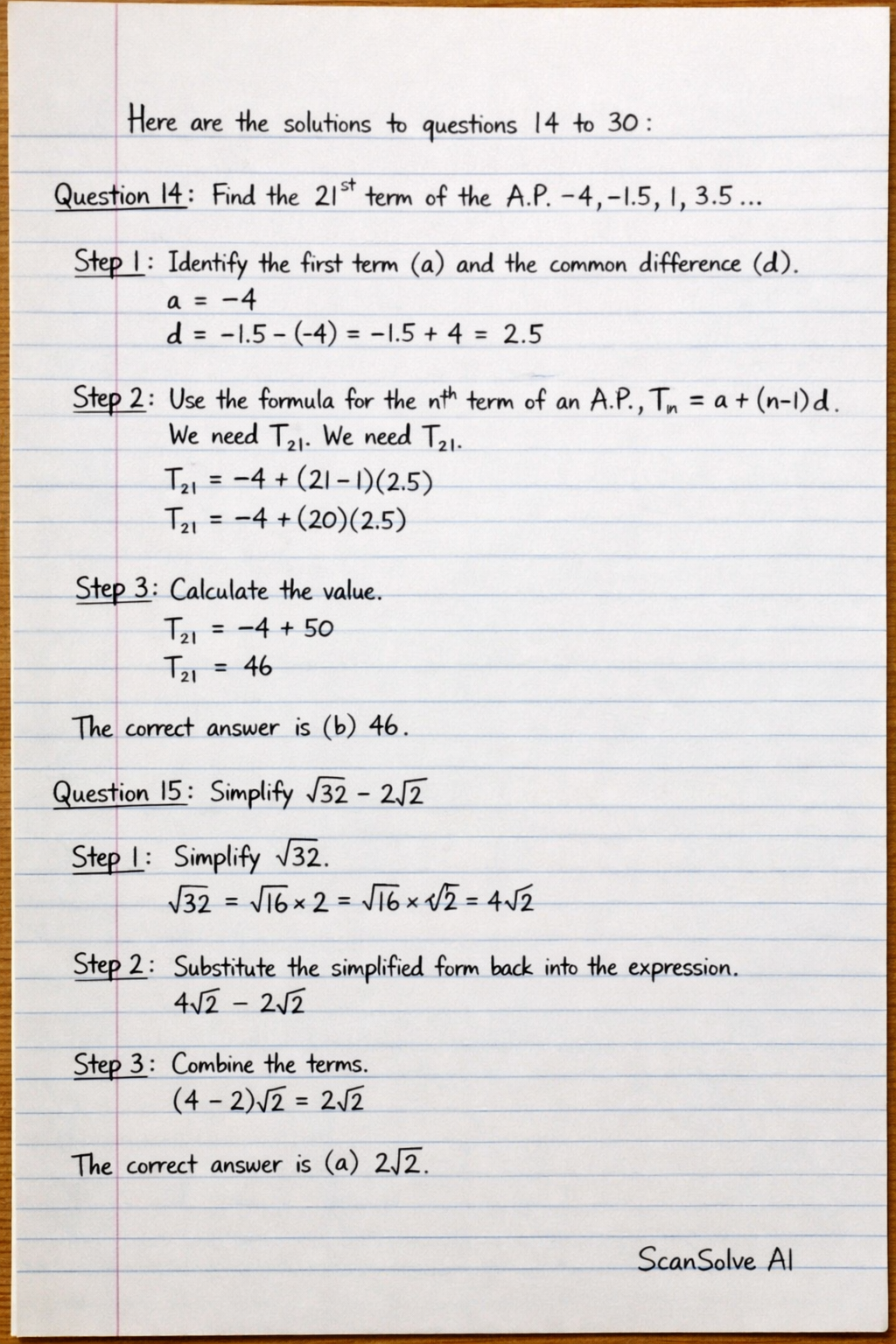
Part 14· 3 steps
Find the term of the A.P -4, -1.5, 1, 3.5 ...
Identify the first term () and the common difference ().
$$ a = -4 $$ $$ d = -1.5 - (-4) = -1.5 + 4 = 2.5 $$Use the formula for the term of an A.P., .
We need .
Calculate the value.
$$ T_{21} = -4 + 50 $$ $$ T_{21} = 46 $$- The correct answer is (b) 46.
Part 15· 3 steps
Simplify
Simplify .
$$ \sqrt{32} = \sqrt{16 \times 2} = \sqrt{16} \times \sqrt{2} = 4\sqrt{2} $$Substitute the simplified form back into the expression.
$$ 4\sqrt{2} - 2\sqrt{2} $$Combine the terms.
$$ (4-2)\sqrt{2} = 2\sqrt{2} $$- The correct answer is (a) .
Part 16· 4 steps
The and term of a G.P. are 81 and 16. Find the term.
For a Geometric Progression (GP), the term is .
$$ T_3 = ar^2 = 81 \quad (\text{Equation 1}) $$ $$ T_7 = ar^6 = 16 \quad (\text{Equation 2}) $$Divide Equation 2 by Equation 1 to find the common ratio .
$$ \frac{ar^6}{ar^2} = \frac{16}{81} $$ $$ r^4 = \frac{16}{81} $$ $$ r = \sqrt[4]{\frac{16}{81}} = \frac{2}{3} $$Substitute into Equation 1 to find the first term .
$$ a\left(\frac{2}{3}\right)^2 = 81 $$ $$ a\left(\frac{4}{9}\right) = 81 $$ $$ a = \frac{81 \times 9}{4} = \frac{729}{4} $$Calculate the term, .
$$ T_5 = \frac{729}{4} \times \left(\frac{2}{3}\right)^4 $$ $$ T_5 = \frac{729}{4} \times \frac{16}{81} $$ $$ T_5 = \frac{729}{81} \times \frac{16}{4} $$ $$ T_5 = 9 \times 4 = 36 $$- The correct answer is (d) 36.
Part 17· 3 steps
If , , Find .
Use the trigonometric identity .
$$ \left(\frac{3}{5}\right)^2 + \cos^2 \theta = 1 $$Solve for .
$$ \frac{9}{25} + \cos^2 \theta = 1 $$ $$ \cos^2 \theta = 1 - \frac{9}{25} $$ $$ \cos^2 \theta = \frac{25 - 9}{25} = \frac{16}{25} $$Take the square root.
Since , is positive.
- The correct answer is (a) .
Part 18· 2 steps
Factorize
Find two numbers that multiply to -21 and add up to -4.
The numbers are -7 and 3 (since $-7 \times 3 = -21$ and $-7 + 3 = -4$).Write the quadratic expression in factored form.
$$ (x-7)(x+3) $$- The correct answer is (d) .
Part 19· 3 steps
Solve the quadratic equation
Factorize the quadratic equation.
Find two numbers that multiply to and add to -3. These numbers are -5 and 2.
Group terms and factor out common factors.
$$ x(2x - 5) + 1(2x - 5) = 0 $$ $$ (x+1)(2x-5) = 0 $$Set each factor to zero and solve for .
$$ x+1 = 0 \implies x = -1 $$ $$ 2x-5 = 0 \implies 2x = 5 \implies x = \frac{5}{2} $$- The correct answer is (a) or .
Part 20· 2 steps
Express 0.000724 in standard form
Move the decimal point to the right until there is one non-zero digit before it.
$$ 0.000724 \implies 7.24 $$Count the number of places the decimal point moved.
It moved 4 places to the right. Since it moved to the right, the exponent will be negative.
- The correct answer is (c) .
Part 21· 4 steps
Solve the inequality .
Distribute the -2 on the left side.
$$ -26 - 2x \ge 9 + 5x $$Gather terms on one side and constant terms on the other.
Add to both sides.
Subtract 9 from both sides.
$$ -26 - 9 \ge 7x $$ $$ -35 \ge 7x $$Divide by 7.
The inequality sign does not change because we are dividing by a positive number.
- This can also be written as .
- The correct answer is (d) .
Part 22· 3 steps
Express in basic form
Find the largest perfect square factor of 98.
$$ 98 = 49 \times 2 $$Rewrite the square root using this factor.
$$ \sqrt{98} = \sqrt{49 \times 2} = \sqrt{49} \times \sqrt{2} $$Simplify the perfect square.
$$ 7\sqrt{2} $$- The correct answer is (b) .
Part 23· 3 steps
Express in basic form
Find the largest perfect square factor of 288.
$$ 288 = 144 \times 2 $$Rewrite the square root using this factor.
$$ \sqrt{288} = \sqrt{144 \times 2} = \sqrt{144} \times \sqrt{2} $$Simplify the perfect square.
$$ 12\sqrt{2} $$- The correct answer is (b) .
Part 24· 5 steps
Simplify
Simplify each surd in the expression.
$$ \sqrt{12} = \sqrt{4 \times 3} = 2\sqrt{3} $$ $$ \sqrt{48} = \sqrt{16 \times 3} = 4\sqrt{3} $$ $$ \sqrt{24} = \sqrt{4 \times 6} = 2\sqrt{6} $$Substitute the simplified surds back into the expression.
$$ \frac{2\sqrt{3} + 4\sqrt{3}}{2\sqrt{6}} = \frac{6\sqrt{3}}{2\sqrt{6}} $$Simplify the fraction.
$$ \frac{6\sqrt{3}}{2\sqrt{6}} = \frac{3\sqrt{3}}{\sqrt{6}} $$Rationalize the denominator by multiplying the numerator and denominator by .
$$ \frac{3\sqrt{3}}{\sqrt{6}} \times \frac{\sqrt{6}}{\sqrt{6}} = \frac{3\sqrt{18}}{6} $$Simplify and then the entire expression.
$$ \sqrt{18} = \sqrt{9 \times 2} = 3\sqrt{2} $$ $$ \frac{3 \times 3\sqrt{2}}{6} = \frac{9\sqrt{2}}{6} = \frac{3\sqrt{2}}{2} $$- The correct answer is (d) .
Part 25· 2 steps
Simplify
Multiply the coefficients and combine the variables using the exponent rule .
$$ (9 \times 4) \times (a^5 \times a^3) $$ $$ 36 \times a^{5+3} $$Calculate the final expression.
$$ 36a^8 $$- The correct answer is (c) .
Part 26· 3 steps
Simplify
Use the logarithm properties and .
$$ \log_4 12 - \log_4 36 + \log_4 192 = \log_4 \left(\frac{12}{36}\right) + \log_4 192 $$Simplify the fraction and then combine the remaining terms.
$$ = \log_4 \left(\frac{1}{3}\right) + \log_4 192 $$ $$ = \log_4 \left(\frac{1}{3} \times 192\right) $$ $$ = \log_4 \left(\frac{192}{3}\right) $$ $$ = \log_4 64 $$Determine the value of .
We need to find such that .
- The correct answer is (a) 3.
Part 27· 3 steps
Simplify
Use the exponent rule .
$$ 3^{(n+1) + (1-n)} $$Simplify the exponent.
$$ 3^{n+1+1-n} = 3^2 $$Calculate the value.
$$ 3^2 = 9 $$- The correct answer is (d) 9.
Part 28· 2 steps
Solve
Express both sides of the equation with the same base.
$$ 4^x = 4^3 $$Equate the exponents.
$$ x = 3 $$- The correct answer is (c) 3.
Part 29· 5 steps
Solve
Express both sides of the equation with the same base.
Since , we can use base 9.
Apply the exponent rule .
$$ 9^{x+1} = 9^{2(x-2)} $$ $$ 9^{x+1} = 9^{2x-4} $$Equate the exponents.
$$ x+1 = 2x-4 $$Solve for .
Subtract from both sides.
Add 4 to both sides.
$$ 1+4 = x $$ $$ x = 5 $$- The correct answer is (b) 5.
Part 30· 5 steps
Given that , find y.
Express both sides of the equation with the same base.
The smallest common base is 2.
Apply the exponent rules and .
$$ \frac{1}{2^{9y}} = 2^{y+2} $$ $$ 2^{-9y} = 2^{y+2} $$Equate the exponents since the bases are the same.
$$ -9y = y+2 $$Solve for .
Subtract from both sides.
Divide by -10.
$$ y = \frac{2}{-10} $$ $$ y = -\frac{1}{5} $$- My calculation yields . This answer is not among the provided options (a) 1, (b) 2, (c) 3, (d) 4. There might be a typo in the question or the options. However, if we assume the question intended to be (a common type of simplification error in such problems), then:
- Assuming this interpretation, the answer would be (a) 1.
Try one yourself
A new problem that tests the same skill.
Still stuck on this one?
Ask a follow-up, and the answer starts from this question.
More Mathematics Questions
Handwritten Step-by-Step Solution
Get this as a handwritten image on WhatsApp — like a tutor wrote it for you.
Try on WhatsApp