

This mathematics problem involves applying core mathematical principles and formulas. Below you will find a complete step-by-step solution with detailed explanations for each step, helping you understand not just the answer but the method behind it.
ScanSolve AI Answer
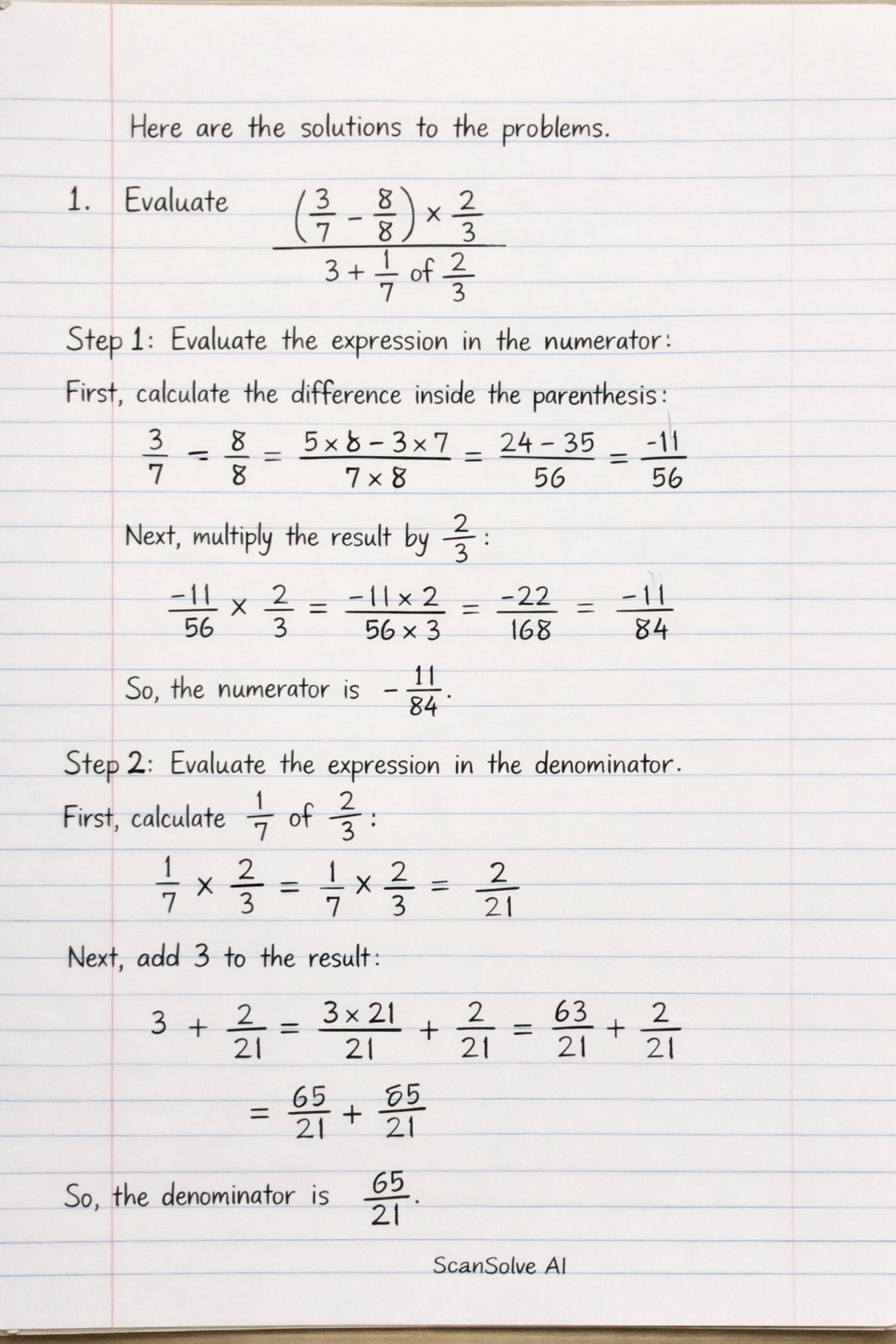
Here are the solutions to the problems. 1. Evaluate ((3)/(7) - (5)/(8)) × (2)/(3)3 + (1)/(7) of (2)/(3) Step 1: Evaluate the expression in the numerator. First, calculate the difference inside the parenthesis: (3)/(7) - (5)/(8) = (3 × 8 - 5 × 7)/(7 × 8) = (24 - 35)/(56) = (-11)/(56) Next, multiply the result by (2)/(3): (-11)/(56) × (2)/(3) = (-11 × 2)/(56 × 3) = (-22)/(168) = (-11)/(84) So, the numerator is (-11)/(84). Step 2: Evaluate the expression in the denominator. First, calculate (1)/(7) of (2)/(3): (1)/(7) × (2)/(3) = (1 × 2)/(7 × 3) = (2)/(21) Next, add 3 to the result: 3 + (2)/(21) = (3 × 21)/(21) + (2)/(21) = (63)/(21) + (2)/(21) = (65)/(21) So, the denominator is (65)/(21). Step 3: Divide the numerator by the denominator. (-11)/(84)(65)/(21) = (-11)/(84) × (21)/(65) Simplify by dividing 84 by 21 (84 ÷ 21 = 4): (-11)/(4 × 65) = (-11)/(260) The evaluated expression is (-11)/(260). 2. A two-digit number is such that when the digits are reversed, the value of the number increases by 36. If the sum of the unit digit and twice the tens digit is 16, find the number. Step 1: Define the two-digit number using variables. Let the tens digit be t and the unit digit be u. The original number can be represented as 10t + u. The number with digits reversed is 10u + t. Step 2: Formulate equations based on the given conditions. Condition 1: When the digits are reversed, the value of the number increases by 36. (10u + t) - (10t + u) = 36 9u - 9t = 36 Divide by 9: u - t = 4 (Equation 1) Condition 2: The sum of the unit digit and twice the tens digit is 16. u + 2t = 16 (Equation 2) Step 3: Solve the system of linear equations. From Equation 1, express u in terms of t: u = t + 4 Substitute this expression for u into Equation 2: (t + 4) + 2t = 16 3t + 4 = 16 3t = 16 - 4 3t = 12 t = (12)/(3) t = 4 Now substitute the value of t back into u = t + 4: u = 4 + 4 u = 8 Step 4: Form the original number. The tens digit is t=4 and the unit digit is u=8. The number is $1