

This mathematics problem involves applying core mathematical principles and formulas. Below you will find a complete step-by-step solution with detailed explanations for each step, helping you understand not just the answer but the method behind it.
ScanSolve AI Answer
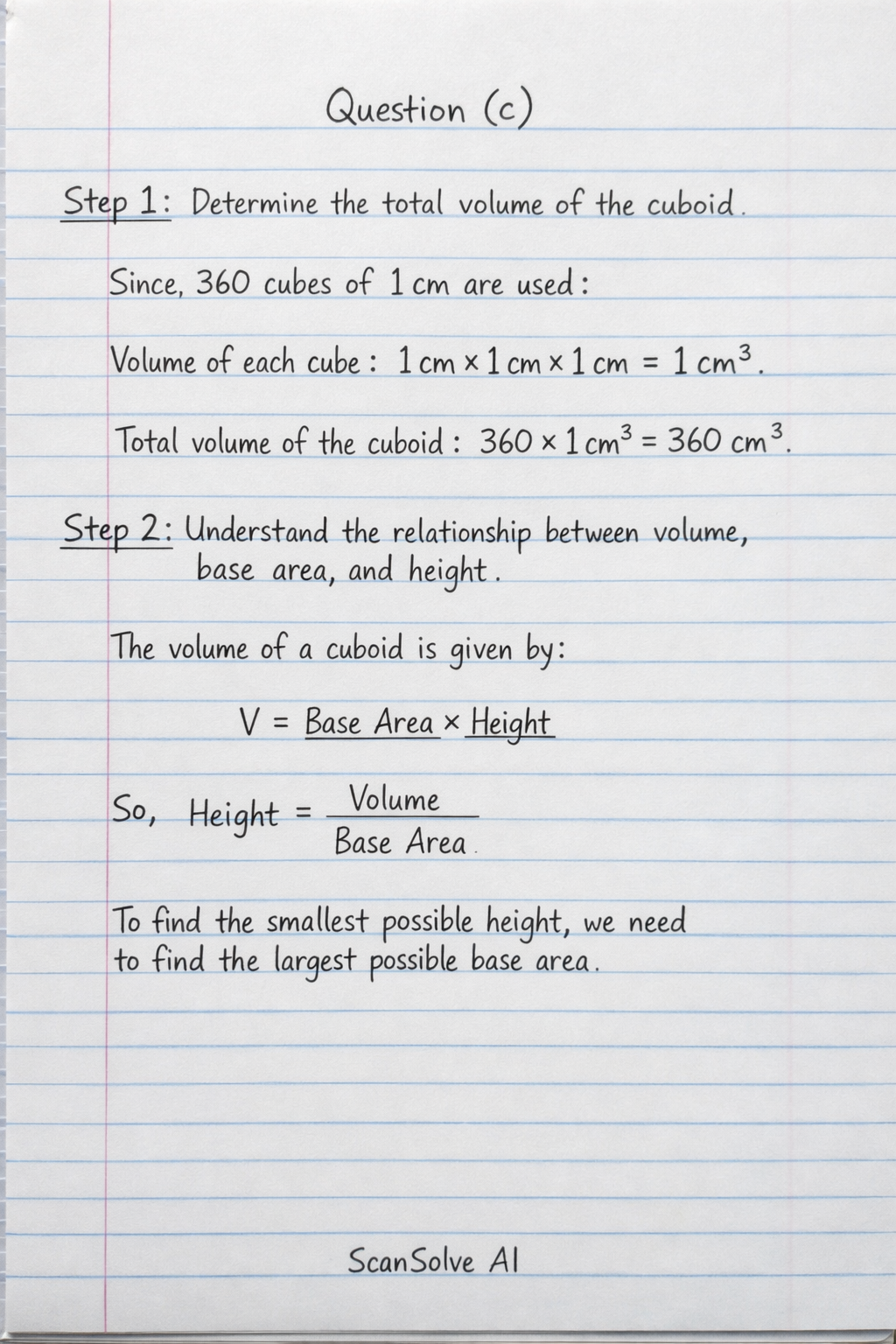
here are the solutions: Question (c) Step 1: Determine the total volume of the cuboid. Since 360 cubes of 1 cm are used, the volume of each cube is 1 cm × 1 cm × 1 cm = 1 cm^3. The total volume of the cuboid is 360 × 1 cm^3 = 360 cm^3. Step 2: Understand the relationship between volume, base area, and height. The volume of a cuboid is given by V = Base Area × Height. So, Height = VolumeBase Area. To find the smallest possible height, we need to find the largest possible base area. Step 3: Identify the largest base area that is a perfect square and a factor of the volume. The volume is 360 cm^3. We need to find the largest perfect square that divides 360. Let's list the perfect square factors of 360: 1^2 = 1 (360 is divisible by 1) 2^2 = 4 (360 is divisible by 4, 360 ÷ 4 = 90) 3^2 = 9 (360 is divisible by 9, 360 ÷ 9 = 40) 4^2 = 16 (360 is not divisible by 16) 5^2 = 25 (360 is not divisible by 25) 6^2 = 36 (360 is divisible by 36, 360 ÷ 36 = 10) The next perfect square is 7^2 = 49, which is not a factor of 360. The largest perfect square factor of 360 is 36. Therefore, the largest base area is 36 cm^2. Step 4: Calculate the smallest possible height. Height = VolumeBase Area = 360 cm^336 cm^2 = 10 cm The smallest possible height of the cuboid is 10 cm. Question (d) Step 1: Start with the given equation. 4k + 3r^2 = 10 Step 2: Isolate the term containing r^2 by subtracting 4k from both sides. 3r^2 = 10 - 4k Step 3: Make r^2 the subject by dividing both sides by 3. r^2 = (10 - 4k)/(3) The formula with r^2 as the subject is r^2 = (10 - 4k)/(3).