We read your photo as:

Calculate the volume of a cone with radius 3.5 cm and height 10 cm, a cube with side 5 cm, and a cuboid with length 8 cm, width 4 cm, and height 2 cm.

Mathematics

ScanSolve AI Answer

Step-by-step solution

16 steps

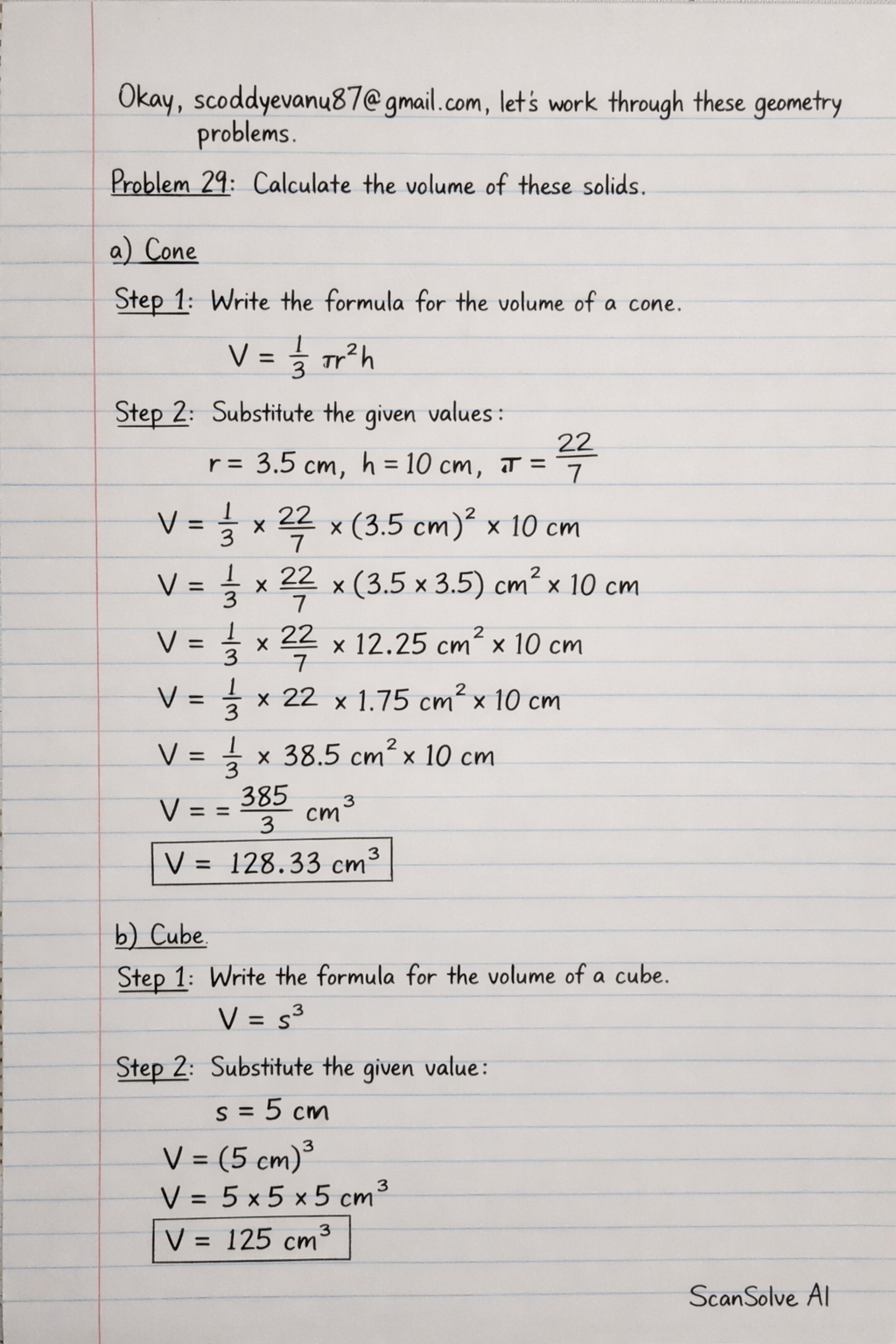
Okay, scoddyevarau87@gmail.com, let's work through these geometry problems.

: Calculate the volume of these solids.

Part a· 2 steps

Cone

  1. Write the formula for the volume of a cone.

    V=13πr2hV = \frac{1}{3}\pi r^2 h
  2. Substitute the given values.

    Given r=3.5 cmr = 3.5 \text{ cm} and h=10 cmh = 10 \text{ cm}. Use π=227\pi = \frac{22}{7}.

    V=13×227×(3.5 cm)2×10 cmV = \frac{1}{3} \times \frac{22}{7} \times (3.5 \text{ cm})^2 \times 10 \text{ cm} V=13×227×(3.5×3.5) cm2×10 cmV = \frac{1}{3} \times \frac{22}{7} \times (3.5 \times 3.5) \text{ cm}^2 \times 10 \text{ cm} V=13×227×12.25 cm2×10 cmV = \frac{1}{3} \times \frac{22}{7} \times 12.25 \text{ cm}^2 \times 10 \text{ cm} V=13×22×1.75 cm2×10 cmV = \frac{1}{3} \times 22 \times 1.75 \text{ cm}^2 \times 10 \text{ cm} V=13×38.5 cm2×10 cmV = \frac{1}{3} \times 38.5 \text{ cm}^2 \times 10 \text{ cm} V=3853 cm3V = \frac{385}{3} \text{ cm}^3 V≈128.33 cm3V \approx \boxed{\text{128.33 cm}^3}

Part b· 2 steps

Cube

  1. Write the formula for the volume of a cube.

    V=s3V = s^3
  2. Substitute the given value.

    Given side s=5 cms = 5 \text{ cm}.

    V=(5 cm)3V = (5 \text{ cm})^3 V=5×5×5 cm3V = 5 \times 5 \times 5 \text{ cm}^3 V=125 cm3V = \boxed{\text{125 cm}^3}

Part c· 2 steps

Cuboid

  1. Write the formula for the volume of a cuboid.

    V=lwhV = lwh
  2. Substitute the given values.

    Given length l=8 cml = 8 \text{ cm}, width w=4 cmw = 4 \text{ cm}, and height h=2 cmh = 2 \text{ cm}.

    V=8 cm×4 cm×2 cmV = 8 \text{ cm} \times 4 \text{ cm} \times 2 \text{ cm} V=32 cm2×2 cmV = 32 \text{ cm}^2 \times 2 \text{ cm} V=64 cm3V = \boxed{\text{64 cm}^3}

Part d· 10 steps

Cylinder

  1. Write the formula for the volume of a cylinder.

    V=πr2hV = \pi r^2 h
  2. Substitute the given values.

    Given r=7 cmr = 7 \text{ cm} and h=10 cmh = 10 \text{ cm}. Use π=227\pi = \frac{22}{7}.

    V=227×(7 cm)2×10 cmV = \frac{22}{7} \times (7 \text{ cm})^2 \times 10 \text{ cm} V=227×49 cm2×10 cmV = \frac{22}{7} \times 49 \text{ cm}^2 \times 10 \text{ cm} V=22×7 cm2×10 cmV = 22 \times 7 \text{ cm}^2 \times 10 \text{ cm} V=154 cm2×10 cmV = 154 \text{ cm}^2 \times 10 \text{ cm} V=1540 cm3V = \boxed{\text{1540 cm}^3}

    : A rectangular tank measures 6 metres×5 metres×4 metres6 \text{ metres} \times 5 \text{ metres} \times 4 \text{ metres}. How many litres of water can it hold?

  3. Calculate the volume of the tank in cubic metres.

    V=lwhV = lwh V=6 m×5 m×4 mV = 6 \text{ m} \times 5 \text{ m} \times 4 \text{ m} V=30 m2×4 mV = 30 \text{ m}^2 \times 4 \text{ m} V=120 m3V = 120 \text{ m}^3
  4. Convert the volume from cubic metres to litres.

    We know that 1 m3=1000 litres1 \text{ m}^3 = 1000 \text{ litres}.

    Vlitres=120 m3×1000 litres1 m3V_{litres} = 120 \text{ m}^3 \times \frac{1000 \text{ litres}}{1 \text{ m}^3} Vlitres=120000 litresV_{litres} = \boxed{\text{120000 litres}}

    : Find the surface area of a sphere of radius 7 cm7 \text{ cm}.

  5. Write the formula for the surface area of a sphere.

    A=4πr2A = 4\pi r^2
  6. Substitute the given values.

    Given r=7 cmr = 7 \text{ cm}. Use π=227\pi = \frac{22}{7}.

    A=4×227×(7 cm)2A = 4 \times \frac{22}{7} \times (7 \text{ cm})^2 A=4×227×49 cm2A = 4 \times \frac{22}{7} \times 49 \text{ cm}^2 A=4×22×7 cm2A = 4 \times 22 \times 7 \text{ cm}^2 A=88×7 cm2A = 88 \times 7 \text{ cm}^2 A=616 cm2A = \boxed{\text{616 cm}^2}

    : Find the surface area of a cuboid 8 cm×6 cm×4 cm8 \text{ cm} \times 6 \text{ cm} \times 4 \text{ cm}.

  7. Write the formula for the surface area of a cuboid.

    A=2(lw+lh+wh)A = 2(lw + lh + wh)
  8. Substitute the given values.

    Given length l=8 cml = 8 \text{ cm}, width w=6 cmw = 6 \text{ cm}, and height h=4 cmh = 4 \text{ cm}.

    A=2((8 cm×6 cm)+(8 cm×4 cm)+(6 cm×4 cm))A = 2((8 \text{ cm} \times 6 \text{ cm}) + (8 \text{ cm} \times 4 \text{ cm}) + (6 \text{ cm} \times 4 \text{ cm})) A=2(48 cm2+32 cm2+24 cm2)A = 2(48 \text{ cm}^2 + 32 \text{ cm}^2 + 24 \text{ cm}^2) A=2(104 cm2)A = 2(104 \text{ cm}^2) A=208 cm2A = \boxed{\text{208 cm}^2}

    : A hemisphere bowl of radius 14 cm14 \text{ cm} is to be painted.

    Assuming the bowl is open, only the curved surface area needs to be painted.

  9. Write the formula for the curved surface area of a hemisphere.

    A=2πr2A = 2\pi r^2
  10. Substitute the given values.

    Given r=14 cmr = 14 \text{ cm}. Use π=227\pi = \frac{22}{7}.

    A=2×227×(14 cm)2A = 2 \times \frac{22}{7} \times (14 \text{ cm})^2 A=2×227×196 cm2A = 2 \times \frac{22}{7} \times 196 \text{ cm}^2 A=2×22×28 cm2A = 2 \times 22 \times 28 \text{ cm}^2 A=44×28 cm2A = 44 \times 28 \text{ cm}^2 A=1232 cm2A = \boxed{\text{1232 cm}^2}
Was this helpful?

Still stuck on this one?

Ask a follow-up, and the answer starts from this question.

Got a different question?Ask your own question
Handwritten step-by-step solution preview

Handwritten Step-by-Step Solution

Get this as a handwritten image on WhatsApp — like a tutor wrote it for you.

Try on WhatsApp