
We read your photo as:
3x2−5x−1=0. 1/x - 1/(x+2) = 1/3 show that it reduces to x2+2x−6=0. x2+2x−6=0. 2x2−3x−7=0.
Mathematics
ScanSolve AI Answer
Answer
Step-by-step solution
4 stepsLet's tackle this algebra problem.
Combine the fractions on the left side of the equation.
To combine , find a common denominator, which is .
Cross-multiply to eliminate the denominators.
Multiply both sides by :
Expand the right side and rearrange the equation into standard quadratic form ().
Subtract 6 from both sides to set the equation to zero:
Compare the derived equation with the target equation.
The derived equation matches the target equation.
Therefore, it is shown that the equation reduces to .
Was this helpful?
Try one yourself
A new problem that tests the same skill.
Still stuck on this one?
Ask a follow-up, and the answer starts from this question.
Got a different question?Ask your own question
More Mathematics Questions
Q2x − 6x/3 = 0 12+2=7/1 (x+3)/5 = (x+2)/−3 x(2x+10) = 10(−10x)QSolve for x: 1.1.1 x(x−3)=0 1.1.2 2x2+1=4x 1.1.3 x2-2x−3>0 1.1.4 22x−2^x+2-32=0 1.1.5…Q2x−5 = −4x+7 4x+1 = x+4 6x−5 = 2x+7 −2x−7 = 3x+14 9x−3 = 5x+9 −3x+5 = -x-1 2x+5 = 4x−3 8x−2 = 6x+10QSolve for x: 1.1.1 (x−2)(3x+1)(x+5)=0 1.1.2 5x2-x-9=0 (correct answer to two decimal places) 1.1.3…QSolve for x: 3.1 x²−2x−3>0, 3.2 x²+x−6<0, 3.3 x²−2x≥0, 3.4 x²+x−12≤0, 3.5 2-x-x²>0, 3.6 10+x≤2x²…
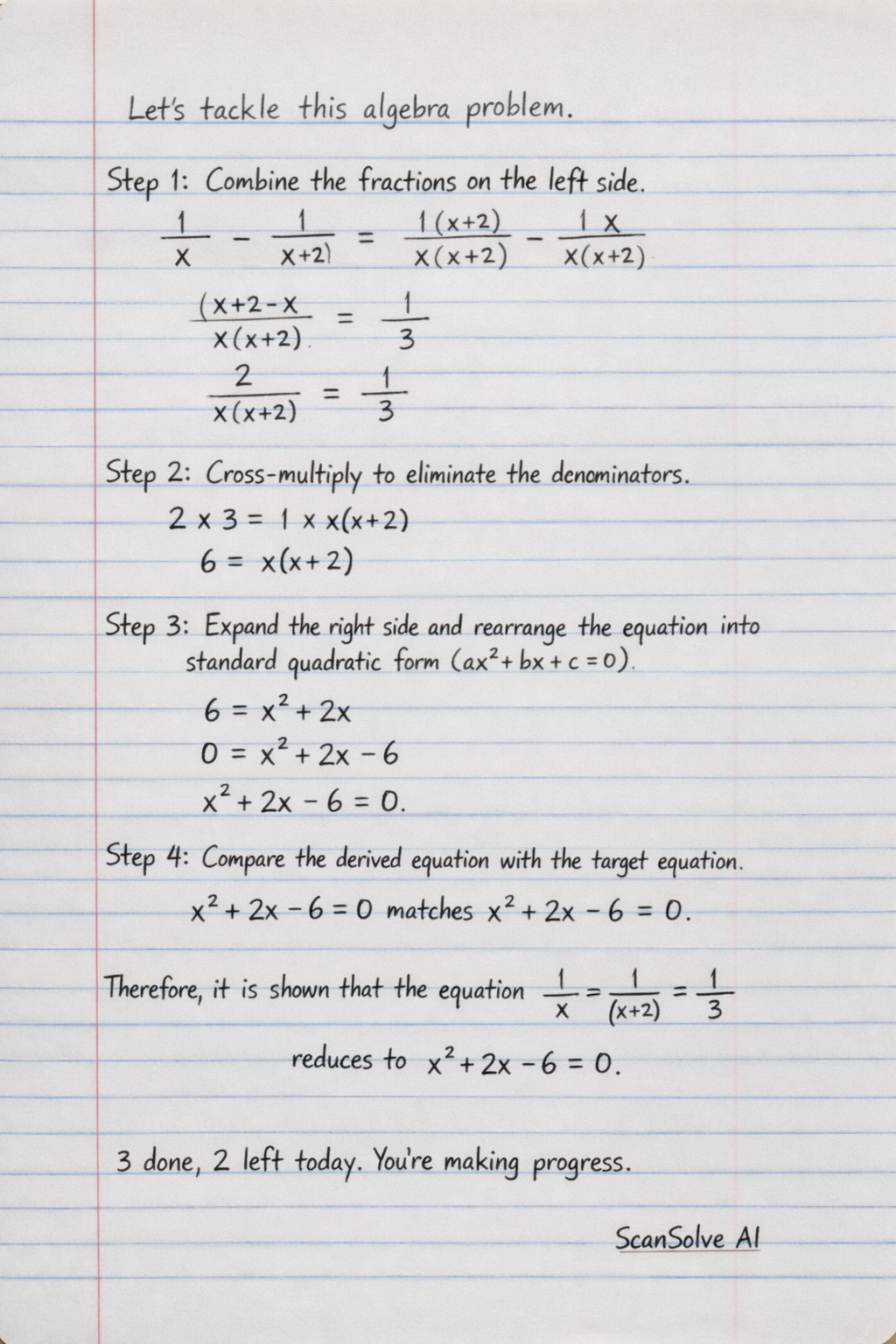
Handwritten Step-by-Step Solution
Get this as a handwritten image on WhatsApp — like a tutor wrote it for you.
Try on WhatsApp