
We read your photo as:
A triangle XYZ with vertices X(1, 2), Y(-1, -2) and Z(5, 0) is translated by a vector 1 2 . The image so formed is reflected on the x-axis. Write the co-ordinate
ScanSolve AI Answer
Here are the solutions to the transformation problems.
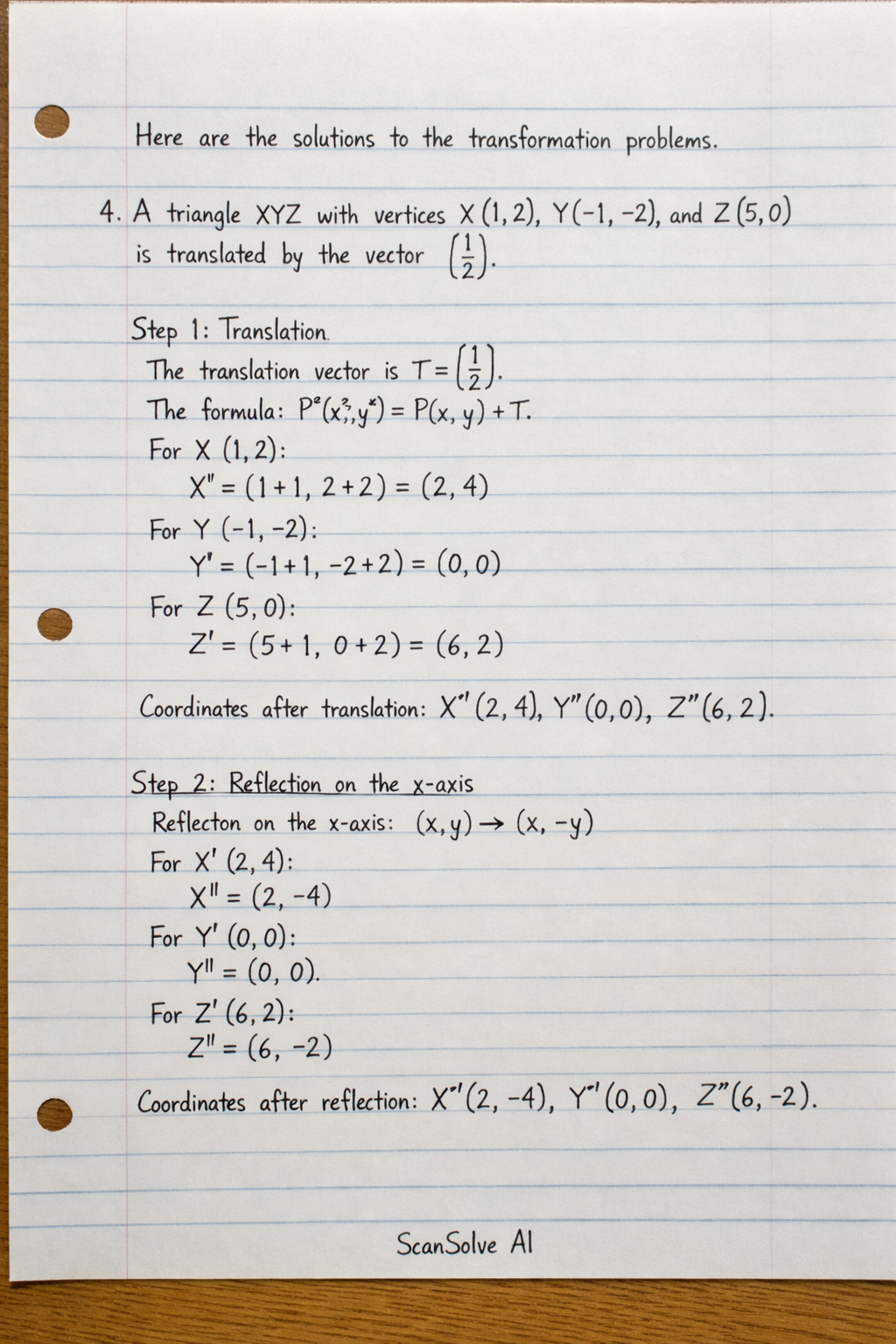
4. A triangle XYZ with vertices X(1, 2), Y(-1, -2) and Z(5, 0) is translated by a vector . The image so formed is reflected on the x-axis. Write the co-ordinates of the vertices of the images thus obtained and represent the and its images on the same graph paper.
-
Step 1: Translation The translation vector is . The formula for translation is . For X(1, 2):
For Y(-1, -2):
For Z(5, 0):
The coordinates after translation are .
-
Step 2: Reflection on the x-axis The formula for reflection on the x-axis is . For X'(2, 4):
For Y'(0, 0):
For Z'(6, 2):
The coordinates after reflection are .
-
Step 3: Graph Representation Plot with vertices X(1, 2), Y(-1, -2), Z(5, 0). Plot with vertices X'(2, 4), Y'(0, 0), Z'(6, 2). Plot with vertices X''(2, -4), Y''(0, 0), Z''(6, -2). This step should be performed on graph paper.
5. with vertices P(2, 1), Q(2, 4) and R(5, 2) is translated by the vector and then the image so formed is rotated about the origin through in positive direction. Write down the co-ordinates of the vertices of the images thus obtained and present and its images in the same graph paper.
-
Step 1: Translation The translation vector is . For P(2, 1):
For Q(2, 4):
For R(5, 2):
The coordinates after translation are .
-
Step 2: Rotation about the origin through in positive direction (counter-clockwise) The formula for rotation about the origin counter-clockwise is . For P'(3, -1):
For Q'(3, 2):
For R'(6, 0):
The coordinates after rotation are .
-
Step 3: Graph Representation Plot with vertices P(2, 1), Q(2, 4), R(5, 2). Plot with vertices P'(3, -1), Q'(3, 2), R'(6, 0). Plot with vertices P''(1, 3), Q''(-2, 3), R''(0, 6). This step should be performed on graph paper.
**6. A triangle LMN with vertices L(-3, 3), M(-6, 3) and N(-3, 9) respectively is reflected in y-axis and then image formed is rotated about the origin through . Write down the co-ordinates of the
Still stuck on this one?
Ask a follow-up, and the answer starts from this question.
More Mathematics Questions
Handwritten Step-by-Step Solution
Get this as a handwritten image on WhatsApp — like a tutor wrote it for you.
Try on WhatsApp