
[5/2, 8:56 PM] ..🙂↔️ Mercy UABS: Two wires, one of copper and one of steel, each of length 1.5 m and diameter 2.0 mm, are joined end-to-end to form a composite wire of length 3.0 m. A load of 200 N is applied to the end of the composite wire. [5/2, 8:57 PM] ..🙂↔️ Mercy UABS: Calculate: The total extension of the composite wire. The stress in each wire.
Mathematics
ScanSolve AI Answer
Here's how to calculate the stress and total extension of the composite wire:
To solve this, we need the Young's Modulus for copper and steel. We will use the following standard values:
- Young's Modulus for Copper () =
- Young's Modulus for Steel () =
Given:
- Length of copper wire () = 1.5 m
- Length of steel wire () = 1.5 m
- Diameter () = 2.0 mm = m
- Load () = 200 N
1. Calculate the stress in each wire.
Step 1: Calculate the cross-sectional area of the wire.
The diameter of the wire is .
The radius is .
The
Was this helpful?
Still stuck on this one?
Ask a follow-up, and the answer starts from this question.
Got a different question?Ask your own question
More Mathematics Questions
QA steel wire has a length of 2.0 m and a cross-sectional area of 2 × 10⁻⁶ m2. When a force of 200 N…QCalculate the strain on a wire given its original length is 100 cm and its extension is 0.008 cm.QAn object of mass 5.0 kg is suspended by an aluminum wire of length 4.0 m and diameter, d = 2.0…QDetermine the tension force in each of the wires shown in Figure 1 Below.QCalculate the energy stored in a wire with length 4 m, cross-sectional area 3e−6 m2, extension 1 mm…
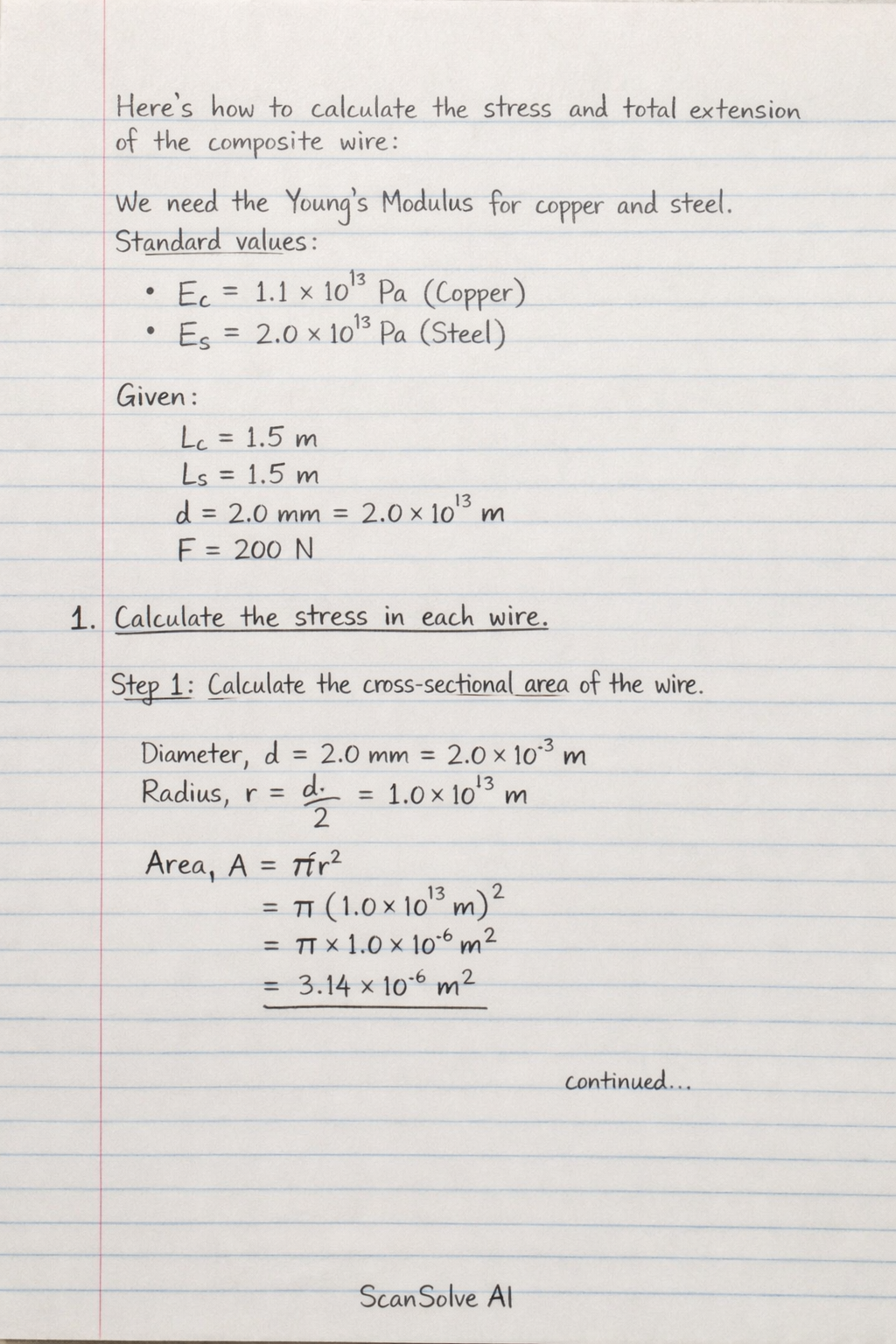
Handwritten Step-by-Step Solution
Get this as a handwritten image on WhatsApp — like a tutor wrote it for you.
Try on WhatsApp