
![කටුස්සන් 60ක් එකම ස්ථානයේ සිටින අතර, 45% ක් පැටවුන්ය. පැටවුන් 27ක් ඇති දැඩි කළේ, ඉතිරි පැටවුන් 27ක් අනාථ විය. අනාථ වූ පැටවුන්ගේ ප්රතිශතය කීය? [Image of a triangle divided into smaller triangles] (1) 6 (2) 7 (3) 8](/_next/image?url=https%3A%2F%2Fohijasnjvprzodcmxltt.supabase.co%2Fstorage%2Fv1%2Fobject%2Fpublic%2Fwhatsapp-images%2F1786108558556-d30a98e9118818db.png&w=3840&q=75)
This mathematics problem involves applying core mathematical principles and formulas. Below you will find a complete step-by-step solution with detailed explanations for each step, helping you understand not just the answer but the method behind it.
ScanSolve AI Answer
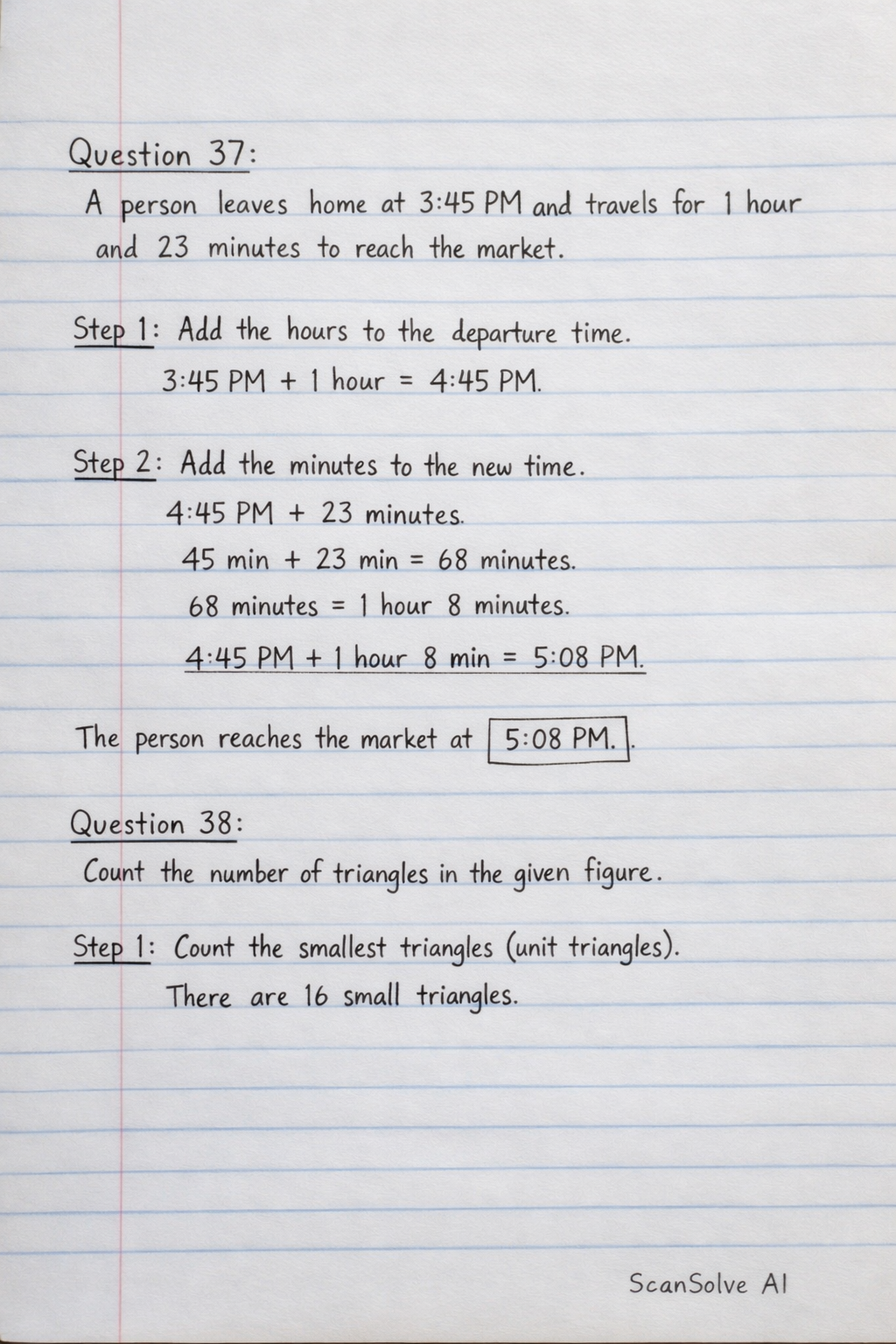
Here are the solutions to questions 37, 38, 39, and 40. Question 37: A person leaves home at 3:45 PM and travels for 1 hour and 23 minutes to reach the market. Step 1: Add the hours to the departure time. 3:45 PM + 1 hour = 4:45 PM Step 2: Add the minutes to the new time. 4:45 PM + 23 minutes 45 minutes + 23 minutes = 68 minutes Since 68 minutes is 1 hour and 8 minutes, we add 1 hour to 4 PM and 8 minutes to the minutes. 4:45 PM + 23 minutes = 5:08 PM The person reaches the market at 5:08 PM. 5:08 PM Question 38: The question asks to count the number of triangles in the given figure. Step 1: Count the smallest triangles (unit triangles). There are 16 small triangles. Step 2: Count triangles made of 4 unit triangles. • Pointing up: There are 3 in the bottom row, 2 in the middle row, 1 in the top row. Total = 3+2+1 = 6. • Pointing down: There is 1 in the middle section. Total = 1. So, 6+1 = 7 triangles of this size. Step 3: Count triangles made of 9 unit triangles. • Pointing up: There is 1 such triangle in the bottom-left, 1 in the bottom-right, and 1 in the top-middle. Total = 3. • Pointing down: There are no triangles of this size pointing down. Step 4: Count the largest triangle. There is 1 large triangle encompassing the entire figure. Step 5: Sum all counted triangles. Total triangles = (16 small) + (7 of size 4) + (3 of size 9) + (1 largest) Total triangles = 16 + 7 + 3 + 1 = 27. The number of triangles in the figure is 27. The options provided are (1) 6, (2) 7, (3) 8. None of these match the count of 27. There might be a misunderstanding of the question or the options provided are incorrect for this figure. Let me re-examine the image and the options. The options (1) 6, (2) 7, (3) 8 are listed next to the diagram. This suggests the question is asking for something specific, or the options are for a different question. However, the question is "How many triangles are there in the given figure?". If I count only the triangles pointing upwards, there are: 16 (small) + 6 (size 4) + 3 (size 9) + 1 (largest) = 26. If I count only the triangles pointing downwards: There are 6 small triangles pointing downwards. There is 1 triangle of size 4 pointing downwards. Total = 16+7+3+1 = 27. Let's re-count carefully. Smallest triangles (1 unit area): Pointing up: 10 Pointing down: 6 Total small: 16 Triangles made of 4 unit triangles: Pointing up: Row 1 (bottom): 3 Row 2 (middle): 2 Row 3 (top): 1 Total pointing up (size 4): 3+2+1 = 6 Pointing down: 1 (in the center, formed by 4 small downward-pointing triangles) Total pointing down (size 4): 1 Total size 4: 6+1 = 7 Triangles made of 9 unit triangles: Pointing up: There are 3 such triangles. (One starting from bottom left, one from bottom right, one from top middle). Pointing down: 0 Total size 9: 3 Largest triangle (16 unit triangles): Pointing up: 1 Total size 16: 1 Total triangles = 16 + 7 + 3 + 1 = 27. The options given are (1) 6, (2) 7, (3) 8. These options do not match the total count of 27. Given the options, it's possible the question is asking for a specific type of triangle, or the options are incorrect. If the question is asking for the number of triangles of a specific size, for example, triangles made of 4 unit triangles, the answer would be 7. This matches option (2). Let's assume the question is implicitly asking for the number of triangles made of 4 unit triangles, as 7 is one of the options. This is a common way for such questions to be phrased if they expect a specific count. Assuming the question implicitly asks for triangles made of 4 unit triangles: Number of triangles made of 4 unit triangles = 7. The correct option is (2) 7. (2) 7 Question 39: The question states: "A, B, C, D are four statements. Which of them is mismatched or incorrect?" The statements are: A. The value of the square root of 1 is 1. (sqrt(1) = 1) - This statement is correct. B. The value of the square root of 4 is 2. (sqrt(4) = 2) - This statement is correct. C. The value of the square root of 9 is 3. (sqrt(9) = 3) - This statement is correct. D. The value of the square root of 16 is 4. (sqrt(16) = 4) - This statement is correct. All four statements (A, B, C, D) are mathematically correct. The question asks to identify an incorrect or mismatched statement. Since all statements are correct, there is no incorrect or mismatched statement among A, B, C, and D. The options provided are: (1) A and B (2) A and D (3) B and C These options are pairs of statements. If the question asks which pair is incorrect or mismatched, then since all individual statements are correct, no pair can be considered incorrect. This question is flawed as presented, as all statements are correct, and the options are combinations of these correct statements. It is not possible to logically select an incorrect or mismatched statement from the given choices. Therefore, I cannot provide a definitive answer from the given options for Question 39. All statements A, B, C, and D are correct. Question 40: Five people A, B, C, D, E are in a queue. Given conditions: • A, B are next to each other. (This means they form a block like (AB) or (BA)). • C, D are next to each other. (This means they form a block like (CD) or (DC)). • E is not next to A or C. (E cannot be adjacent to A, and E cannot be adjacent to C). We need to choose the correct statement from the options: (1) E, B are next to each other. (2) C, B are next to each other. (3) A, C are next to each other. Step 1: Evaluate options (2) and (3) based on the first two conditions. If A and B are next to each other, and C and D are next to each other, it implies that B is always next to A (or vice versa), and C is always next to D (or vice versa). Therefore: • B cannot be next to C. So, statement (2) "C, B are next to each other" is false. • A cannot be next to C. So, statement (3) "A, C are next to each other" is false. Step 2: Evaluate option (1). Since options (2) and (3) are definitively false, option (1) "E, B are next to each other" must be the correct statement in a multiple-choice context. Let's verify if it's possible for E and B to be next to each other while satisfying all conditions. Consider the blocks (AB) and (CD), and person E. E cannot be next to A, and E cannot be next to C. Possible arrangements where E is next to B: • If the arrangement is (CD)(AB)E, then E is next to B. • (CD)(AB)E: E is next to B. E is not next to C (true). E is not next to A (true). This is a valid arrangement. Example: C D A B E. • If the arrangement is E(BA)(DC), then E is next to B. • E(BA)(DC): E is next to B. E is not next to A (true). E is not next to C (true). This is a valid arrangement. Example: E B A D C. Since it is possible for E and B to be next to each other, and the other options are impossible, statement (1) is the correct one. The correct statement is (1) E, B are next to each other. (1) E, B are next to each other Send me the next one 📸