
We read your photo as:
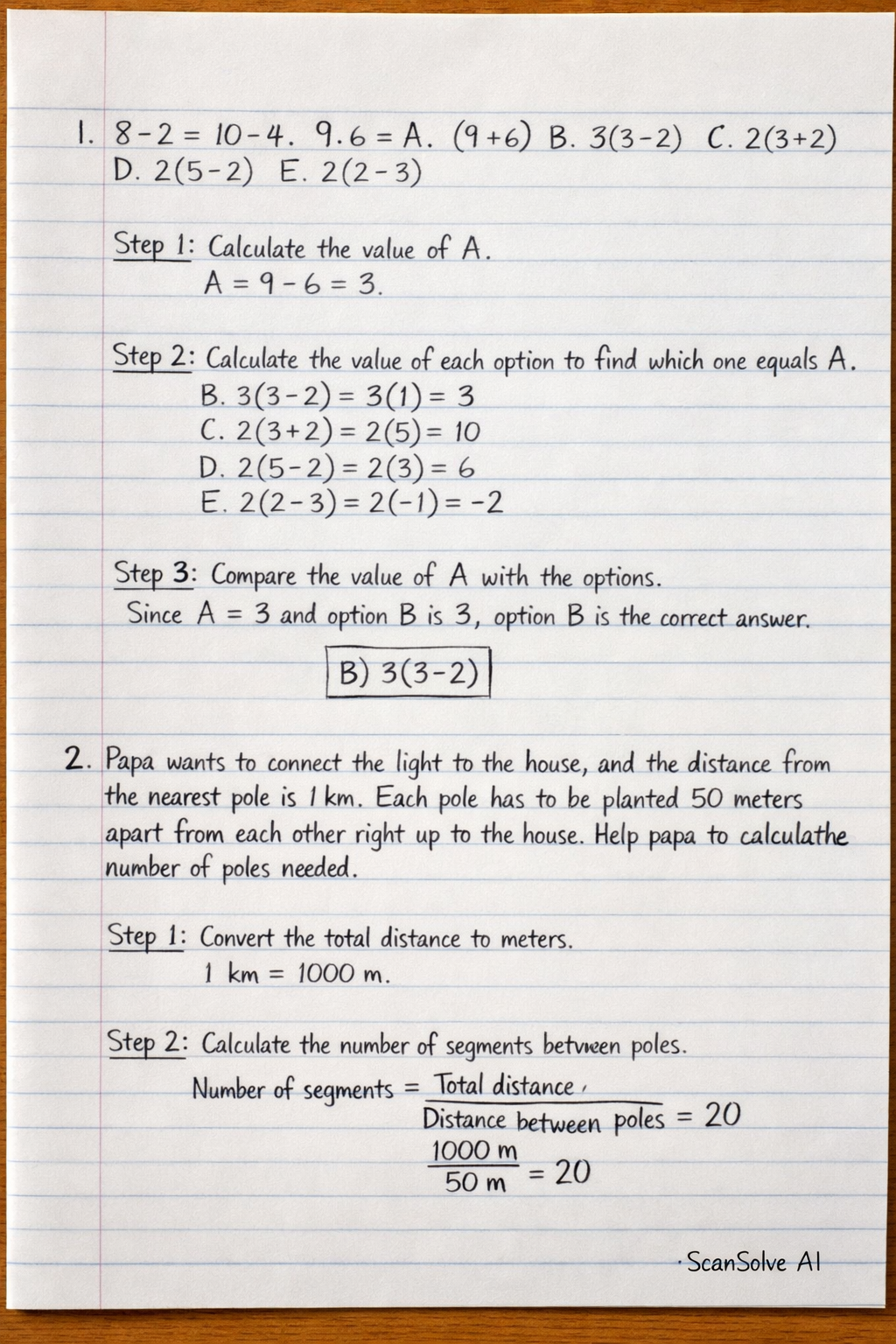
8 − 2 = 10 − 4. 9 − 6 = A. Which of the following equals A? B. 3(3 - 2) C. 2(3 + 2) D. 2(5 - 2) E. 2(2 - 3). 2. Papa wants to connect the light to the house, and the distance from the nearest pole is
ScanSolve AI Answer
Answer
Step-by-step solution
10 stepshere are the solutions to the problems from the image:
1. . . B. C. D. E.
Calculate the value of .
.
Calculate the value of each option to find which one equals .
B. .
C. .
D. .
E. .Compare the value of with the options.
Since and option B is 3, option B is the correct answer.
2. Papa wants to connect the light to the house, and the distance from the nearest pole is 1 km. Each pole has to be planted 50 meters apart from each other right up to the house. Help papa to calculate the number of poles needed.
Convert the total distance to meters.
.
Calculate the number of segments between poles.
Number of segments .
Determine the total number of poles.
For segments, poles are needed (including the first and last pole).
Number of poles .3. The sum of an even and odd number is always an odd number, and the sum of two odd numbers is:
Consider examples of adding two odd numbers.
(Even)
(Even)
(Even)Conclude the pattern.
The sum of two odd numbers is always an even number.
4. Numbers can be written in series. Find the next number in the series 23, 31, 39, 47, .....
Find the common difference between consecutive terms.
The common difference is 8.Add the common difference to the last term to find the next number.
Next number .
**5. 0.5 is bigger than $0.2
Try one yourself
A new problem that tests the same skill.
Still stuck on this one?
Ask a follow-up, and the answer starts from this question.
More Mathematics Questions
Handwritten Step-by-Step Solution
Get this as a handwritten image on WhatsApp — like a tutor wrote it for you.
Try on WhatsApp