
We read your photo as:
Evaluate 9⁻¹ x ((3)/(4))2 and solve for x in 16^x = 8^x+1 and 813x x 272x = 729.
Mathematics
ScanSolve AI Answer
Step-by-step solution
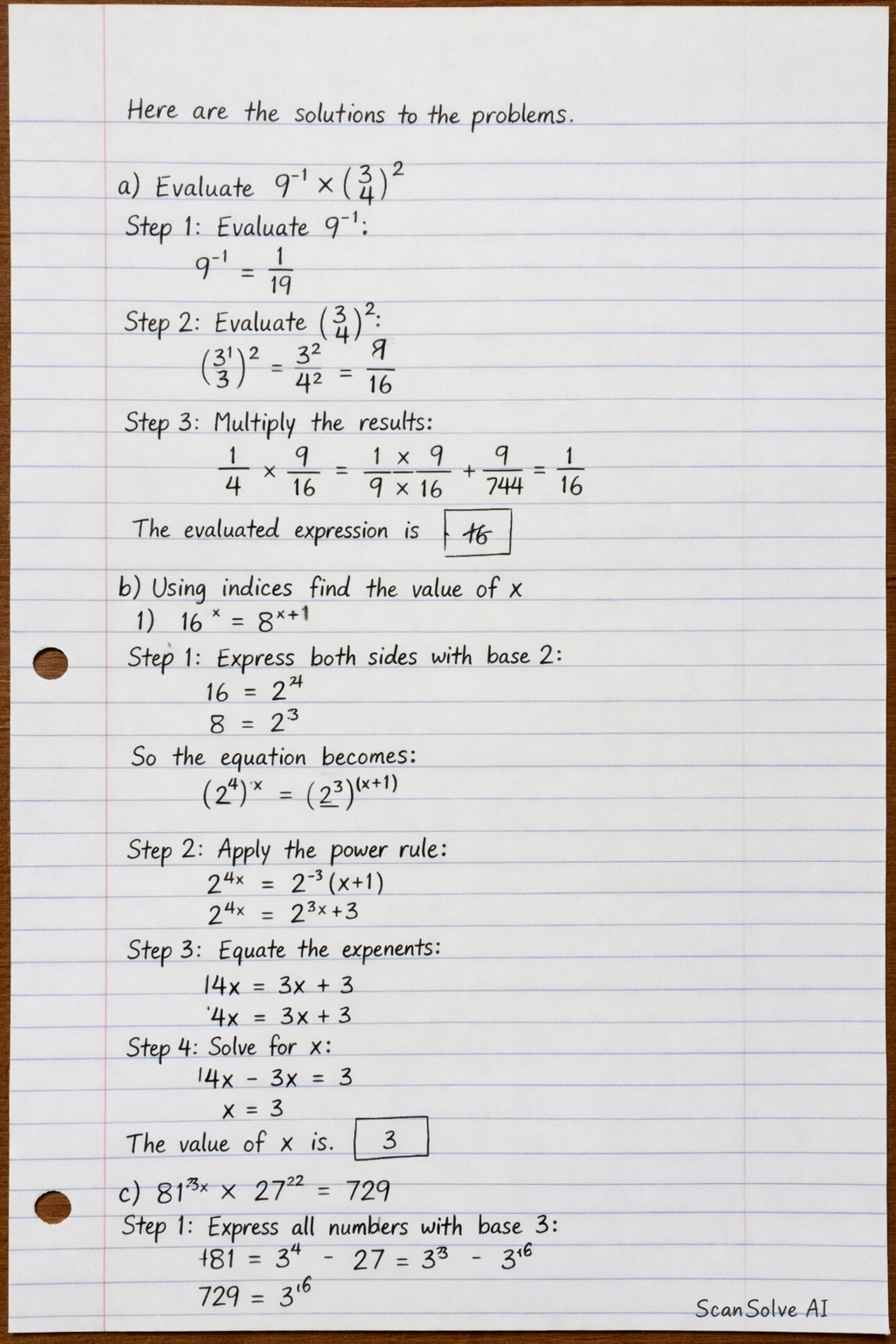
16 stepsHere are the solutions to the problems.
a) Evaluate
Evaluate .
Evaluate .
Multiply the results.
The evaluated expression is .
b) Using indices find the value of
a)
Express both sides with base 2.
So the equation becomes:
Apply the power rule .
Equate the exponents since the bases are the same.
Solve for .
The value of is .
b)
Express all numbers with base 3.
So the equation becomes:
Apply the power rule .
Apply the product rule .
Equate the exponents since the bases are the same.
Solve for .
The value of is .
c)
Express all numbers with base 2.
So the equation becomes:
Simplify the left side using index rules.
First, apply the product rule in the numerator:
Next, apply the quotient rule :
Equate the exponents since the bases are the same.
Solve for .
The value of is .
Was this helpful?
Still stuck on this one?
Ask a follow-up, and the answer starts from this question.
Got a different question?Ask your own question
More Mathematics Questions
QSimplify the expression [(21)/(3) × 8^(2)/(3) × 6^(5)/(4) × 3^(3)/(4)9-1 × [3]16]⁻⁴ to find the…QSolve for x in the equation, 9^x+1 + 32x = 270QSolve the following problems: 1. 3^x = 81 2. sqrt(64) 3. sqrt((16)/(25)) 4. Show 5346 is divisible…QSolve the equation: (27^x * 9^(2x)) / (1/3)^x = 81QSolve the following exponential equations: 274x = 9^x+1 and ((1)/(8))⁻²x = 2^x+3.
Browse by topic:Algebra
Handwritten Step-by-Step Solution
Get this as a handwritten image on WhatsApp — like a tutor wrote it for you.
Try on WhatsApp