
![A = [[1, 2, 1], [2, 1, 5], [x1, x2, x3]] = [[4], [5]] for which a system of equations has the maximum number of solutions?](/_next/image?url=https%3A%2F%2Fohijasnjvprzodcmxltt.supabase.co%2Fstorage%2Fv1%2Fobject%2Fpublic%2Fwhatsapp-images%2F1782975849573-3b6a6c2a1265eac7.png&w=3840&q=75)
This mathematics problem involves applying core mathematical principles and formulas. Below you will find a complete step-by-step solution with detailed explanations for each step, helping you understand not just the answer but the method behind it.
ScanSolve AI Answer
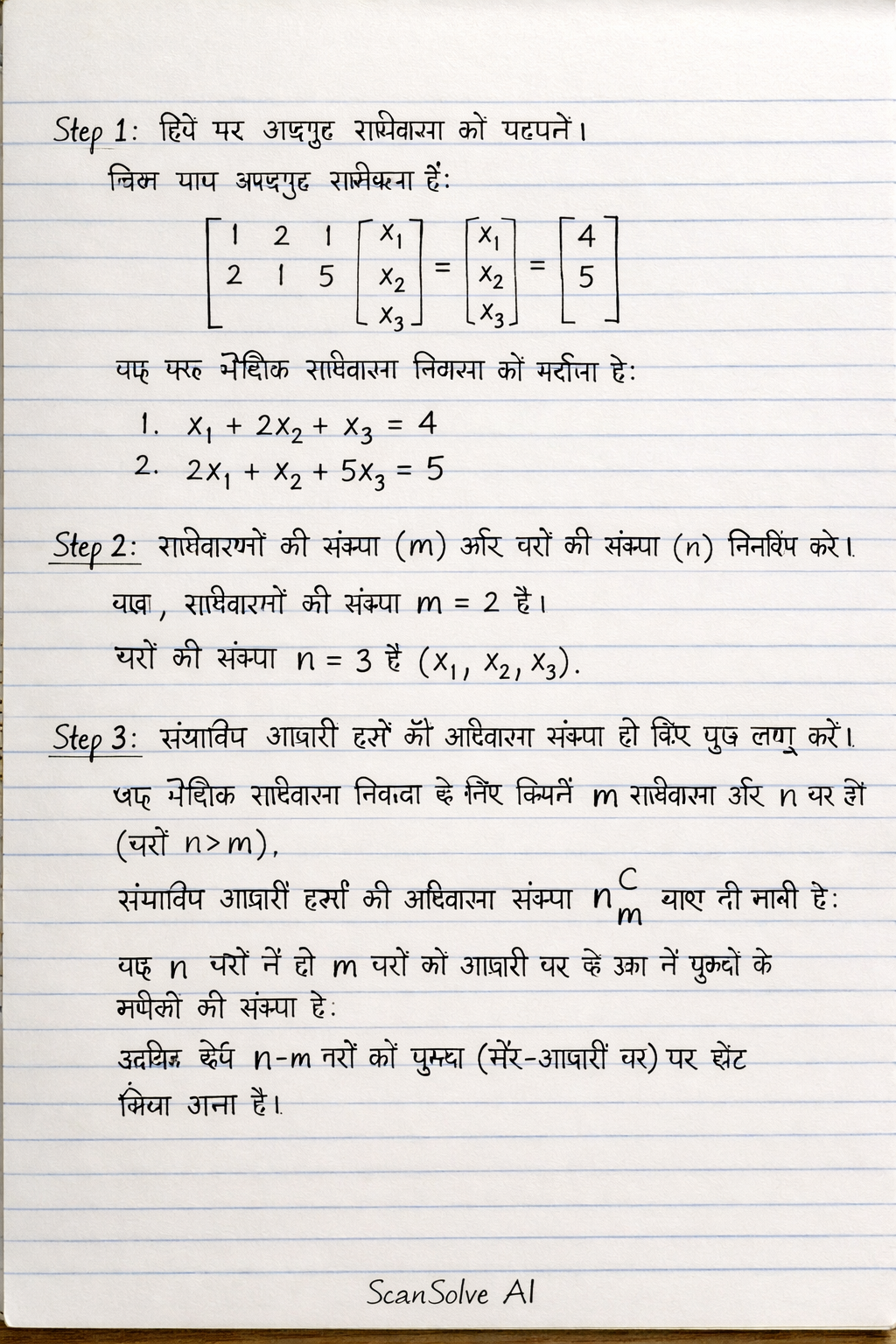
Step 1: दिए गए आव्यूह समीकरण को पहचानें। दिया गया आव्यूह समीकरण है: 1 & 2 & 1 \\ 2 & 1 & 5 x_1 \\ x_2 \\ x_3 = 4 \\ 5 यह एक रैखिक समीकरण निकाय को दर्शाता है: 1. x_1 + 2x_2 + x_3 = 4 2. 2x_1 + x_2 + 5x_3 = 5 Step 2: समीकरणों की संख्या (m) और चरों की संख्या (n) निर्धारित करें। यहां, समीकरणों की संख्या m = 2 है। चरों की संख्या n = 3 है (x_1, x_2, x_3)। Step 3: संभावित आधारी हलों की अधिकतम संख्या के लिए सूत्र लागू करें। एक रैखिक समीकरण निकाय के लिए जिसमें m समीकरण और n चर हों (जहाँ n > m), संभावित आधारी हलों की अधिकतम संख्या nm द्वारा दी जाती है। यह n चरों में से m चरों को आधारी चर के रूप में चुनने के तरीकों की संख्या है, जबकि शेष n-m चरों को शून्य (गैर-आधारी चर) पर सेट किया जाता है। Step 4: मानों को सूत्र में प्रतिस्थापित करें और गणना करें। यहां n=3 और m=2 है। संभावित आधारी हलों की अधिकतम संख्या है: nm = 32 संयोजन सूत्र का उपयोग करके: 32 = (3!)/(2!(3-2)!) = (3!)/(2!1!) 32 = (3 × 2 × 1)/((2 × 1)(1)) = (6)/(2) = 3 Step 5: प्राप्त परिणाम की तुलना दिए गए विकल्पों से करें। गणना के अनुसार, संभावित आधारी हलों की अधिकतम संख्या 3 है। यह विकल्प (1) से मेल खाता है। The final answer is (1) 3. अगला प्रश्न भेजें 📸