
![Q1. a) Solve the following set of linear equations by the matrix method. X1+2X2+X3=4, 3X1-4X2-2X3=2, 5X1+3X2+5X3=-1. b) Find the values of x for which the matrix [[2x, -2],[-4, x]] is singular.](/_next/image?url=https%3A%2F%2Fohijasnjvprzodcmxltt.supabase.co%2Fstorage%2Fv1%2Fobject%2Fpublic%2Fwhatsapp-images%2F1785640148159-a55c18460b776ef2.png&w=3840&q=75)
This mathematics problem involves applying core mathematical principles and formulas. Below you will find a complete step-by-step solution with detailed explanations for each step, helping you understand not just the answer but the method behind it.
ScanSolve AI Answer
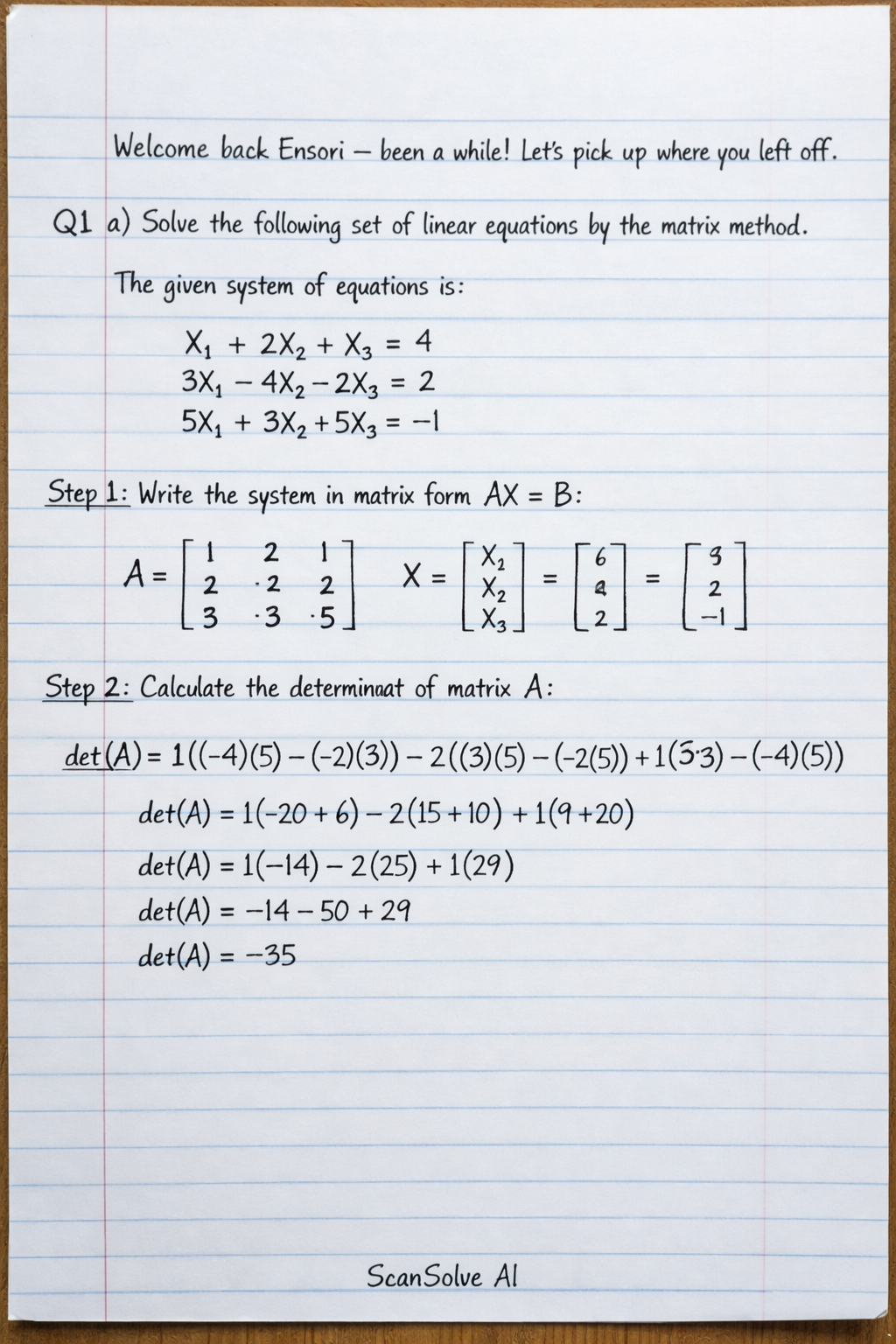
Q1 a) Solve the following set of linear equations by the matrix method. The given system of equations is: X_1 + 2X_2 + X_3 = 4 3X_1 - 4X_2 - 2X_3 = 2 5X_1 + 3X_2 + 5X_3 = -1 Step 1: Write the system in matrix form AX = B. A = 1 & 2 & 1 \\ 3 & -4 & -2 \\ 5 & 3 & 5 , X = X_1 \\ X_2 \\ X_3 , B = 4 \\ 2 \\ -1 Step 2: Calculate the determinant of matrix A. (A) = 1((-4)(5) - (-2)(3)) - 2((3)(5) - (-2)(5)) + 1((3)(3) - (-4)(5)) (A) = 1(-20 + 6) - 2(15 + 10) + 1(9 + 20) (A) = 1(-14) - 2(25) + 1(29) (A) = -14 - 50 + 29 = -35 Step 3: Calculate the adjoint of matrix A. First, find the cofactor matrix C: C = (-4)(5)-(-2)(3) & -((3)(5)-(-2)(5)) & (3)(3)-(-4)(5) \\ -((2)(5)-(1)(3)) & (1)(5)-(1)(5) & -((1)(3)-(2)(5)) \\ ((2)(-2)-(1)(-4)) & -((1)(-2)-(1)(3)) & ((1)(-4)-(2)(3)) C = -14 & -25 & 29 \\ -7 & 0 & 7 \\ 0 & 5 & -10 The adjoint matrix is the transpose of the cofactor matrix: adj(A) = C^T = -14 & -7 & 0 \\ -25 & 0 & 5 \\ 29 & 7 & -10 Step 4: Calculate the inverse of matrix A. A^-1 = (1)/((A)) adj(A) = (1)/(-35) -14 & -7 & 0 \\ -25 & 0 & 5 \\ 29 & 7 & -10 Step 5: Solve for X using X = A^-1B. X = (1)/(-35) -14 & -7 & 0 \\ -25 & 0 & 5 \\ 29 & 7 & -10 4 \\ 2 \\ -1 X = (1)/(-35) (-14)(4) + (-7)(2) + (0)(-1) \\ (-25)(4) + (0)(2) + (5)(-1) \\ (29)(4) + (7)(2) + (-10)(-1) X = (1)/(-35) -56 - 14 + 0 \\ -100 + 0 - 5 \\ 116 + 14 + 10 X = (1)/(-35) -70 \\ -105 \\ 140 = (-70)/(-35) \\ (-105)/(-35) \\ (140)/(-35) = 2 \\ 3 \\ -4 The solution is: X_1 = 2, X_2 = 3, X_3 = -4 Q1 b) Find the values of x for which the matrix 2x & -2 \\ -4 & x is singular. Step 1: Understand the condition for a singular matrix. A matrix is singular if its determinant is equal to zero. Step 2: Calculate the determinant of the given matrix. For a 2 × 2 matrix a & b \\ c & d , the determinant is ad - bc. 2x & -2 \\ -4 & x = (2x)(x) - (-2)(-4) = 2x^2 - 8 Step 3: Set the determinant to zero and solve for x. 2x^2 - 8 = 0 2x^2 = 8 x^2 = (8)/(2) x^2 = 4 x = ± sqrt(4) x = ± 2 Q2 a) (i) Evaluate the following _1^2 4 t \,dt. Step 1: Find the antiderivative of 4 t. The antiderivative of t is t. So, the antiderivative of 4 t is 4 t. Step 2: Evaluate the definite integral using the Fundamental Theorem of Calculus. _1^2 4 t \,dt = [4 t]_1^2 = 4 (2) - 4 (1) = 4((2) - (1)) 4((2) - (1)) (Note: The angles are in radians.) Send me the next one 📸