
We read your photo as:
A 2.6 m long pipe leans against a wall. If the bottom of the pipe is pulled away from the wall at a rate of 0.2 m/s, how fast is the area of the triangle formed by the pipe, wall, and ground changing
ScanSolve AI Answer
Answer
Step-by-step solution
6 stepsDefine variables and establish relationships.
Let be the length of the pipe, be the distance of the lower end from the wall, and be the height of the top end on the wall.
Given:- Pipe length m (constant).
- Rate at which the lower end is pulled away m/s.
- We need to find the rate of change of the area when m.
The pipe, wall, and ground form a right-angled triangle, so by the Pythagorean theorem:
The area of this triangle is:
Find the height when m.
Substitute m and m into the Pythagorean theorem:
Differentiate the Pythagorean theorem with respect to time to find .
Now, substitute m, m, and m/s:
Differentiate the area formula with respect to time .
Using the product rule:
Substitute all known values into the differentiated area formula.
Substitute m, m, m/s, and m/s:
Calculate the rate of change of the area.
To simplify, convert 0.48 to a fraction: .
Find a common denominator for 25 and 12, which is 300:
The rate at which the area is changing is .
Try one yourself
A new problem that tests the same skill.
Still stuck on this one?
Ask a follow-up, and the answer starts from this question.
More Mathematics Questions
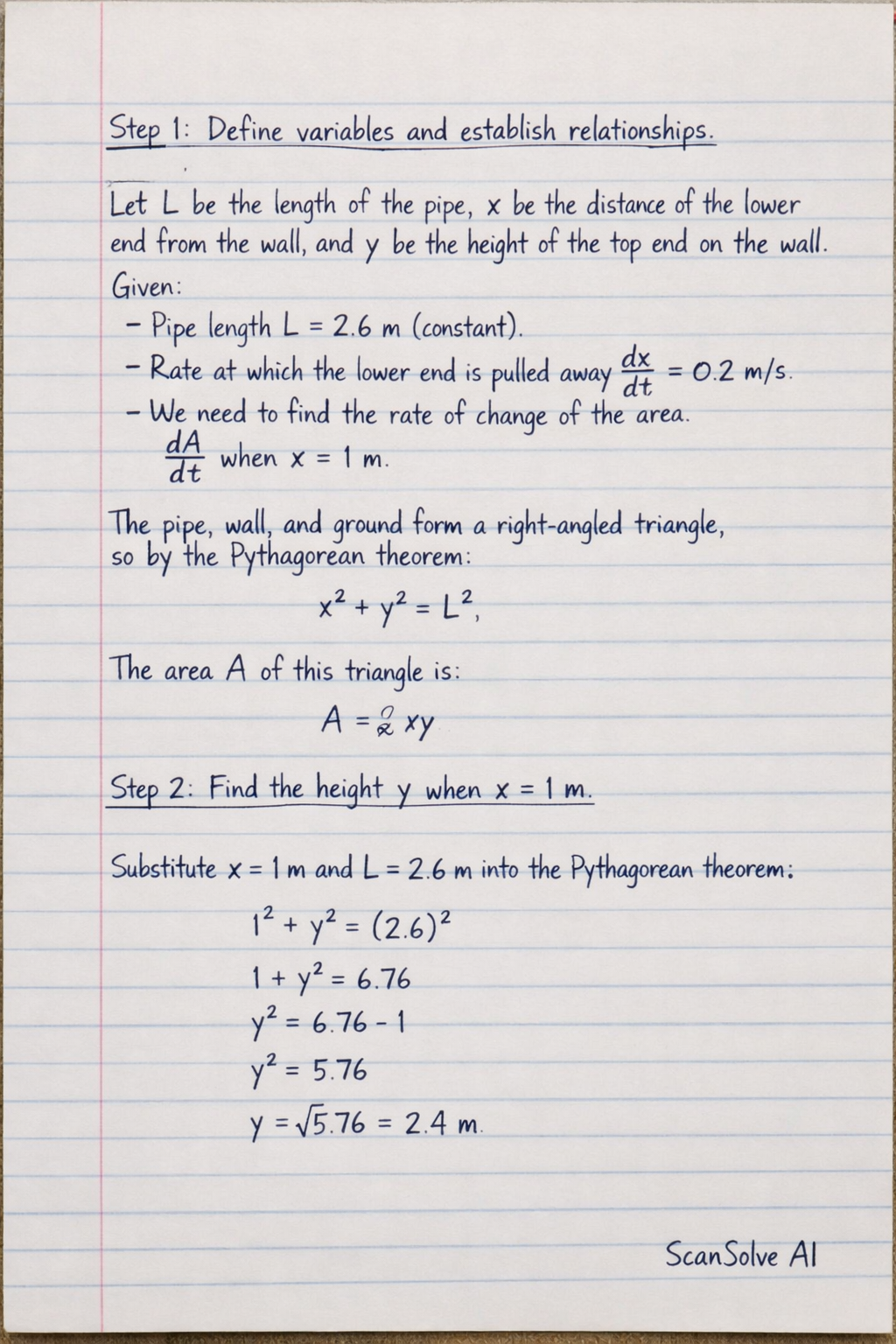
Handwritten Step-by-Step Solution
Get this as a handwritten image on WhatsApp — like a tutor wrote it for you.
Try on WhatsApp