We read your photo as:

A bag contains 3 different marbles x, y and z. The total number of marbles in the bag is 27. The ratios are x:y = 1:2 and y:z = 1:3. a) Find the number of z marbles in the bag. b) Calculate the probab

Mathematics

ScanSolve AI Answer

Answers

2 parts
a
18
b

5117\frac{5}{117}

Step-by-step solution

13 steps

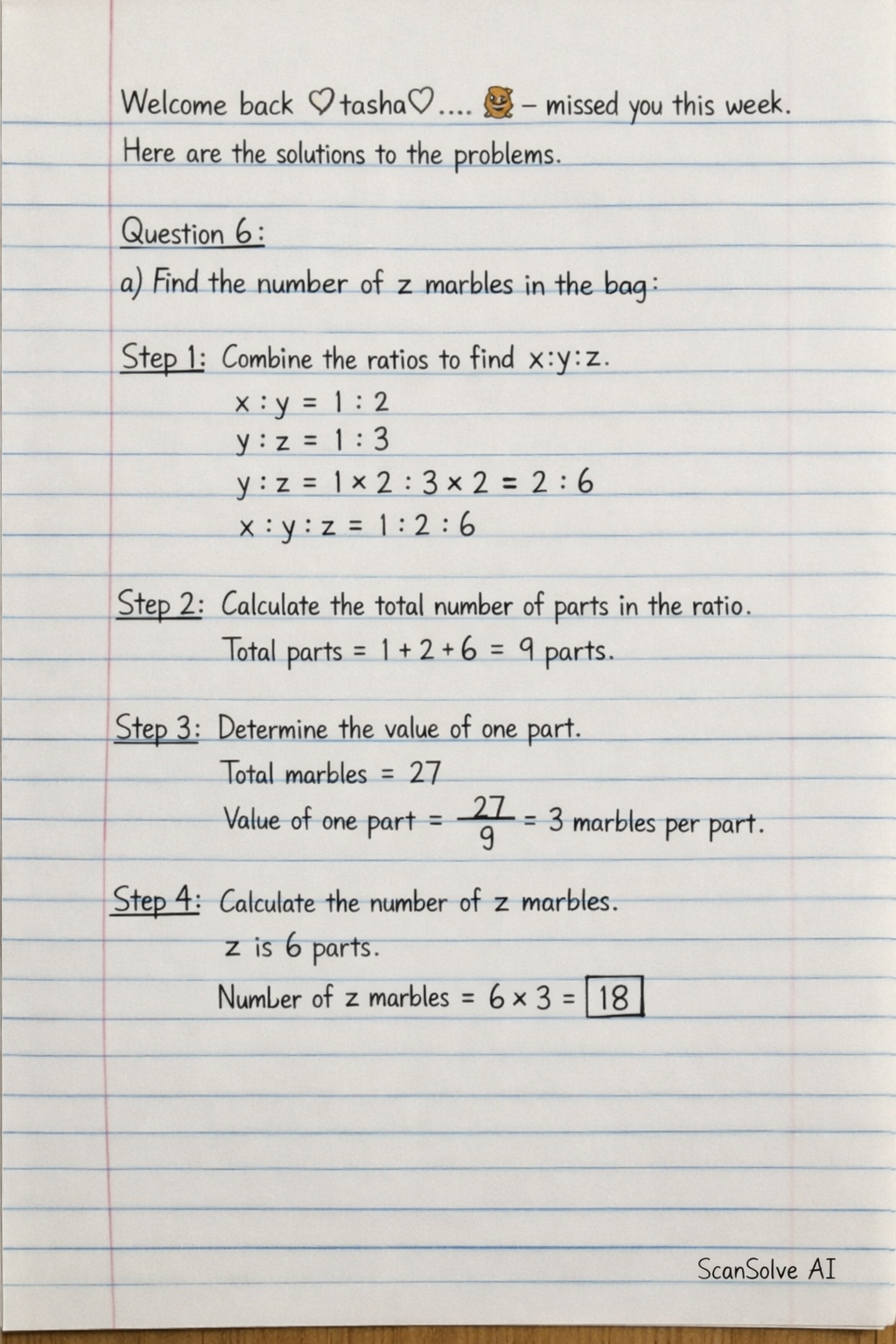
Here are the solutions to the problems.


Part 6

A bag contains 3 different marbles x,yx, y and zz. The total number of marbles in the bag is 27.
The ratios are x:y=1:2x:y = 1:2 and y:z=1:3y:z = 1:3.

Part a18

Find the number of zz marbles in the bag

  1. Combine the ratios to find x:y:zx:y:z.

    Given x:y=1:2x:y = 1:2.
    Given y:z=1:3y:z = 1:3.
    To combine these, we make the yy component consistent. We can multiply the second ratio by 2:
    y:z=(1×2):(3×2)=2:6y:z = (1 \times 2) : (3 \times 2) = 2:6.
    Now, we have x:y=1:2x:y = 1:2 and y:z=2:6y:z = 2:6.
    So, the combined ratio is x:y:z=1:2:6x:y:z = 1:2:6.

  2. Calculate the total number of parts in the ratio.

    Total parts = 1+2+6=91 + 2 + 6 = 9 parts.

  3. Determine the value of one part.

    The total number of marbles is 27.
    Value of one part = Total marblesTotal parts=279=3\frac{\text{Total marbles}}{\text{Total parts}} = \frac{27}{9} = 3 marbles per part.

  4. Calculate the number of zz marbles.

    The ratio for zz is 6 parts.
    Number of zz marbles = 6×3=186 \times 3 = \boxed{18}.

Part b

5117\frac{5}{117}

Calculate the probability of selecting two of the yy marbles at random from the bag one after the other without replacement.

  1. Calculate the number of yy marbles.

    From the combined ratio x:y:z=1:2:6x:y:z = 1:2:6, the ratio for yy is 2 parts.
    Number of yy marbles = 2×3=62 \times 3 = 6.

  2. Calculate the probability of selecting the first yy marble.

    Total marbles in the bag = 27.
    Number of yy marbles = 6.

    P(1st y)=Number of y marblesTotal marbles=627P(\text{1st } y) = \frac{\text{Number of } y \text{ marbles}}{\text{Total marbles}} = \frac{6}{27}
  3. Calculate the probability of selecting the second yy marble without replacement.

    After selecting one yy marble, there are 6−1=56-1=5 yy marbles left.
    The total number of marbles remaining in the bag is 27−1=2627-1=26.

    P(2nd y | 1st y)=Remaining y marblesRemaining total marbles=526P(\text{2nd } y \text{ | 1st } y) = \frac{\text{Remaining } y \text{ marbles}}{\text{Remaining total marbles}} = \frac{5}{26}
  4. Calculate the overall probability.

    The probability of selecting two yy marbles one after the other without replacement is the product of the probabilities from Step 2 and Step 3.

    P(two y marbles)=P(1st y)×P(2nd y | 1st y)P(\text{two } y \text{ marbles}) = P(\text{1st } y) \times P(\text{2nd } y \text{ | 1st } y) P(two y marbles)=627×526P(\text{two } y \text{ marbles}) = \frac{6}{27} \times \frac{5}{26}

    Simplify the fractions:

    P(two y marbles)=29×526P(\text{two } y \text{ marbles}) = \frac{2}{9} \times \frac{5}{26} P(two y marbles)=19×513P(\text{two } y \text{ marbles}) = \frac{1}{9} \times \frac{5}{13} P(two y marbles)=5117P(\text{two } y \text{ marbles}) = \boxed{\frac{5}{117}}

Part 7· 5 steps

Given that m=2i+pjm = 2i + pj, n=−3i+4jn = -3i + 4j and cos⁡θ=6513\cos \theta = \frac{6}{5\sqrt{13}}, where θ\theta is an angle between mm and nn.
Find the values of pp.

  1. Recall the dot product formula for two vectors.

    The dot product of two vectors mm and nn is given by:

    m⋅n=∣m∣∣n∣cos⁡θm \cdot n = |m| |n| \cos \theta
  2. Calculate the dot product m⋅nm \cdot n.

    Given m=2i+pjm = 2i + pj and n=−3i+4jn = -3i + 4j.

    m⋅n=(2)(−3)+(p)(4)=−6+4pm \cdot n = (2)(-3) + (p)(4) = -6 + 4p
  3. Calculate the magnitudes of vectors $|m|$ and $|n|$.

    ∣m∣=22+p2=4+p2|m| = \sqrt{2^2 + p^2} = \sqrt{4 + p^2} ∣n∣=(−3)2+42=9+16=25=5|n| = \sqrt{(-3)^2 + 4^2} = \sqrt{9 + 16} = \sqrt{25} = 5
  4. Substitute the values into the dot product formula.

    We have m⋅n=−6+4pm \cdot n = -6 + 4p, ∣m∣=4+p2|m| = \sqrt{4 + p^2}, ∣n∣=5|n| = 5, and cos⁡θ=6513\cos \theta = \frac{6}{5\sqrt{13}}.

    −6+4p=(4+p2)(5)(6513)-6 + 4p = (\sqrt{4 + p^2})(5)\left(\frac{6}{5\sqrt{13}}\right)
  5. Simplify the equation.

    −6+4p=4+p2(613)-6 + 4p = \sqrt{4 + p^2} \left(\frac{6}{\sqrt{13}}\right)

    Multiply both sides by 13\sqrt{13}:

    13(−6+4p)=64+p2\sqrt{13}(-6 + 4p) = 6\sqrt{4 + p^2}
Was this helpful?

Still stuck on this one?

Ask a follow-up, and the answer starts from this question.

Got a different question?Ask your own question
Handwritten step-by-step solution preview

Handwritten Step-by-Step Solution

Get this as a handwritten image on WhatsApp — like a tutor wrote it for you.

Try on WhatsApp