
We read your photo as:
A bag contains 6 white balls and 4 black balls. Two balls are drawn one after another with replacement. a) If A and B are mutually exclusive events, then write the principle of P(A U B). b) Present th
ScanSolve AI Answer
Answers
3 partsStep-by-step solution
9 stepshere are the solutions to :
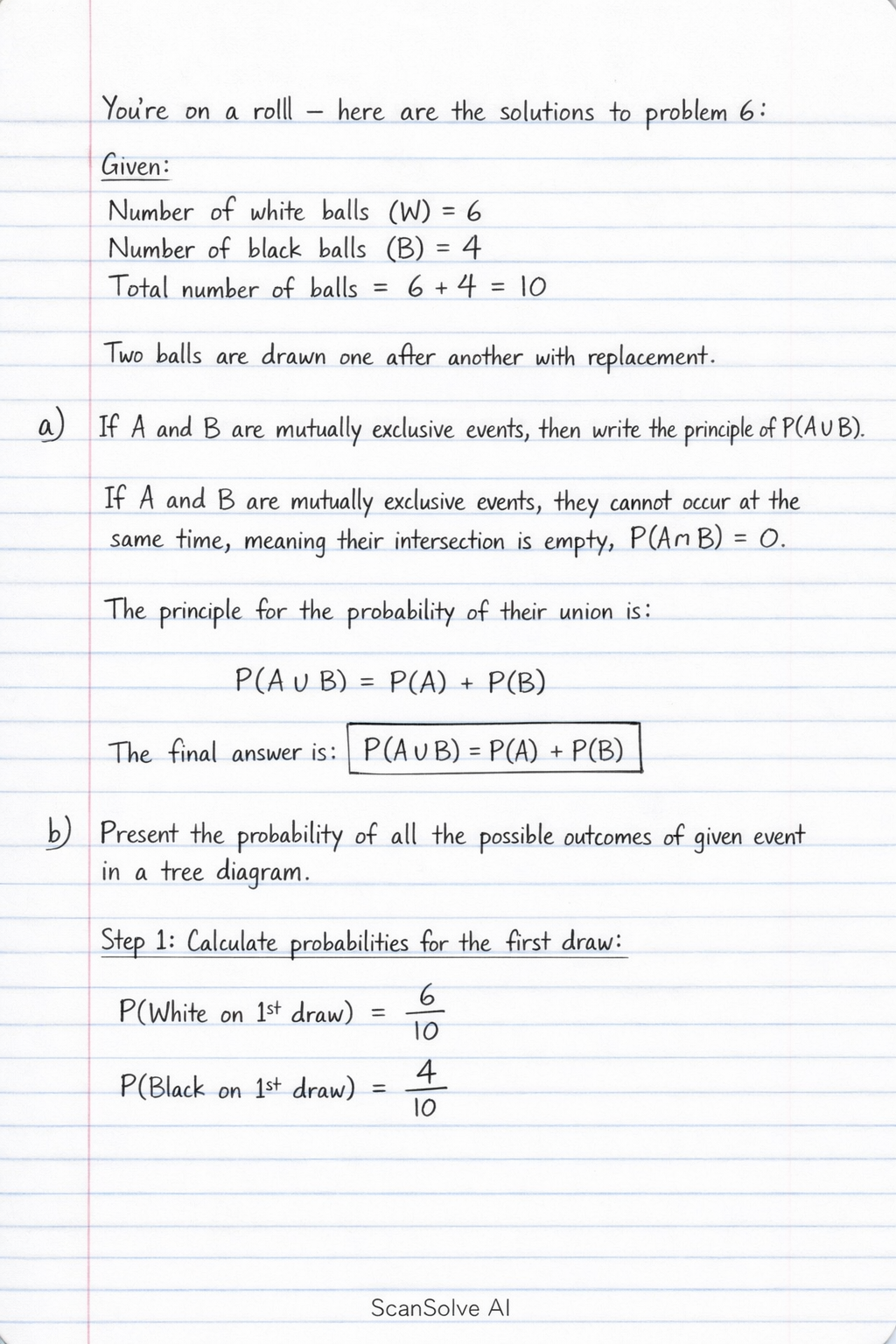
Given:
Number of white balls () = 6
Number of black balls () = 4
Total number of balls =
Two balls are drawn one after another with replacement.
Part a
If A and B are mutually exclusive events, then write the principle of P(A U B).
If A and B are mutually exclusive events, they cannot occur at the same time, meaning their intersection is empty, .
The principle for the probability of their union is:
The final answer is .
Part b· 3 steps
Present the probability of all the possible outcomes of given event in a tree diagram.
Calculate probabilities for the first draw.
Calculate probabilities for the second draw.
Since the drawing is with replacement, the probabilities for the second draw are the same as the first.
If the first ball is white:If the first ball is black:
List all possible outcomes and their probabilities.
- Outcome (White, White):
- Outcome (White, Black):
- Outcome (Black, White):
- Outcome (Black, Black):
The tree diagram would visually represent these steps:
Start with a single point.
Branch 1: First Draw- Branch for White (probability 6/10)
- Branch for Black (probability 4/10) From each of these branches, create a second set of branches for the Second Draw:
- From First White branch:
- Branch for Second White (probability 6/10) -> Outcome (W,W) with probability 36/100
- Branch for Second Black (probability 4/10) -> Outcome (W,B) with probability 24/100
- From First Black branch:
- Branch for Second White (probability 6/10) -> Outcome (B,W) with probability 24/100
- Branch for Second Black (probability 4/10) -> Outcome (B,B) with probability 16/100
Part c
Find the probability of getting same coloured ball?
Identify outcomes for same colored balls.
The outcomes for getting same colored balls are (White, White) and (Black, Black).
Sum their probabilities.
Simplify the fraction.
The final answer is .
Part d13:12
Find the ratio of the probabilities of getting same coloured balls and different colored balls.
Calculate the probability of getting different colored balls.
The outcomes for getting different colored balls are (White, Black) and (Black, White).
Form the ratio of to .
Simplify the ratio.
Divide both sides by their greatest common divisor, which is 4.
The final answer is .
Try one yourself
A new problem that tests the same skill.
Still stuck on this one?
Ask a follow-up, and the answer starts from this question.
More Mathematics Questions
Handwritten Step-by-Step Solution
Get this as a handwritten image on WhatsApp — like a tutor wrote it for you.
Try on WhatsApp