
We read your photo as:
A bucket in the shape of a frustum of a cone has top diameter 40 cm, bottom diameter 30 cm and height 30 cm. A cylindrical tank of radius 1.2 m and height 1.35 m is initially three-fifths full of wate
ScanSolve AI Answer
Step-by-step solution
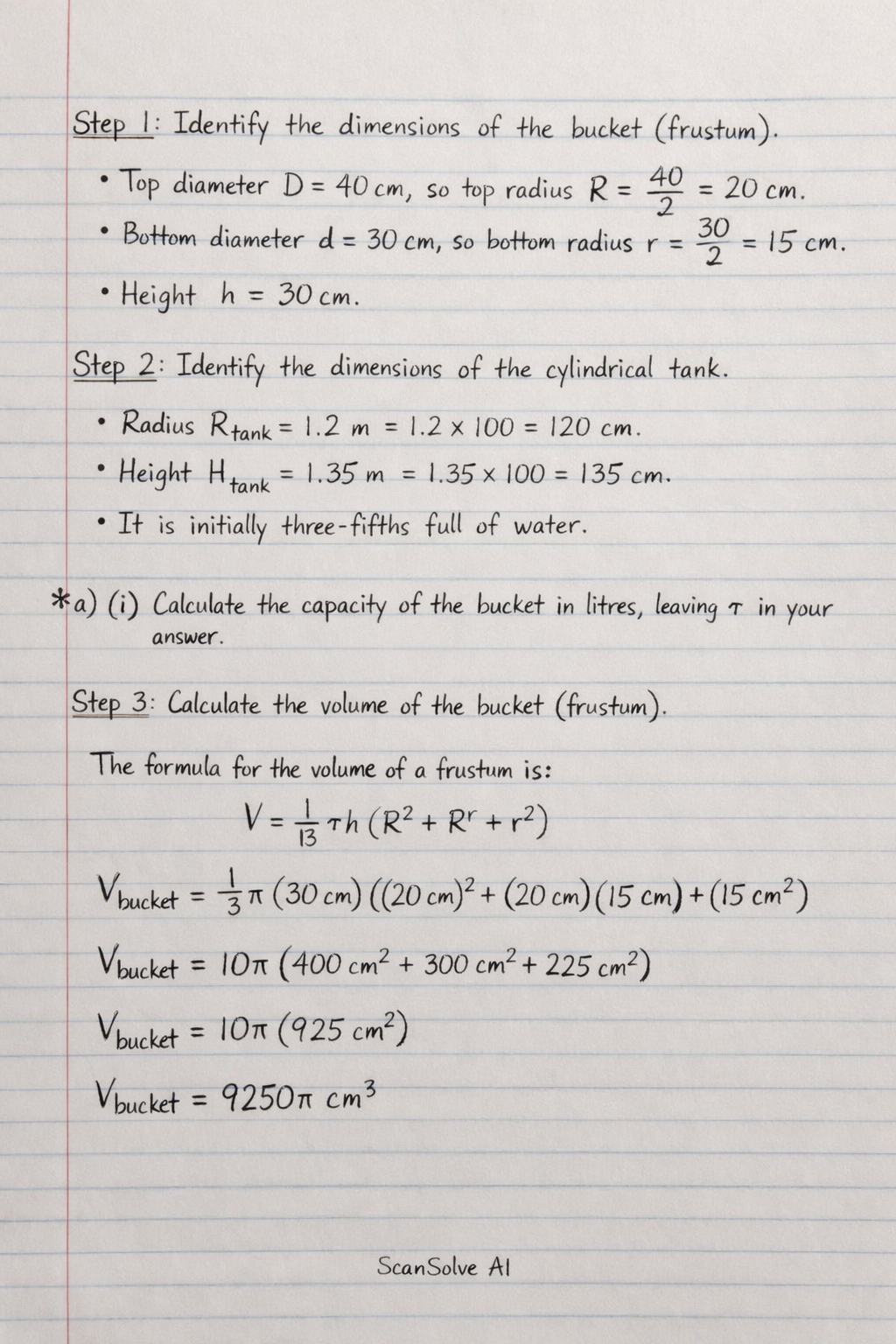
8 stepsIdentify the dimensions of the bucket (frustum).
The bucket is a frustum with:
- Top diameter cm, so top radius cm.
- Bottom diameter cm, so bottom radius cm.
- Height cm.
Identify the dimensions of the cylindrical tank.
The cylindrical tank has:
- Radius m cm.
- Height m cm.
- It is initially three-fifths full of water.
a) (i) Calculate the capacity of the bucket in litres, leaving in your answer.
Calculate the volume of the bucket (frustum).
The formula for the volume of a frustum is .
Convert the bucket's volume to litres.
Since :
The capacity of the bucket is .
a) (ii) Calculate the volume of water required to fill the tank in litres.
Calculate the total volume of the cylindrical tank.
The formula for the volume of a cylinder is .
Calculate the volume of water required to fill the tank.
The tank is initially three-fifths full, so the remaining volume to fill is two-fifths of the total volume.
Convert the required volume to litres.
The volume of water required to fill the tank is .
b) Calculate the number of buckets that must be drawn to fill the tank.
Calculate the number of buckets needed.
Divide the volume of water required by the capacity of one bucket.
Since you cannot use a fraction of a bucket, round up to the nearest whole number.
The number of buckets that must be drawn to fill the tank is .
Still stuck on this one?
Ask a follow-up, and the answer starts from this question.
More Mathematics Questions
Handwritten Step-by-Step Solution
Get this as a handwritten image on WhatsApp — like a tutor wrote it for you.
Try on WhatsApp