
We read your photo as:
A businessman sells 60% of his wares at a profit of 15%. The remainder is sold at a loss of 25%. What is the percentage profit or loss on the sale of the whole wares?
ScanSolve AI Answer
Answers
3 partsStep-by-step solution
8 stepsHere are the solutions to your questions.
Part 1· 4 steps
A businessman sells 60% of his wares at a profit of 15%. The remainder is sold at a loss of 25%. What is the percentage profit or loss on the sale of the whole wares?
Calculate the selling price for the first 60% of wares.
Let the total cost price of the wares be .
The cost price of 60% of the wares is .
The profit on this portion is 15%, so the selling price () is:Calculate the selling price for the remaining 40% of wares.
The remainder is of the wares.
The cost price of this portion is .
The loss on this portion is 25%, so the selling price () is:Calculate the total selling price and compare it to the total cost price.
The total selling price () is the sum of and :
The total cost price is .
Since is less than , there is an overall loss.Calculate the percentage loss.
The total loss is .
The percentage loss is:The percentage profit or loss on the sale of the whole wares is a 1% loss.
Part 2
The coordinates of the vertices of a parallelogram are , , and .
Part a(4, -4)
Find and .
Find vector .
To find , subtract the coordinates of A from B:
Find vector .
To find , subtract the coordinates of D from C:
So, and .
Part b(1, 4)
Find the coordinates of D.
Use the property of a parallelogram that opposite sides are equal and parallel.
For a parallelogram ABCD, .
Equating the components of the vectors from Step 1 and Step 2:Equating the x-components:
Equating the y-components:
The coordinates of D are .
Part c5.1
Calculate $|DB|$ correct to one decimal place.
Calculate the distance between points D and B.
The coordinates are and .
The distance formula is .Calculating the numerical value and rounding to one decimal place:
Still stuck on this one?
Ask a follow-up, and the answer starts from this question.
More Mathematics Questions
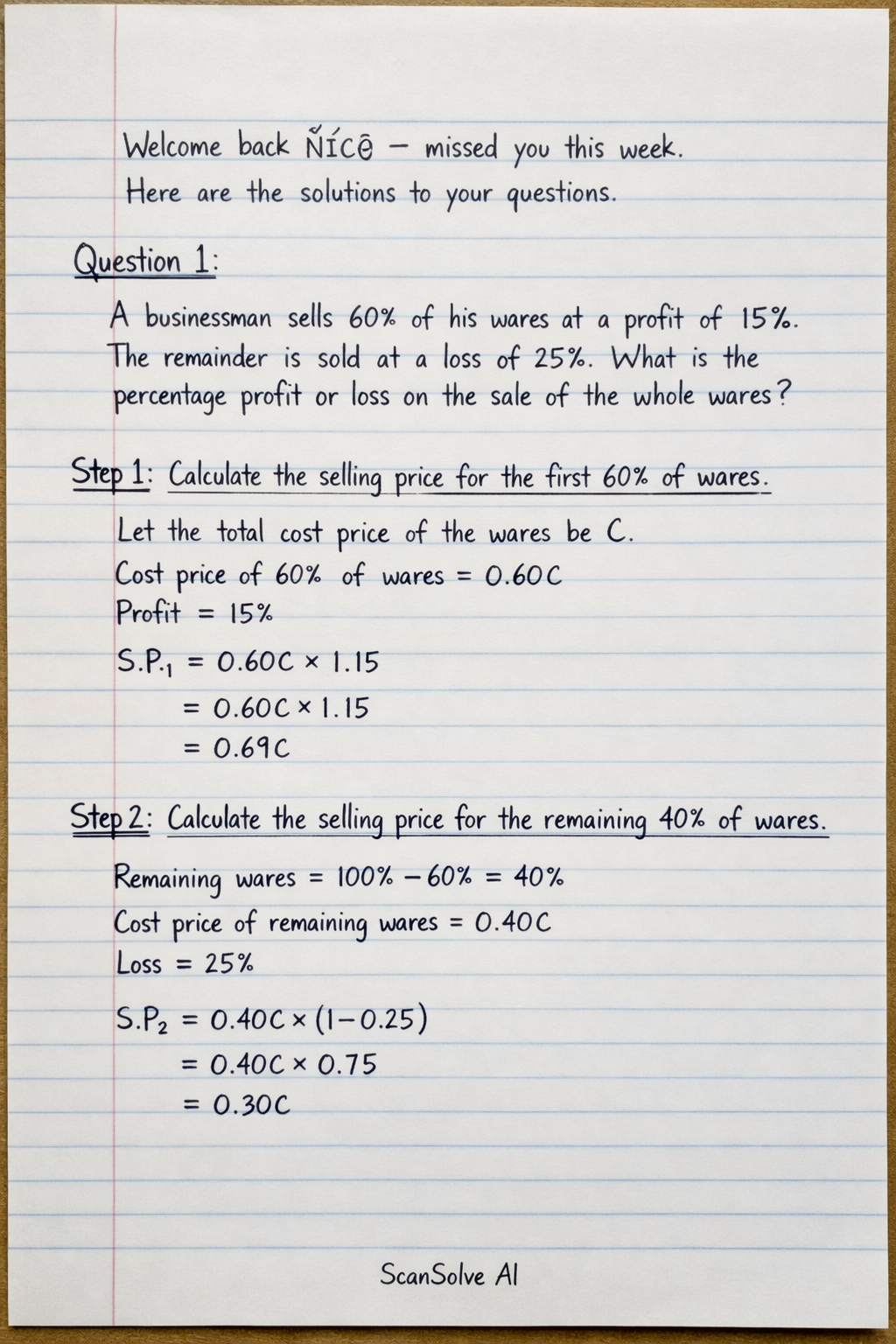
Handwritten Step-by-Step Solution
Get this as a handwritten image on WhatsApp — like a tutor wrote it for you.
Try on WhatsApp