
We read your photo as:
A cellular network offers two plans. Plan 1 costs R2.50 per minute. Plan 2 costs R10 plus R3 per minute. Which plan is cheaper for 20 minutes? Explain how changes in fixed fees and per-minute costs af
ScanSolve AI Answer
Step-by-step solution
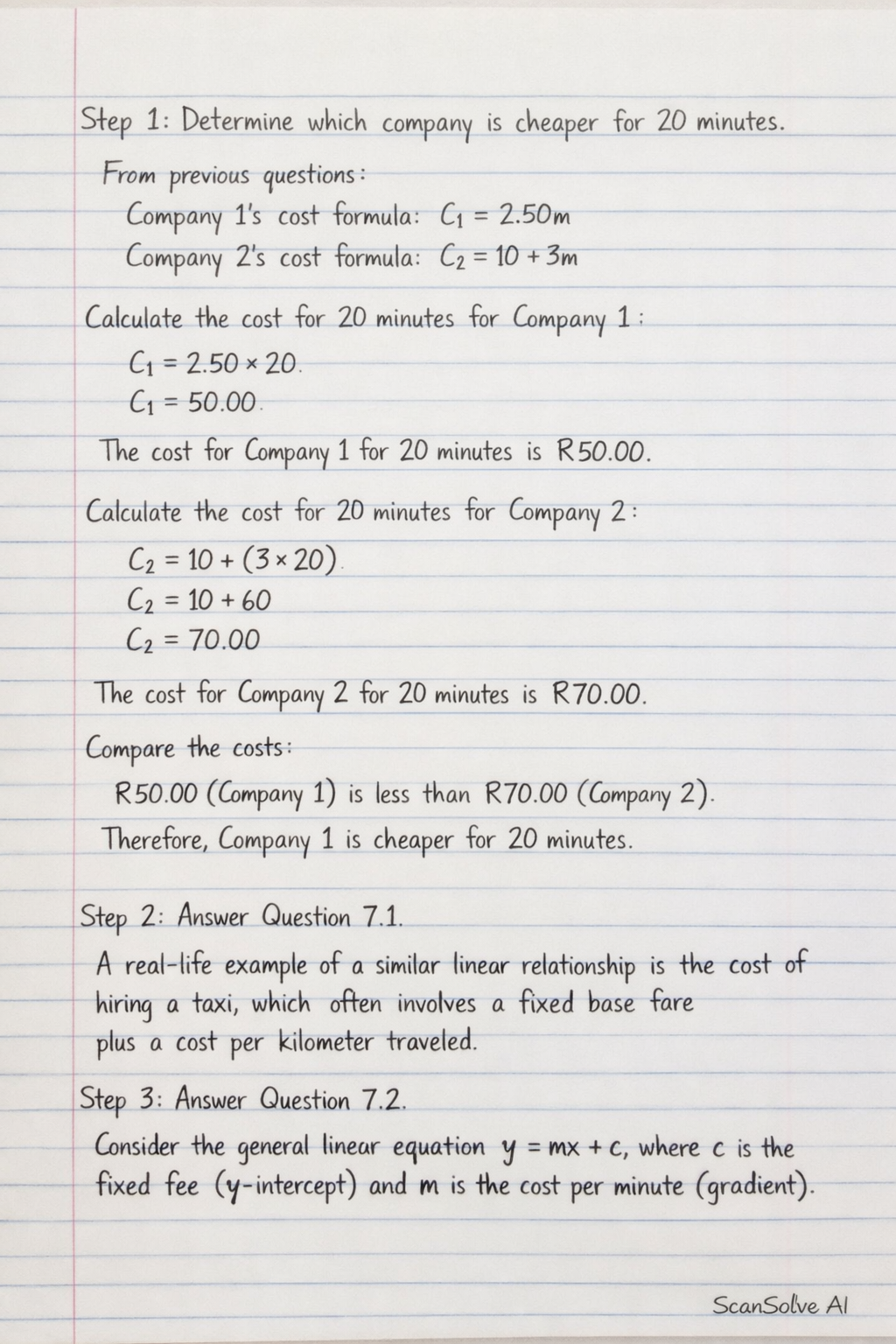
3 stepsDetermine which company is cheaper for 20 minutes.
From previous questions:
Company 1's cost formula:
Company 2's cost formula:Calculate the cost for 20 minutes for Company 1:
The cost for Company 1 for 20 minutes is R50.00.
Calculate the cost for 20 minutes for Company 2:
The cost for Company 2 for 20 minutes is R70.00.
Compare the costs:
R50.00 (Company 1) is less than R70.00 (Company 2).
Therefore, Company 1 is cheaper for 20 minutes.Answer Question 7.1.
A real-life example of a similar linear relationship is the cost of hiring a taxi, which often involves a fixed base fare plus a cost per kilometer traveled.
Answer Question 7.2.
Consider the general linear equation , where is the fixed fee (y-intercept) and is the cost per minute (gradient).
-
If the fixed fee increases: The graph will shift upwards parallel to its original position. The y-intercept will move higher on the y-axis.
-
If the cost per minute increases: The graph will become steeper. The gradient of the line will increase, causing it to rotate upwards around the y-intercept.
-
Still stuck on this one?
Ask a follow-up, and the answer starts from this question.
More Mathematics Questions
Handwritten Step-by-Step Solution
Get this as a handwritten image on WhatsApp — like a tutor wrote it for you.
Try on WhatsApp