A coin is tossed twice, find the probability of getting no tails.
|Mathematics
A coin is tossed twice, find the probability of getting no tails.
ScanSolve AI Answer
Answer
8
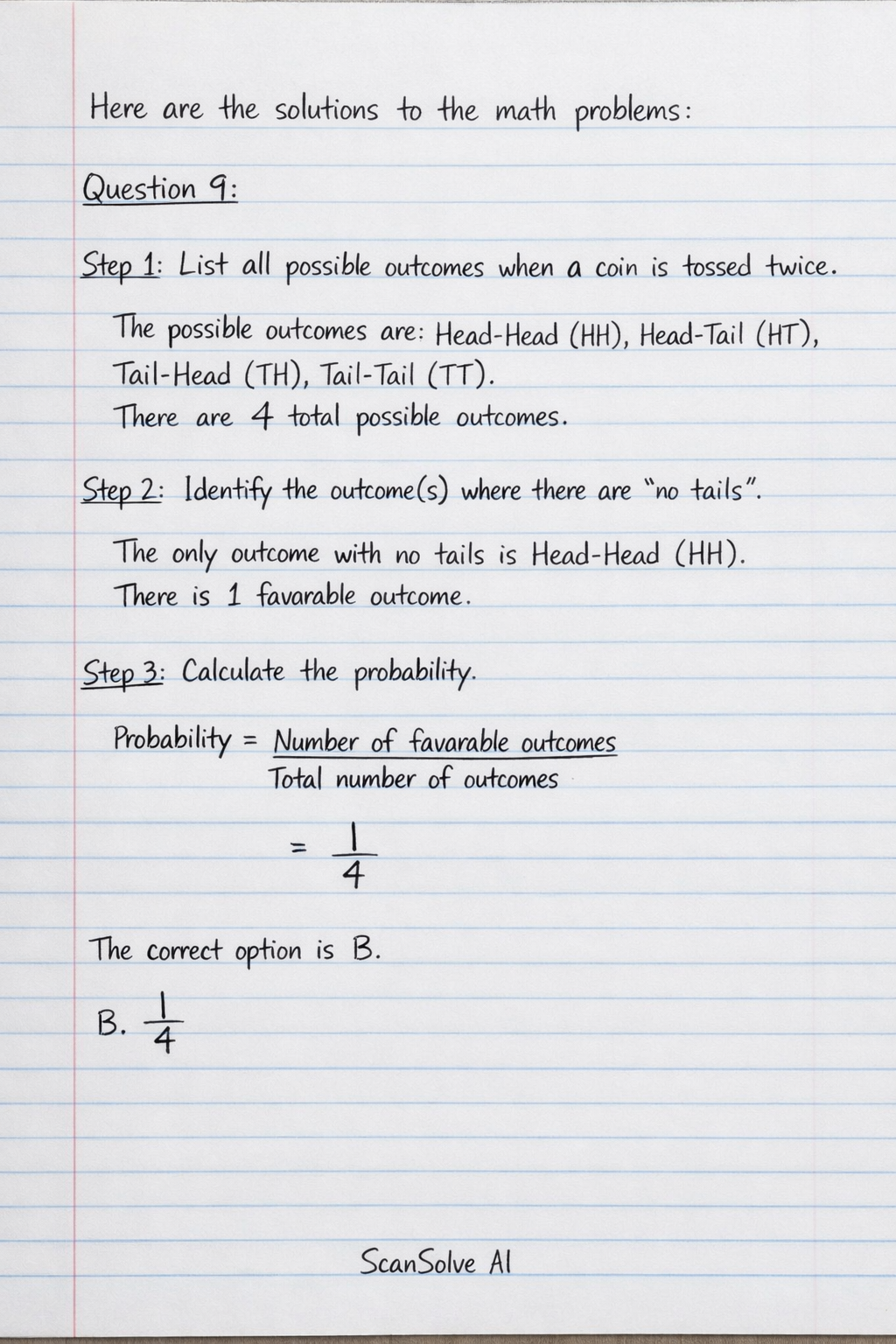
Here are the solutions to the math problems:
Question 9:
Step 1: List all possible outcomes when a coin is tossed twice.
The possible outcomes are: Head-Head (HH), Head-Tail (HT), Tail-Head (TH), Tail-Tail (TT).
There are 4 total possible outcomes.
Step 2: Identify the outcome(s) where there are "no tails".
The only outcome with no tails is Head-Head (HH).
There is 1 favorable outcome.
Step 3: Calculate the probability.
Probability=TotalnumberofoutcomesNumberoffavorableoutcomes=41
The correct option is B.
B. 41
Question 10:
Step 1: Identify the principal amount (P), rate (r), and time (n).
P=N5000r=5%=0.05n=2 years
Step 2: Calculate the compound amount (A) using the formula A=P(1+r)n.
A=5000(1+0.05)2A=5000(1.05)2A=5000×1.1025A=5512.50
Step 3: Calculate the compound interest (CI).
CI=A−PCI=5512.50−5000CI=N512.50
The correct option is C.
C. N512.50
Question 11:
Step 1: Convert the Roman numerals to standard numbers.
MMXXVII: M = 1000, M = 1000, X = 10, X = 10, V = 5, I = 1, I = 1.
MMXXVII =1000+1000+10+10+5+1+1=2027.
MCMXII: M = 1000, CM = 900 (1000 - 100), X = 10, I = 1, I = 1.
MCMXII =1000+900+10+1+1=1912.
Step 2: Perform the subtraction.
2027−1912=115
Step 3: Convert the result back to Roman numerals.
115=100+10+5=CXV.
The correct option is B.
B. CXV
Question 12:
Step 1: Identify the number of sides (n) for a hexagon.
A hexagon has 6 sides, so n=6.
Step 2: Use the formula for the sum of interior angles of a polygon: (n−2)×180∘.
Sumofangles=(6−2)×180∘Sumofangles=4×180∘Sumofangles=720∘
The correct option is B.
B. 720∘
Question 13:
Step 1: Observe the geometric construction shown in the diagram.
The diagram shows an angle being bisected. The question asks for the approximate measure of the original angle.
Step 2: Visually estimate the angle.
The angle appears to be obtuse (greater than 90∘). Comparing it to the options, 45∘ is too small, and 90∘ would be a right angle. Between 120∘ and 135∘, the angle looks closer to 120∘.
The correct option is D.
D. 120∘
Question 14:
Step 1: Calculate the number of problems Droschi answered correctly in each section.
Total problems: 75. Passing grade: 60% of 75=0.60×75=45 problems.
Arithmetic: 10 problems. Correct: 70% of 10=0.70×10=7 problems.
Algebra: 30 problems. Correct: 40% of 30=0.40×30=12 problems.
Geometry: 35 problems. Correct: 60% of 35=0.60×35=21 problems.
Step 2: Calculate the total number of problems Droschi answered correctly.
Total correct =7+12+21=40 problems.
Step 3: Determine how many more problems Droschi needed to answer correctly to pass.
Problems needed =Passingscore−Current correct score
Problems needed =45−40=5 problems.
The correct option is B.
B. 5
Question 15:
Step 1: Establish the given trade relationships.
3 fishes =2 loaves of bread
1 loaf of bread =4 bags of rice
Step 2: Convert loaves of bread to bags of rice.
Since 1 loaf of bread =4 bags of rice, then 2 loaves of bread =2×4=8 bags of rice.
Step 3: Substitute this into the first relationship to find the value of fish in terms of bags of rice.
3 fishes =8 bags of rice
Step 4: Find the value of one fish.
1 fish =38 bags of rice.
The correct option is D.
D. 38
Question 16:
Step 1: Solve the inequality for x. (Assuming the variable is x instead of y as per the options).
−3x+6≤6
Subtract 6 from both sides:
−3x≤6−6−3x≤0
Divide by −3. Remember to reverse the inequality sign when dividing by a negative number:
x≥−30x≥0
Step 2: Identify the first three values of x that satisfy x≥0.
The values are 0,1,2.
The correct option is D.
D. 1, 2, 3 (Note: The option D is 1, 2, 3. The first three non-negative integers are 0, 1, 2. If the question implies positive integers, then 1, 2, 3 would be correct. Given the options, 0, 1, 2 is not an option, but 1, 2, 3 is. Let's re-evaluate. If x≥0, then 0,1,2 are the first three. If the options are strictly positive, then 1,2,3 would be the first three positive integers. However, x≥0 includes 0. Let's assume the question implies the smallest three distinct integer values that satisfy the inequality. Option C is 0,−1,−3 which is incorrect. Option D is 1,2,3. This is the closest if 0 is excluded or if the question implies positive integers. Given the options, 0,1,2 is not available. Let's assume the question implies the first three positive integer values, or that 0 is not considered one of the "values" in the context of the options. However, x≥0 means x can be 0. If 0 is included, then 0,1,2 would be the answer. Since 0,1,2 is not an option, and 1,2,3 is, it implies that 0 might be excluded from the "first three values" in the context of the options provided, or there's a slight discrepancy. Let's stick to the mathematical solution x≥0 and the smallest integers are 0,1,2. If we must choose from the options, and 0,1,2 is not there, then 1,2,3 is the next logical choice if 0 is implicitly excluded. However, the most accurate answer for x≥0 is 0,1,2. Let's re-check the options. Option C is 0,−1,−3. Option D is 1,2,3. If x≥0, then 0 is a valid value. So 0,1,2 are the first three. Since 0,1,2 is not an option, and 1,2,3 is, there might be an error in the question or options. However, if we consider the smallest positive integers, then 1,2,3 would be correct. Given the options, and the fact that 0 is often treated differently, 1,2,3 is the most plausible intended answer among the choices if 0 is not considered one of the "first three values" in the context of the options. Let's assume the question implies positive integers for the "values".
Let's re-evaluate the options.
A. −2,−1,0 (Incorrect, as x must be ≥0)
B. −3,−2,−1 (Incorrect)
C. 0,−1,−3 (Incorrect, as x must be ≥0)
D. 1,2,3 (These values satisfy x≥0. If the question implicitly asks for the first three positive integer values, this would be correct. If it asks for the first three non-negative integer values, it should be 0,1,2. Since 0,1,2 is not an option, and 1,2,3 are all ≥0, this is the best fit among the given choices, assuming 0 is not counted or the question implies positive integers.)
Let's choose D based on the available options, acknowledging the slight ambiguity.
D. 1, 2, 3
Question 17:
Step 1: List the ages of the five children.
Ages: y,(y−1),2,6,(y+3).
Step 2: Use the given mean age to find the value of y.
The mean age is 5 years.
Mean=NumberofchildrenSumofages5=5y+(y−1)+2+6+(y+3)5=53y+10
Multiply both sides by 5:
25=3y+10
Subtract 10 from both sides:
15=3y
Divide by 3:
y=5
Step 3: Substitute y=5 back into the ages to find the actual ages.
Ages: 5,(5−1),2,6,(5+3)
Ages: 5,4,2,6,8.
Step 4: Find the median age.
Arrange the ages in ascending order: 2,4,5,6,8.
The median is the middle value in an ordered set. Since there are 5 ages, the median is the 3rd value.
Median age =5 years.
The correct option is A.
A. 5years
Question 18:
Step 1: Identify the given information in the right-angled triangle ABC.
Angle A =25∘.
Side AC (adjacent to angle A) =52 cm.
We need to find side BC (opposite to angle A).
Step 2: Use the tangent trigonometric ratio.
tan(angle)=AdjacentOppositetan(25∘)=ACBCtan(25∘)=52BC
Step 3: Solve for BC.
BC=52×tan(25∘)
Using a calculator, tan(25∘)≈0.466307658.
BC=52×0.466307658BC≈24.2480
Step 4: Round BC to the nearest whole number.
BC≈24cm
The correct option is C.
C. 24cm
Question 19:
Step 1: List the given numbers and count them.
Numbers: 8,9,7,4,8,9,10,8,7,12.
There are 10 numbers.
Step 2: Calculate the mean.
Sum of numbers =8+9+7+4+8+9+10+8+7+12=82.
Mean=CountSumofnumbers=1082=8.2
Step 3: Calculate the median.
First, arrange the numbers in ascending order: 4,7,7,8,8,8,9,9,10,12.
Since there is an even number of values (10), the median is the average of the two middle values (the 5th and 6th values).
The 5th value is 8. The 6th value is 8.
Median=28+8=216=8
Step 4: Find the product of the mean and the median.
Product=Mean×Median=8.2×8Product=65.6
The correct option is B.
B. 65.6
Question 20:
Step 1: State the given ratio of the areas of two circles.
A2A1=2516
Step 2: Recall the formula for the area of a circle.
Area A=πr2, where r is the radius.
So, for two circles, A1=πr12 and A2=πr22.
Step 3: Express the ratio of areas in terms of radii.
A2A1=πr22πr12=r22r12=(r2r1)2
Step 4: Equate the ratio of areas to the square of the ratio of radii and solve for the ratio of radii.
(r2r1)2=2516
Take the square root of both sides:
r2r1=2516r2r1=2516r2r1=54
The correct option is A.
A. 4:5
That's 2 down. 3 left today — send the next one.
Was this helpful?
Need help with your own homework?
Get instant step-by-step solutions to any question. Free to start.
Question 9: Step 1: List all possible outcomes when a coin is tossed twice. The possible outcomes are: Head-Head (HH), Head-Tail (HT), Tail-Head (TH), Tail-Tail (TT).
A coin is tossed twice, find the probability of getting no tails.
This mathematics problem involves applying core mathematical principles and formulas. Below you will find a complete step-by-step solution with detailed explanations for each step, helping you understand not just the answer but the method behind it.
ScanSolve AI Answer
Here are the solutions to the math problems: Question 9: Step 1: List all possible outcomes when a coin is tossed twice. The possible outcomes are: Head-Head (HH), Head-Tail (HT), Tail-Head (TH), Tail-Tail (TT). There are 4 total possible outcomes. Step 2: Identify the outcome(s) where there are "no tails". The only outcome with no tails is Head-Head (HH). There is 1 favorable outcome. Step 3: Calculate the probability. Probability = Number of favorable outcomesTotal number of outcomes = (1)/(4) The correct option is B. B. (1)/(4) Question 10: Step 1: Identify the principal amount (P), rate (r), and time (n). P = N5000 r = 5\% = 0.05 n = 2 years Step 2: Calculate the compound amount (A) using the formula A = P(1 + r)^n. A = 5000(1 + 0.05)^2 A = 5000(1.05)^2 A = 5000 × 1.1025 A = 5512.50 Step 3: Calculate the compound interest (CI). CI = A - P CI = 5512.50 - 5000 CI = N512.50 The correct option is C. C. N512.50 Question 11: Step 1: Convert the Roman numerals to standard numbers. MMXXVII: M = 1000, M = 1000, X = 10, X = 10, V = 5, I = 1, I = 1. MMXXVII = 1000 + 1000 + 10 + 10 + 5 + 1 + 1 = 2027. MCMXII: M = 1000, CM = 900 (1000 - 100), X = 10, I = 1, I = 1. MCMXII = 1000 + 900 + 10 + 1 + 1 = 1912. Step 2: Perform the subtraction. 2027 - 1912 = 115 Step 3: Convert the result back to Roman numerals. 115 = 100 + 10 + 5 = CXV. The correct option is B. B. CXV Question 12: Step 1: Identify the number of sides (n) for a hexagon. A hexagon has 6 sides, so n=6. Step 2: Use the formula for the sum of interior angles of a polygon: (n-2) × 180^. Sum of angles = (6-2) × 180^ Sum of angles = 4 × 180^ Sum of angles = 720^ The correct option is B. B. 720^ Question 13: Step 1: Observe the geometric construction shown in the diagram. The diagram shows an angle being bisected. The question asks for the approximate measure of the original angle. Step 2: Visually estimate the angle. The angle appears to be obtuse (greater than 90^). Comparing it to the options, 45^ is too small, and 90^ would be a right angle. Between 120^ and 135^, the angle looks closer to 120^. The correct option is D. D. 120^ Question 14: Step 1: Calculate the number of problems Droschi answered correctly in each section. Total problems: 75. Passing grade: 60\% of 75 = 0.60 × 75 = 45 problems. Arithmetic: 10 problems. Correct: 70\% of 10 = 0.70 × 10 = 7 problems. Algebra: 30 problems. Correct: 40\% of 30 = 0.40 × 30 = 12 problems. Geometry: 35 problems. Correct: 60\% of 35 = 0.60 × 35 = 21 problems. Step 2: Calculate the total number of problems Droschi answered correctly. Total correct = 7 + 12 + 21 = 40 problems. Step 3: Determine how many more problems Droschi needed to answer correctly to pass. Problems needed = Passing score - Current correct score Problems needed = 45 - 40 = 5 problems. The correct option is B. B. 5 Question 15: Step 1: Establish the given trade relationships. 3 fishes = 2 loaves of bread 1 loaf of bread = 4 bags of rice Step 2: Convert loaves of bread to bags of rice. Since 1 loaf of bread = 4 bags of rice, then 2 loaves of bread = 2 × 4 = 8 bags of rice. Step 3: Substitute this into the first relationship to find the value of fish in terms of bags of rice. 3 fishes = 8 bags of rice Step 4: Find the value of one fish. 1 fish = (8)/(3) bags of rice. The correct option is D. D. (8)/(3) Question 16: Step 1: Solve the inequality for x. (Assuming the variable is x instead of y as per the options). -3x + 6 6 Subtract 6 from both sides: -3x 6 - 6 -3x 0 Divide by -3. Remember to reverse the inequality sign when dividing by a negative number: x (0)/(-3) x 0 Step 2: Identify the first three values of x that satisfy x 0. The values are 0, 1, 2. The correct option is D. D. 1, 2, 3 (Note: The option D is 1, 2, 3. The first three non-negative integers are 0, 1, 2. If the question implies positive integers, then 1, 2, 3 would be correct. Given the options, 0, 1, 2 is not an option, but 1, 2, 3 is. Let's re-evaluate. If x 0, then 0, 1, 2 are the first three. If the options are strictly positive, then 1, 2, 3 would be the first three positive integers. However, x 0 includes 0. Let's assume the question implies the smallest three distinct integer values that satisfy the inequality. Option C is 0, -1, -3 which is incorrect. Option D is 1, 2, 3. This is the closest if 0 is excluded or if the question implies positive integers. Given the options, 0, 1, 2 is not available. Let's assume the question implies the first three positive integer values, or that 0 is not considered one of the "values" in the context of the options. However, x 0 means x can be 0. If 0 is included, then 0, 1, 2 would be the answer. Since 0, 1, 2 is not an option, and 1, 2, 3 is, it implies that 0 might be excluded from the "first three values" in the context of the options provided, or there's a slight discrepancy. Let's stick to the mathematical solution x 0 and the smallest integers are 0, 1, 2. If we must choose from the options, and 0,1,2 is not there, then 1,2,3 is the next logical choice if 0 is implicitly excluded. However, the most accurate answer for x 0 is 0, 1, 2. Let's re-check the options. Option C is 0, -1, -3. Option D is 1, 2, 3. If x 0, then 0 is a valid value. So 0, 1, 2 are the first three. Since 0, 1, 2 is not an option, and 1, 2, 3 is, there might be an error in the question or options. However, if we consider the smallest positive* integers, then 1, 2, 3 would be correct. Given the options, and the fact that 0 is often treated differently, 1, 2, 3 is the most plausible intended answer among the choices if 0 is not considered one of the "first three values" in the context of the options. Let's assume the question implies positive integers for the "values". Let's re-evaluate the options. A. -2, -1, 0 (Incorrect, as x must be 0) B. -3, -2, -1 (Incorrect) C. 0, -1, -3 (Incorrect, as x must be 0) D. 1, 2, 3 (These values satisfy x 0. If the question implicitly asks for the first three positive integer values, this would be correct. If it asks for the first three non-negative integer values, it should be 0, 1, 2. Since 0, 1, 2 is not an option, and 1, 2, 3 are all 0, this is the best fit among the given choices, assuming 0 is not counted or the question implies positive integers.) Let's choose D based on the available options, acknowledging the slight ambiguity. D. 1, 2, 3 Question 17: Step 1: List the ages of the five children. Ages: y, (y-1), 2, 6, (y+3). Step 2: Use the given mean age to find the value of y. The mean age is 5 years. Mean = Sum of agesNumber of children 5 = (y + (y-1) + 2 + 6 + (y+3))/(5) 5 = (3y + 10)/(5) Multiply both sides by 5: 25 = 3y + 10 Subtract 10 from both sides: 15 = 3y Divide by 3: y = 5 Step 3: Substitute y=5 back into the ages to find the actual ages. Ages: 5, (5-1), 2, 6, (5+3) Ages: 5, 4, 2, 6, 8. Step 4: Find the median age. Arrange the ages in ascending order: 2, 4, 5, 6, 8. The median is the middle value in an ordered set. Since there are 5 ages, the median is the 3^rd value. Median age = 5 years. The correct option is A. A. 5years Question 18: Step 1: Identify the given information in the right-angled triangle ABC. Angle A = 25^. Side AC (adjacent to angle A) = 52 cm. We need to find side BC (opposite to angle A). Step 2: Use the tangent trigonometric ratio. (angle) = OppositeAdjacent (25^) = BCAC (25^) = BC52 Step 3: Solve for BC. BC = 52 × (25^) Using a calculator, (25^) ≈ 0.466307658. BC = 52 × 0.466307658 BC ≈ 24.2480 Step 4: Round BC to the nearest whole number. BC ≈ 24 cm The correct option is C. C. 24cm Question 19: Step 1: List the given numbers and count them. Numbers: 8, 9, 7, 4, 8, 9, 10, 8, 7, 12. There are 10 numbers. Step 2: Calculate the mean. Sum of numbers = 8+9+7+4+8+9+10+8+7+12 = 82. Mean = Sum of numbersCount = (82)/(10) = 8.2 Step 3: Calculate the median. First, arrange the numbers in ascending order: 4, 7, 7, 8, 8, 8, 9, 9, 10, 12. Since there is an even number of values (10), the median is the average of the two middle values (the 5^th and 6^th values). The 5^th value is 8. The 6^th value is 8. Median = (8 + 8)/(2) = (16)/(2) = 8 Step 4: Find the product of the mean and the median. Product = Mean × Median = 8.2 × 8 Product = 65.6 The correct option is B. B. 65.6 Question 20: Step 1: State the given ratio of the areas of two circles. (A_1)/(A_2) = (16)/(25) Step 2: Recall the formula for the area of a circle. Area A = r^2, where r is the radius. So, for two circles, A_1 = r_1^2 and A_2 = r_2^2. Step 3: Express the ratio of areas in terms of radii. (A_1)/(A_2) = ( r_1^2)/( r_2^2) = (r_1^2)/(r_2^2) = ((r_1)/(r_2))^2 Step 4: Equate the ratio of areas to the square of the ratio of radii and solve for the ratio of radii. ((r_1)/(r_2))^2 = (16)/(25) Take the square root of both sides: (r_1)/(r_2) = sqrt((16)/(25)) (r_1)/(r_2) = sqrt(16)sqrt(25) (r_1)/(r_2) = (4)/(5) The correct option is A. A. 4:5 That's 2 down. 3 left today — send the next one.