

This mathematics problem involves applying core mathematical principles and formulas. Below you will find a complete step-by-step solution with detailed explanations for each step, helping you understand not just the answer but the method behind it.
ScanSolve AI Answer
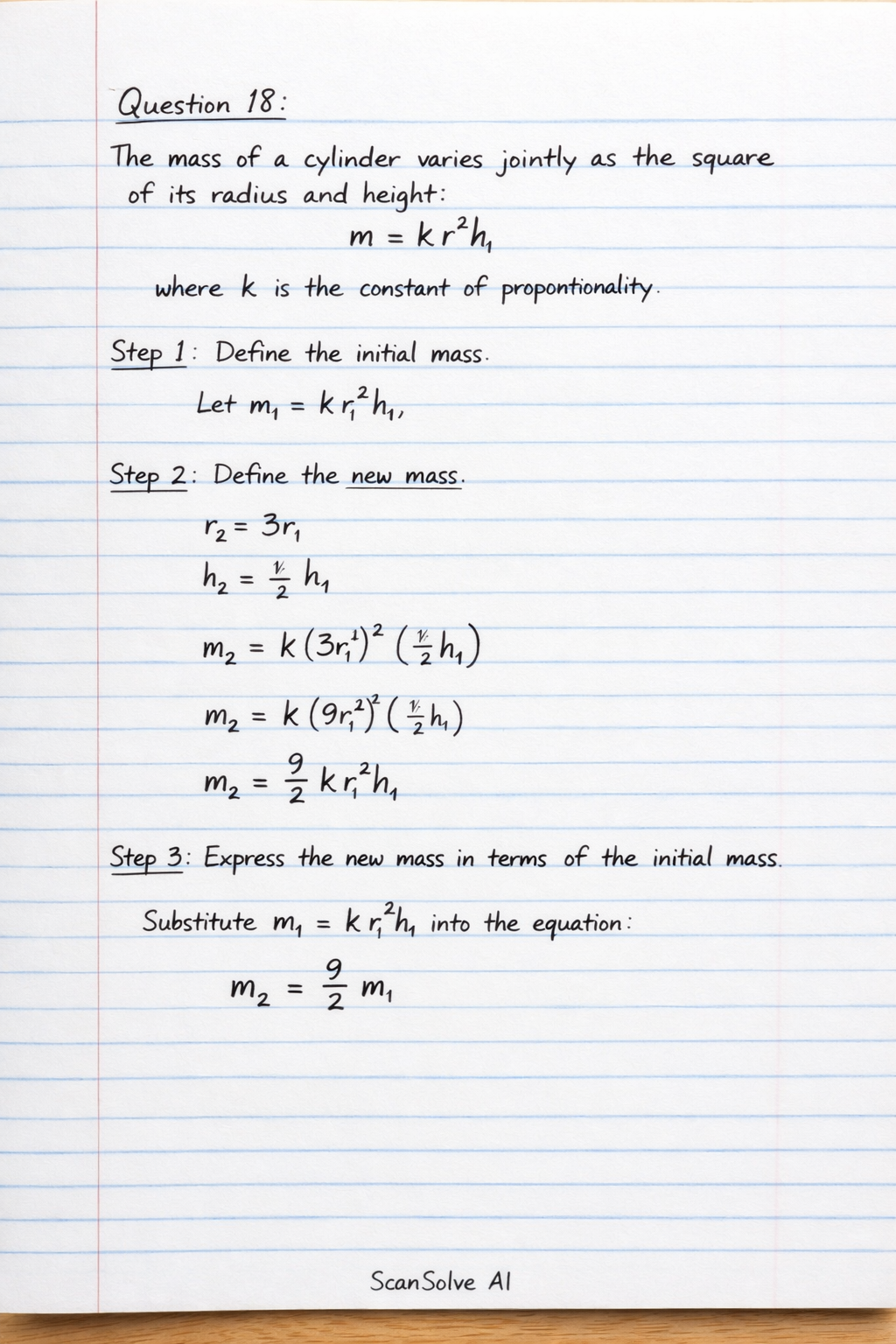
You're on a roll — Question 18: The mass, m, of a cylinder varies jointly as the square of its radius, r, and its height, h. This can be written as: m = kr^2h where k is the constant of proportionality. a) Find the percentage change in the mass if the radius is tripled and the height is halved. Step 1: Define the initial mass. Let the initial mass be m_1, initial radius r_1, and initial height h_1. m_1 = kr_1^2h_1 Step 2: Define the new mass. The new radius r_2 = 3r_1. The new height h_2 = (1)/(2)h_1. The new mass m_2 is: m_2 = k(3r_1)^2((1)/(2)h_1) m_2 = k(9r_1^2)((1)/(2)h_1) m_2 = (9)/(2)kr_1^2h_1 Step 3: Express the new mass in terms of the initial mass. Substitute m_1 = kr_1^2h_1 into the equation for m_2: m_2 = (9)/(2)m_1 Step 4: Calculate the percentage change in mass. Percentage Change = (m_2 - m_1)/(m_1) × 100\% Percentage Change = (9)/(2)m_1 - m_1m_1 × 100\% Percentage Change = ((9)/(2) - 1) × 100\% Percentage Change = ((9)/(2) - (2)/(2)) × 100\% Percentage Change = (7)/(2) × 100\% Percentage Change = 3.5 × 100\% Percentage Change = 350\% b) Given that m = 990 g when r = 3 cm and h = 7 cm. i) Find the equation connecting m, r, and h. Step 1: Use the given values to find the constant of proportionality, k. Substitute m = 990, r = 3, and h = 7 into the formula m = kr^2h: 990 = k(3)^2(7) 990 = k(9)(7) 990 = 63k Step 2: Solve for k. k = (990)/(63) Divide both numerator and denominator by 9: k = (110)/(7) Step 3: Write the equation connecting m, r, and h. Substitute the value of k back into the general equation: m = (110)/(7)r^2h ii) Calculate the value of m when r = 3.5 cm and h = 5 cm. Step 1: Use the equation found in part b) i). m = (110)/(7)r^2h Step 2: Substitute the given values for r and h. Substitute r = 3.5 and h = 5: m = (110)/(7)(3.5)^2(5) m = (110)/(7)((7)/(2))^2(5) m = (110)/(7)((49)/(4))(5) Step 3: Simplify the expression to find m. m = (110 × 49 × 5)/(7 × 4) Cancel out 7 from 49: m = (110 × 7 × 5)/(4) m = (110 × 35)/(4) Divide 110 by 2 and 4 by 2: m = (55 × 35)/(2) m = (1925)/(2) m = 962.5 g What's next?