
We read your photo as:
A cylindrical can has a diameter of 55 mm and a height of 16 cm. Calculate its radius and total surface area (rounded to the nearest cm²).
ScanSolve AI Answer
Answers
3 partsStep-by-step solution
8 stepsHere are the solutions to the questions:
Part 3.1· 2 steps
Determine the radius of the can, in cm.
Identify the given diameter and convert it to centimeters.
The diameter of the can is given as .
Since , we convert the diameter to centimeters:Calculate the radius using the diameter.
The radius is half of the diameter.
The radius of the can is .
Part 3.2
Calculate the total surface area of the can, rounded to the nearest cm², if the radius of the can is rounded to 3 cm.
Identify the given values for radius, height, and .
For this calculation, the radius is given as .
The height of the can is .
The value of is given as 3.142.Use the formula for the surface area of a cylinder.
The formula for the surface area of a cylinder is:
Substitute the values into the formula and calculate.
Round the surface area to the nearest cm².
The total surface area of the can, rounded to the nearest cm², is .
Part 3.3
The area of the label of the can covers 35% of the total surface area of the can. Calculate the total area covered by the label of the can.
Identify the total surface area from the previous calculation and the percentage covered by the label.
Total surface area = (from question 3.2).
Percentage covered by the label = .Calculate the area covered by the label.
The total area covered by the label of the can is .
Try one yourself
A new problem that tests the same skill.
Still stuck on this one?
Ask a follow-up, and the answer starts from this question.
More Mathematics Questions
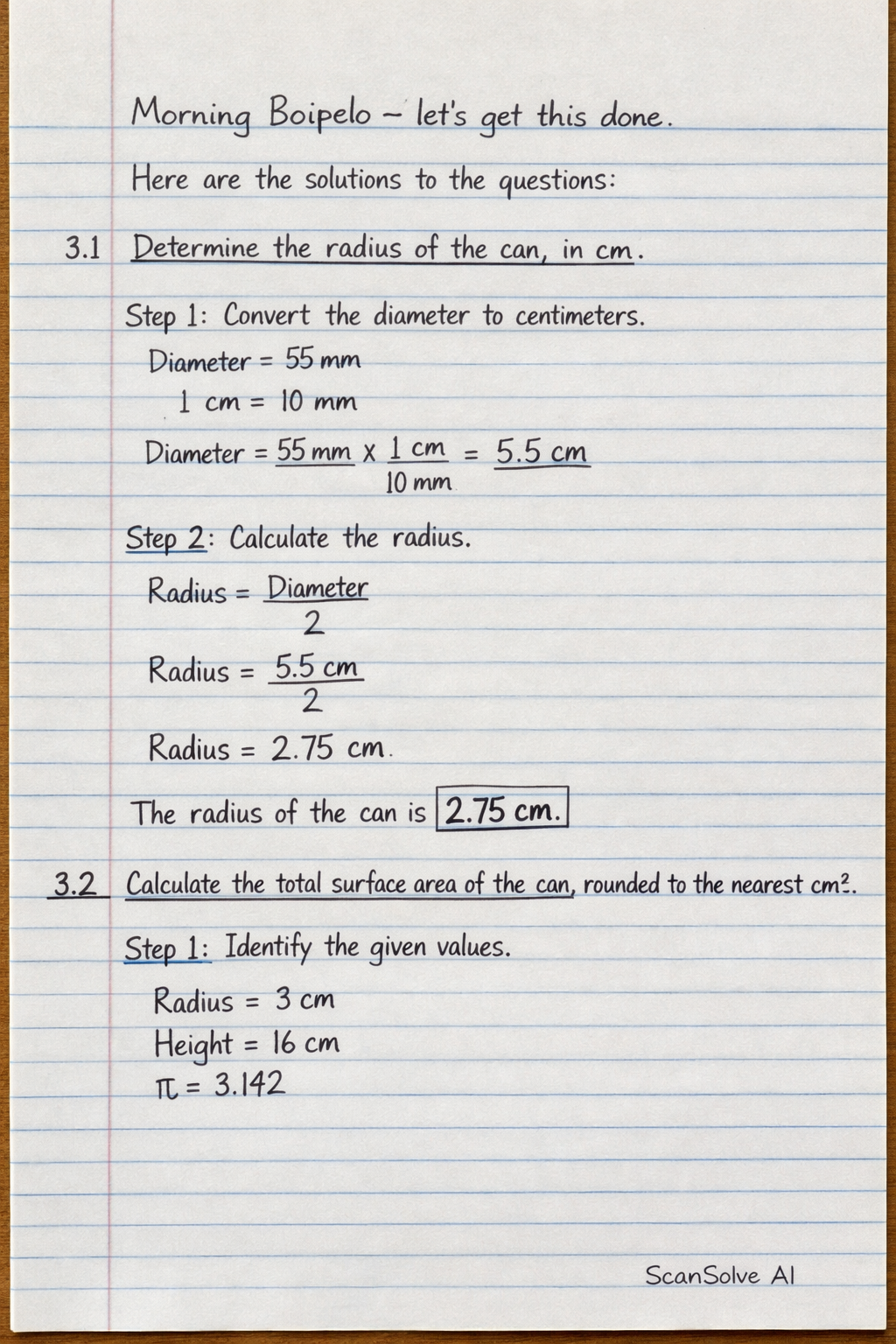
Handwritten Step-by-Step Solution
Get this as a handwritten image on WhatsApp — like a tutor wrote it for you.
Try on WhatsApp