

This mathematics problem involves applying core mathematical principles and formulas. Below you will find a complete step-by-step solution with detailed explanations for each step, helping you understand not just the answer but the method behind it.
ScanSolve AI Answer
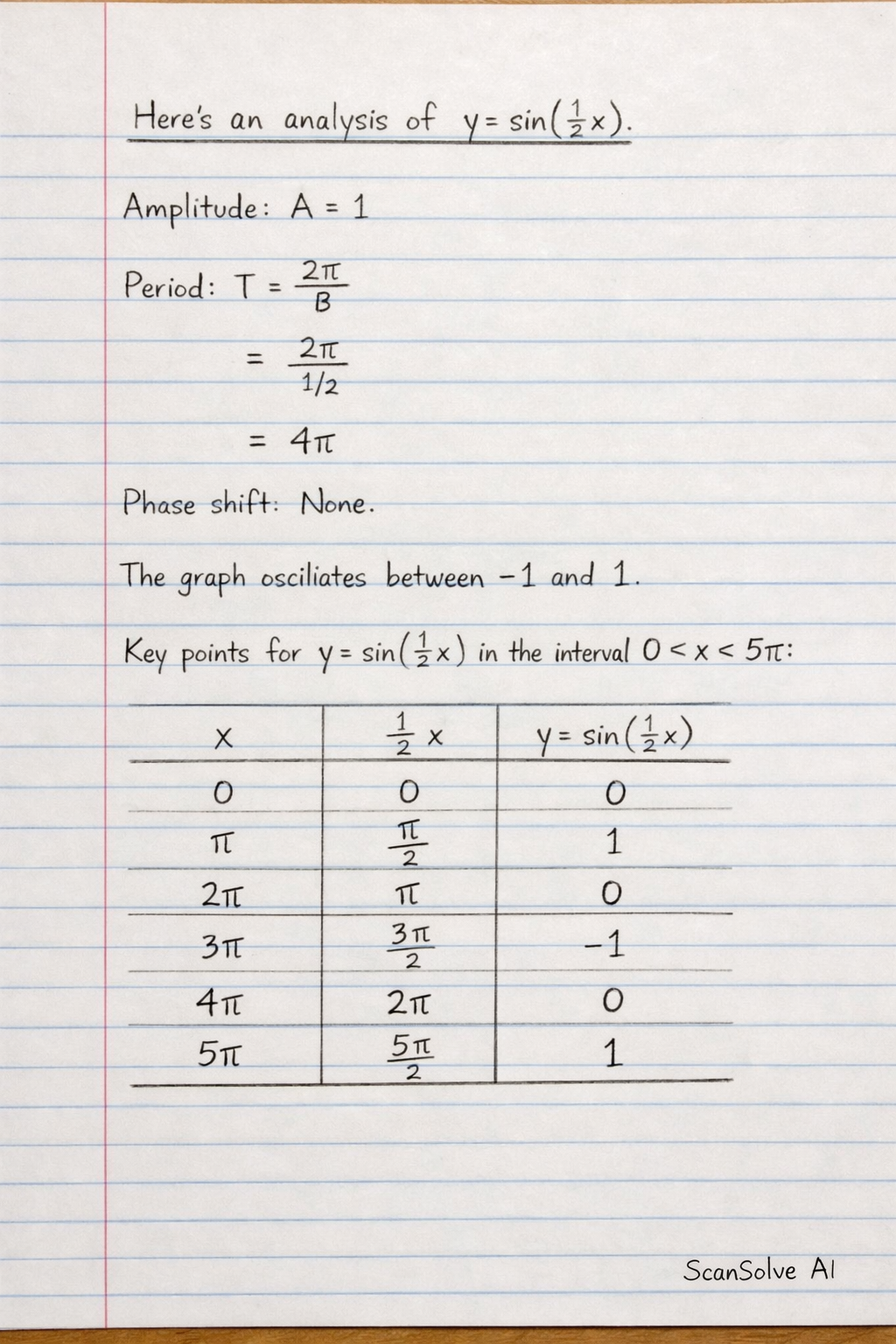
Here's how to approach this problem: a) Draw the graph of the functions of y= (1)/(2)x and y=3 ((1)/(2)x+()/(3)) on same axes for which 0 x 5. Step 1: Analyze the first function, y = ((1)/(2)x). This is a sine wave with: • Amplitude: A = 1 • Period: T = (2)/(B) = (2)/(1/2) = 4 • Phase shift: None The graph oscillates between -1 and 1. Key points for y = ((1)/(2)x) in the interval 0 x 5: |c|c|c| x & (1)/(2)x & y = ((1)/(2)x) \\ 0 & 0 & 0 \\ & ()/(2) & 1 \\ 2 & & 0 \\ 3 & (3)/(2) & -1 \\ 4 & 2 & 0 \\ 5 & (5)/(2) & 1 \\ Step 2: Analyze the second function, y = 3((1)/(2)x + ()/(3)). This is a sine wave with: • Amplitude: A = 3 • Period: T = (2)/(B) = (2)/(1/2) = 4 • Phase shift: To find the phase shift, factor out the coefficient of x from the argument: (1)/(2)x + ()/(3) = (1)/(2)(x + (2)/(3)). The phase shift is (2)/(3) units to the left. The graph oscillates between -3 and 3. Key points for y = 3((1)/(2)x + ()/(3)) in the interval 0 x 5: |c|c|c|c| x & (1)/(2)x + ()/(3) & ((1)/(2)x + ()/(3)) & y = 3((1)/(2)x + ()/(3)) \\